Get Full Government Meeting Transcripts, Videos, & Alerts Forever!
Get email alerts on the Ambulance Fee Increase topic
No spam. Unsubscribe anytime.
Bonner County approves ambulance fee increase, adds nonresident surcharges and new service charges
Summary
The Bonner County Ambulance Taxing District approved a roughly 15% increase in ambulance fees, added nonresident surcharges and new line items such as an ALS‑2 charge and hourly standby. Commissioners debated a larger increase and whether to pursue a levy; the resolution passed with one abstention.
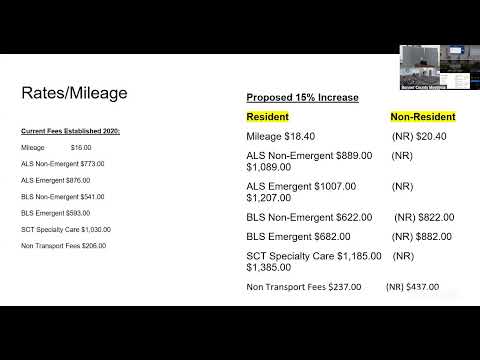
Bonner County commissioners voted to approve a new fee schedule for ambulance services that raises resident fees by about 15%, creates a separate nonresident surcharge and adds new charges such as an ALS‑2 line and an hourly standby rate, the county said at a public hearing. The board approved the action as “Resolution 25‑2” (number to be formally assigned) after a public hearing and deliberation; the motion passed with one abstention.
Chief Lindsay, chief of Bonner County EMS, told the board the fee change is intended to stop erosion of the district—s reserves and to reflect higher post‑2020 costs. “Since 2020, our call volume is up,” Lindsay said, and he noted that billing revenue accounts for roughly 40% of the ambulance district—s budget.
The hearing drew questions from commissioners and members of the public about how much costs and call volume have increased, who ultimately pays new charges and whether the proposed increases will produce the expected revenue. “I think 15% is probably a little bit on the low side,” Commissioner Corn said during deliberations, urging a larger increase; other commissioners said they preferred an incremental approach and more data before approving a still‑larger hike.
Why it matters: The ambulance district has not raised service fees since 2020, Chief Lindsay said, while operating costs and call volume have risen. The district—s billing company provided a conservative estimate that enacting the new fees could increase collections by about 10% relative to current receipts, but the board heard that the actual revenue impact will depend on payer mix (Medicare/Medicaid/VA versus commercial insurers) and on how many billed balances are ultimately paid.
Key details approved and discussed
- Fee change and new items: The board approved a resident fee increase of about 15% across the schedule and added a separate nonresident surcharge (an across‑the‑board $200 upcharge in the examples presented), a new ALS‑2 charge for higher‑resource advanced life support calls, an hourly dedicated standby rate in place of a low per‑day standby fee, and adjustments to paramedic intercept and non‑transport charges.
- Typographical correction: The board required and noted a correction to the ALS emergency base nonresident amount; the corrected nonresident ALS emergency base rate approved in the motion is $1,207 (not $1,200 as shown on one handout).
- Expected revenue: Chief Lindsay said billing revenue represents about 40% of the district budget and that the billing firm estimated roughly a 10% increase in collected revenue after the fee change, a figure he described as conservative. Commissioners and speakers asked for more granular follow‑up data to confirm that estimate once actual post‑change billing cycles are complete.
- Collection and payer mix: Board members noted a current collection rate cited in the hearing of about 55% and discussed how much of the district—s volume is paid by government programs (Medicare, Medicaid, VA) versus commercial insurers; Lindsay and other speakers emphasized that government payers set payment amounts that the district cannot negotiate.
- Call volume and seasonality: Lindsay and public commenters said call volume has risen since 2020 (participants cited an approximate 20% increase since 2020), and commissioners discussed the county—s large summer population increase from visitors and recreators as a driver of nonresident calls in areas such as Priest Lake, Clark Fork and resort areas.
Board deliberation and next steps
Commissioners expressed different views on the size and timing of fee increases. Some favored a larger, single increase (one commissioner said a 20% hike would be justified), while others supported the proposed 15% increase now with a commitment to review detailed billing results and operational costs after a full billing cycle and after the ambulance district—s service configuration is finalized. Several commissioners and speakers said the board should also evaluate whether a tax levy or other funding source is needed to cover core availability and staffing (the sunk‑cost portion of the service that supports readiness countywide).
Chief Lindsay and the board agreed to present more granular data in the next budget cycle showing payer mix, actual post‑change collections and line‑item costs (for example, high‑cost medications and nontransport supply usage) so the board can reassess fees or levy options. The motion as read by the board directed staff to incorporate the typographical correction noted above and to file the resolution number when assigned.
Ending
The board adopted the resolution approving the new fee schedule and directed staff to monitor the first full year of billing under the new rates and report back with detailed collection and cost data. Commissioners signaled they will consider additional adjustments, including a possible levy, only after reviewing that follow‑up data and the district—s finalized staffing and operational structure.