Get Full Government Meeting Transcripts, Videos, & Alerts Forever!
Get email alerts on the Robotics Law Enforcement topic
No spam. Unsubscribe anytime.
Senate panel approves bill setting rules for law-enforcement use of robots and unmanned aerial vehicles
Summary
The Senate Judiciary Committee amended and recommended a due pass on House Bill 1613, defining terms for autonomous devices, restricting autonomous activation of weapons and requiring use-of-force policies and reporting for law-enforcement deployment of robots and unmanned aerial vehicles.
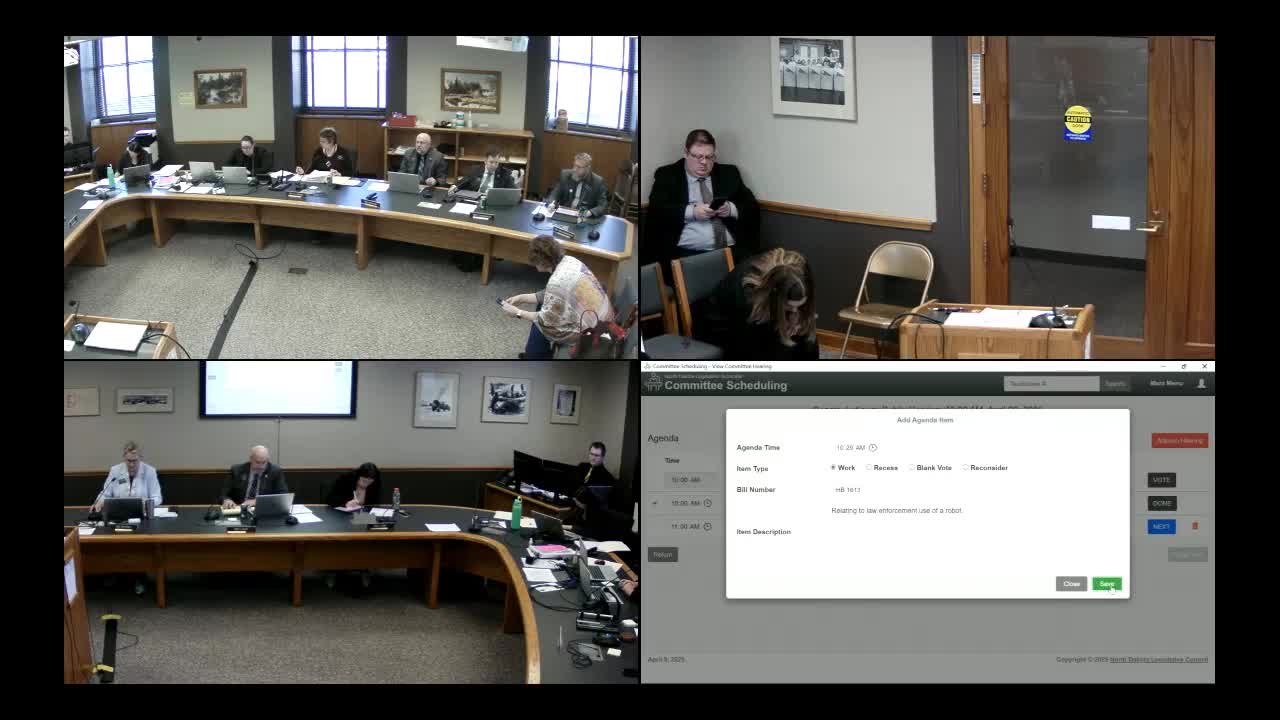
The Senate Judiciary Committee on Thursday approved amendments and gave a due-pass recommendation to House Bill 1613, which establishes definitions and limits for law-enforcement use of autonomous devices, robots and unmanned aerial vehicles (UAVs).
Sponsor Senator Castaneda presented the amended bill as a framework: it defines “autonomous” and “remote” operation, distinguishes lethal and less-than-lethal weapons, and establishes a broad definition of “robot” while expressly excluding common law-enforcement cameras and license-plate readers. The bill requires a warrant for certain flights or deployments used for surveillance and prohibits a robot from autonomously activating a weapon; weapons must be controlled remotely by a human when used.
The amendment adds exceptions and clarifications requested by law enforcement and other stakeholders, and requires agencies to incorporate robot and UAV deployments into existing use-of-force policies. If a robot armed with a lethal weapon is used, the bill requires documentation consistent with existing reporting for officer use of force.
Questions from committee members ranged from examples such as using robots to render explosive devices safe, to the use of drones against wildlife or in firefighting. Scott Winkleman, chief of the North Dakota Game and Fish Department, told the committee the department would have no issue with a robot or UAV deployed to remove a pack of wolves. Castaneda said the bill is intended as an initial statutory framework to be revisited as technology evolves.
The committee adopted an amendment (number 25.13070.02004 on the engrossed bill) and then voted to recommend a due pass on the bill as amended. Roll-call responses recorded in committee included Senator Merrittel, Senator Brownberger, Senator Paulson, Senator Corey, Senator Castaneda, Senator Luke and Chair Larson voting aye. The motion carried.
Supporters and prior opponents said the changes addressed earlier concerns and produced a workable baseline. Sponsor Castaneda said the bill aims to give law enforcement lawful tools while placing guardrails on autonomous weapons functions and ensuring agency policies and reporting processes cover new technologies.