Get Full Government Meeting Transcripts, Videos, & Alerts Forever!
Get email alerts on the Trucking Litigation topic
No spam. Unsubscribe anytime.
Texas panel reopens debate on "admission rule" in trucking lawsuits as SB 39 advances to public testimony
Summary
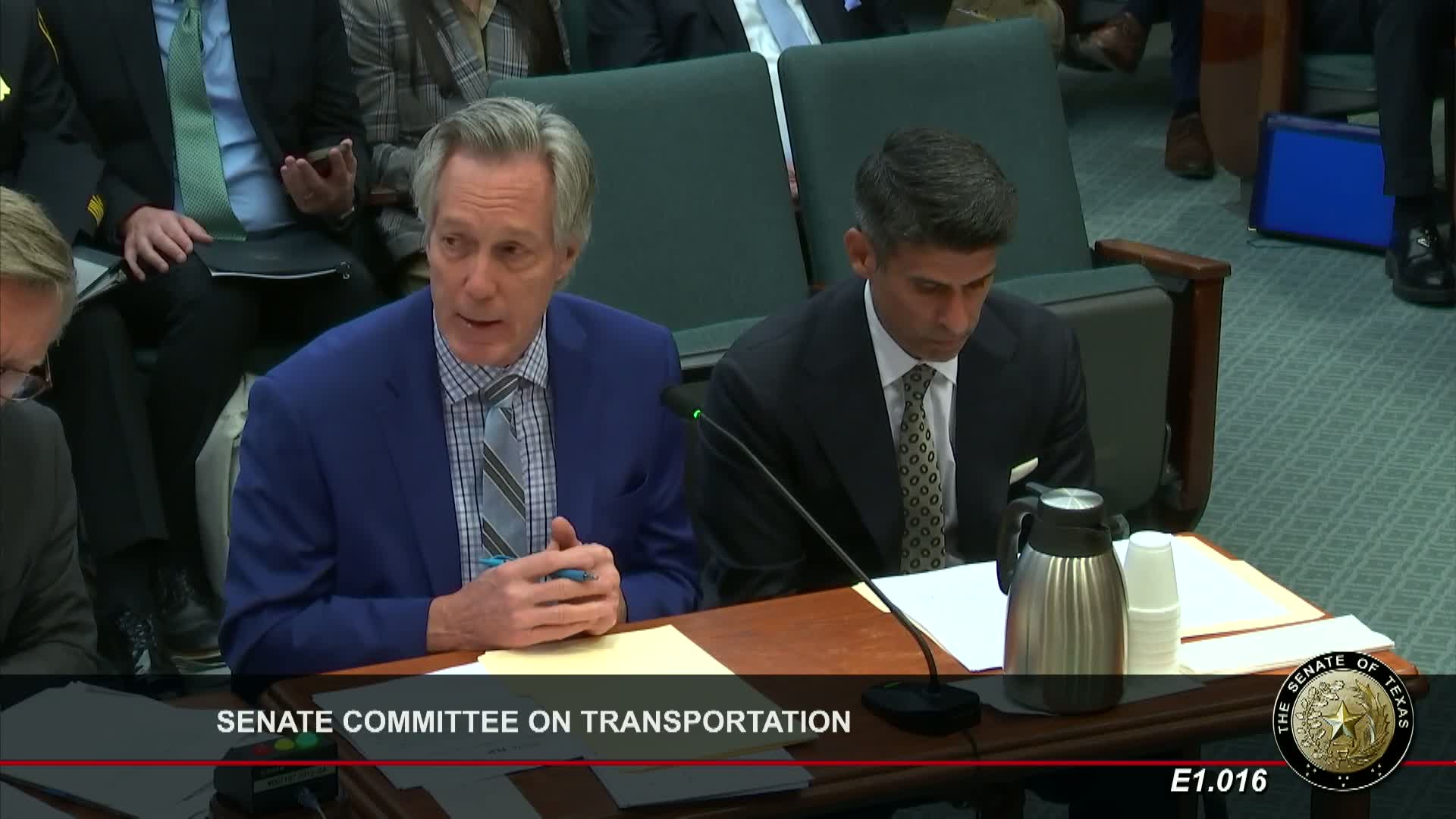
Senate Transportation Committee members heard more than four hours of testimony on Senate Bill 39 on a proposal to change how evidence of employer conduct is treated in bifurcated commercial motor vehicle trials.
Senate Transportation Committee members heard more than four hours of testimony on Senate Bill 39 on a proposal to change how evidence of employer conduct is treated in bifurcated commercial motor vehicle (CMV) trials.
Sen. Birdwell, the bills author, told the committee SB 39 would "repeal the admission rule exceptions that were amended into HB 19," restoring a rule he and supporters say has governed Texas courts since 1961. He and backers said the change would limit the first phase of a bifurcated CMV trial to proving who caused the collision and the plaintiffs compensatory damages, leaving punitive questions and some company‑conduct evidence for a later phase if the company does not concede respondeat superior.
Why it matters: The debate pits two policy aims against each other. Proponents argue the bill protects juries from evidence that unfairly inflates compensatory awards by introducing a companys unrelated safety history; opponents say it can hide conduct that made a crash more likely and deny jurors the context they need to apportion fault fairly.
Supporters' case
Lee Parsley, testifying for Texans for Lawsuit Reform, said the amendment that followed HB 19 in 2021 created practical problems and "made House Bill 19 dramatically less effective for its purpose." Parsley and other defense‑side witnesses argued that if an employer admits the driver was acting in the scope of employment (respondeat superior), the first phase should not be a forum to relitigate employer conduct unrelated to the immediate cause of the collision.
Representative Eddie Lucio III, who helped negotiate the HB 19 amendment in 2021, told the committee the original goal was to enable "an option at the trial court level that would be meaningful to contain and reward plaintiffs justly, but not beyond what I remember in law school as a principle of making plaintiffs whole." Lucio said the 2021 amendment had been well intended but produced confusion that limited HB 19's use in trials.
Several insurance‑industry and transportation witnesses pressed a similar point: SB 39, they said, narrows the evidence considered in phase 1 to the proximate cause of the crash and compensatory damages, leaving punitive or company‑wide misconduct to a separate phase.
Opponents' case
Trial lawyers, crash victims and family members offered extended testimony opposing the substitute. Greg Allen, a trial attorney, testified that under the bill as drafted "the jury will never hear about the company's conduct" in many cases where loading, maintenance or unsafe hiring practices contributed to a wreck. He and other plaintiffs' counsel warned the bill could prevent jurors from assigning proper fault to owners or carriers when practices such as negligent loading, brake maintenance failures or hiring unqualified drivers were causal.
Victimsfamily testimony was frequent and emotional. Amy Boulding, whose family was severely injured in a crash, told the committee, "Please don't take away a victim's right to hold a trucking company responsible for failing to have safety policies that protect the public." Jessica and Jason Sprague, whose 16‑year‑old son Colton died in a crash, recounted evidence they said showed the company had hired and retained drivers with known safety problems and did not enforce drug testing.
Points of legal dispute
Witnesses and committee members repeatedly parsed statutory subparts and prior court rulings. Speakers referenced the 1961 Patterson v. East Texas Motor Freight case in describing the historical "admission rule" and discussed current Texas statutory sections cited in committee testimony (transcript references included "72.052," "72.053," "72.054," and subsection "d"), and the role of the Code of Federal Regulations when trucking‑industry standards are raised as evidence.
Several senators and witnesses agreed a technical fix might clarify the bill's scope. Commissioner‑style and defense witnesses said items such as negligent loading, negligent maintenance and similar causes should remain admissible when they are the proximate causes of collision. Several defense witnesses and the bills supporters signaled willingness to meet with plaintiffs' representatives to draft clarifying language.
Committee action and next steps
Sen. Bettencourt sent up a committee substitute for SB 39 and the committee opened lengthy public testimony; the bill was left pending by the chair at the end of the hearing.
Committee discussion continued into detailed statutory drafting concerns. Multiple senators urged stakeholders to work together on clarifying language so that evidence of negligent maintenance, loading or other proximate causes remains available where appropriate while preserving the bills stated goal of simplifying liability and compensatory determinations.
Ending
The committee did not vote on SB 39 in this session; the author and witnesses indicated they would continue negotiations on statutory language. Supporters framed the bill as restoring predictability to bifurcated CMV trials; opponents said their priority is preserving juries' access to evidence linking carriers' conduct to catastrophic crashes. The committee left the bill pending and said it would reconvene to continue consideration.