Get Full Government Meeting Transcripts, Videos, & Alerts Forever!
Get email alerts on the Transportation Board Nominations topic
No spam. Unsubscribe anytime.
Committee holds confirmation hearings for two nominees to Board of Public Roads Classification and Standards
Summary
The Transportation and Telecommunications Committee heard testimony from two nominees to the Nebraska Board of Public Roads Classification and Standards and supporters, focusing on minimum design standards, road safety and board operations; no committee vote was recorded in the transcript.
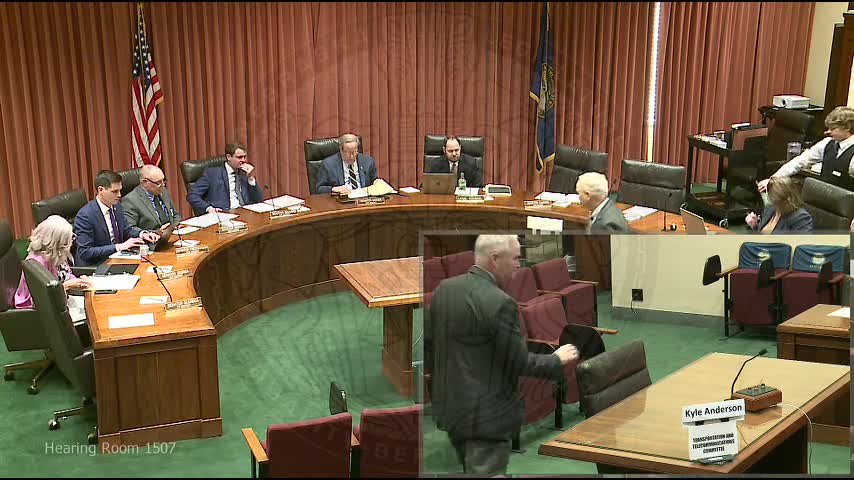
Lincoln — The Nebraska Legislature’s Transportation and Telecommunications Committee on Oct. 12 held confirmation hearings for two nominees to the Board of Public Roads Classification and Standards, hearing each nominee’s background and views on minimum design standards and road safety.
Kyle Anderson, a transportation engineer nominated to represent a district-level seat on the board, told the committee he has roughly 40 years of experience working across the Midwest and with Nebraska road authorities. Anderson said he hoped to use his experience to “ensure that we're following the design criteria and the functional classification requirements that are outlined in the state law.”
Nathan Sorben, who identified himself as the right-of-way division engineer for the Nebraska Department of Transportation, described his work drafting and revising the department’s minimum design standards and said the board’s future revisions should focus on “practical design” to stretch limited funds while maintaining safety. “We want to make sure that what we're putting out there is safe,” Sorben said.
Roger Feigert, who identified himself as the chair of the Board of Public Roads Classification and Standards, spoke in support of both nominees, saying the appointees would bring “experience, expertise, and common sense” and praising Sorben’s role on prior standard revisions. Feigert described the board’s goal of using crash and traffic data to target improvements: “Using common sense design ... You fix safety issues where you have them. And when you don't have a problem, that money then is available to go somewhere else.”
Committee members questioned nominees about current and future design trends. Testimony discussed “road diets” and lane reductions in urban cores to add bicycle facilities, and the trade-offs between lane width, traffic capacity and safety. Anderson described a trend in some urban areas toward narrowing lane widths to accommodate bike lanes and calmer traffic, and cautioned that engineering judgments must fit local context. Sorben described applying crash history and other data to set different minimum standards for interstates, expressways, principal arterials, collectors and local roads.
Witnesses also addressed the board’s operation. Committee members asked why the board has met infrequently; testimony from the nominees and the board chair said the body convenes only when there is business to do to conserve state funds and that board membership is statewide and geographically distributed. Witnesses stated the board has 11 members; speakers gave differing accounts of the date of the last formal meeting (see clarifying details).
There was one public commenter during the neutral testimony period who did not address the nominations directly. The committee did not record any formal motion or vote on either nominee in the transcript. Chairman Mike Moser closed the public hearing portion and asked the committee to remain briefly to discuss other business.
The hearing record included no committee vote on either nomination in the provided transcript.