Get Full Government Meeting Transcripts, Videos, & Alerts Forever!
Get email alerts on the Local Transportation topic
No spam. Unsubscribe anytime.
Gilmore Road no-through-truck petition draws residents’ complaints about dust and safety; item dies for lack of motion
Summary
Residents at a public hearing urged the court to limit truck traffic on Gilmore Road because of silica dust, farm damage and safety near 90-degree turns. County staff described past dust-control work and recommended targeted signage; no motion was made and the item died for lack of a motion.
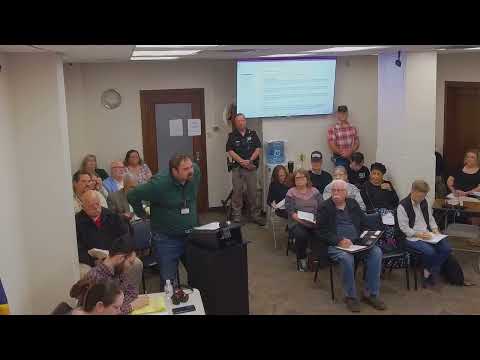
County officials and local residents debated a petition to post "no through truck" signs on Gilmore Road in Precinct 3 during a public hearing Tuesday, April 8, 2025; the court took no formal action after discussion and the item died for lack of a motion.
The petition, which asked the county to prohibit through truck traffic on Gilmore Road between State Highway 36 North and Murray Road, was prompted by residents' complaints about heavy truck traffic that they say bypasses a low-clearance railroad trestle on State Highway 390 and uses county roads instead. "The dust blows into our yard, our house, into pastures where cows are," said Steve Malden, who identified himself as a property owner on Gilmore Road. "That's the primary concern."
The petition met the technical requirements to prompt a hearing, and Washington County road and bridge staff presented findings and a recommendation. County Road & Bridge staff member Mister Stultz told the court the department had placed recycled asphalt pavement (RAP) on Gilmore about three to four years earlier but that the emulsion binder has worn and dust remains where heavy truck traffic occurs. Stultz recommended posting a no-through-truck sign on the Gilmore segment (about 0.7 miles) rather than diverting trucks onto the alternate gravel route via Moray (approximately 0.33 miles), on the grounds that the narrower county roadway is less suited to commercial truck traffic and would require more maintenance if truck volumes continued.
Residents who spoke at the hearing cited dust and safety concerns. Diane Smith and Karen Hartnell described trucks speeding, failing to stop at the stop sign and repeatedly damaging culverts and fences near homes and bus stops; Smith said she had witnessed trucks almost collide with a school bus. Ross Martella, who described a long history in local mineral and trucking industries, urged the court not to permit truck traffic on that route and criticized use of rounded "bull rock" material for roads, calling silica dust a health hazard.
County Judge John Durberg asked Road & Bridge to provide commissioners with documentation of past work on Gilmore so the court could see what maintenance and dust-control steps had been taken. Durberg also said paving would be a preferable long-term fix but acknowledged it was not in the short-term plan. Road & Bridge estimated dust-control alternatives could cost thousands of dollars per half-mile annually and said some treatments are not financially sustainable at scale.
After extended discussion of dust, pavement types, safety at a nearby 90-degree turn and the effects of diverting traffic, no commissioner moved to adopt the proposed no-through-truck order. "Hearing no motion, the item dies from lack of a motion," the judge said. No formal vote was recorded.
The court noted continuing interest in paving plans and dust-control options, and commissioners asked staff to supply records of prior surface treatments and maintenance on Gilmore Road for further consideration.
Ending
Because the court took no action, the county's current maintenance responsibilities and traffic patterns remain in place. Residents who testified said they will continue to press the county for long-term fixes, including possible paving or targeted enforcement.