Get Full Government Meeting Transcripts, Videos, & Alerts Forever!
Get email alerts on the Legislation topic
No spam. Unsubscribe anytime.
Judiciary committee adopts package of amendments on guardianship, evidence access, corrections and AI; lays SF1098 over to be incorporated into SF1417
Summary
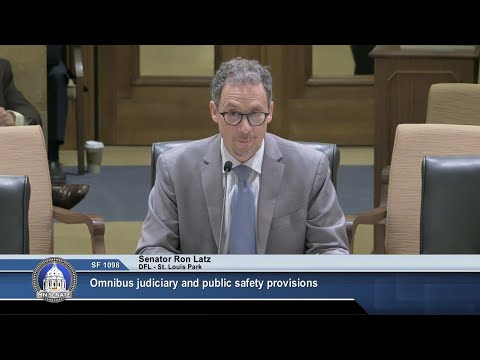
Members of the Minnesota Senate Judiciary and Public Safety Committee adopted a package of amendments to an omnibus judiciary bill and laid Senate File 1098, as amended, over to be incorporated into Senate File 1417 on Friday.
Members of the Minnesota Senate Judiciary and Public Safety Committee adopted a series of amendments to an omnibus judiciary bill and agreed to lay Senate File 1098, as amended, over to be incorporated into Senate File 1417 on Friday.
The package included changes addressing guardianship visitation and emergency guardianship notice (A9), access for auto‑accident claimants to investigative recordings (A7), technical corrections to Department of Corrections funding and probation formulas (A23), a provision authorizing use of mobile tracking devices on fleeing vehicles (A16), language on AI notification and related immunity (A21), and an amendment addressing childlike dolls and AI child sexual abuse material (A18). Several other technical and housekeeping amendments were also adopted.
Why it matters: the amendments touch on civil‑justice procedures (guardianship and evidence access), criminal‑justice tools (tracking devices), corrections funding and administration, and emerging technology issues (AI notification and immunity). Committee members described many items as technical fixes or stakeholder compromises; a handful prompted substantive explanation from witnesses and agency officials.
Suzanne Scheller, who introduced the guardianship amendment to the committee, said the A9 changes "expand[] the notice requirements to the court and the affected persons" when a guardian restricts visitation and add language to require consideration of "less restrictive alternatives" to visitation limits. She told the committee the amendment grew from stakeholder conversations and "strengthening language around these concepts but stopping short of possible additional court involvement."
On investigative recordings, Senator Seeberger introduced the A7 amendment and said it "would require that access and put some guardrails around its accessibility and use as well." The measure was described as intended to let potential claimants obtain recorded evidence earlier in the claims process to facilitate pre‑lawsuit resolution.
Paul Schnell, Commissioner of the Department of Corrections, described A23 as "largely technical fixes" dealing with how funding flows and a three‑year averaging period for probation population counts that affects county billings. Schnell said the amendment aims to reduce abrupt local impacts from population shifts.
On fiscal questions raised about one amendment, Chris Turner of the fiscal office said the estimated cost was small: "It's a fraction of a bed, and that's flat going out. So it would dollarize into like $5,000 a year." That estimate was discussed in relation to a provision that would affect felony‑level violations in the prevention of cruelty to animals chapter and a change to the statutory definition at 624.712.
Committee action and votes were taken by voice; where members indicated views the record shows repeated use of the phrase "I view this as friendly" by Senator Latz on multiple amendments, and the committee chair called each voice vote and announced the motion prevailed. For amendments that originated from bill sponsors or outside stakeholders, the committee generally adopted the changes after brief explanation and occasional technical corrections from counsel.
Votes at a glance A3 — Moved by Senator Wesselin; amendment adopted (voice vote). The amendment includes a change to 624.712 and was described as affecting only felony violations of the prevention of cruelty to animals chapter 343; staff estimated negligible fiscal impact (~$5,000/year). A4 — Moved by Senator Seeberger; adopted. State Fire Marshal bill repealing statutes predating the state fire code. A6 — Moved by Senator Seeberger; adopted. Technical fix adding the word "juvenile" to a community supervision funding formula adjustment. A7 — Moved by Senator Seaburger; adopted. Requires access, with guardrails, to investigative recordings for automobile accident claimants; sponsor said it is intended to enable pre‑lawsuit resolution. A8 — Moved by Senator Pappas; adopted. Foreclosure bill carried as Senate File 1962. A9 — Moved by Senator Wesselin (for Senator Dibble); adopted. Changes to emergency guardianship procedures and visitation notice and reporting requirements; sponsor described stakeholder input and that the amendment reduces court intervention while expanding notice and reporting. A11 — Moved by Senator Umhofer; adopted. Language (from Senate File 1909) granting county attorneys certain subpoena power in wage‑theft investigations, as amended in committee. A12 — Moved by Senator Clark; adopted. Removes Senate File 1626 (DOC local licensing changes) from the package to allow more stakeholder work. A16 — Moved by Senator Seaburger; adopted. Authorizes law enforcement to use a mobile tracking device on a fleeing motor vehicle (provision derived from Senate File 191). A18 — Moved by Senator Seaburger; adopted. Includes agreed language relating to a bill banning childlike dolls and AI child sexual abuse material (Senate File 1577). A19 — Moved by Senator Seaburger; adopted. Deletes specified grant administrative percentage language to defer to a future, omnibus approach. A20 — Moved by Senator Umu Verbatim; adopted. Clarifies drug possession language and makes a section retroactive to Aug. 1, 2023 (from Senate File 1905); sponsor said affected stakeholders supported the rewrite. A21 — Moved by Senator Umu Verbatim; adopted. Incorporates AI notification language (previously heard) and includes Commerce‑committee additions such as a limited immunity provision that a witness said was drafted to target perpetrators rather than platforms. A22 — Moved by Senator Anderson; adopted. Language to assist families seeking information about missing persons (related to testimony about a case at Saint John's University; carried as Senate File 631). A23 — Moved by Senator Seaburger; adopted. Department of Corrections technical fixes on funding flows and a three‑year averaging method for probation counts; Commissioner Paul Schnell appeared to explain the amendment. A25 — Moved by Senator Omuver Baton; adopted. Clarifies effective dates for Senate File 206. Oral amendment by Senator Latz — adopted. Deletes section 10 of Senate File 1409 (removes an increase to certain marriage‑record fees that would have paid local registrars $20 per request).
The committee chair announced that the bill as assembled will be laid over for incorporation and that the package reflects work across many committee members and stakeholders. The committee scheduled its next hearing for Friday at 9 a.m. in the Minnesota State Senate Building, room 1200.
Ending: The committee adopted the amendments by voice votes and laid Senate File 1098, as amended, over for incorporation into Senate File 1417; no roll‑call tallies were recorded in the transcript of the session.