Get Full Government Meeting Transcripts, Videos, & Alerts Forever!
Get email alerts on the Multifamily Tax Exemption topic
No spam. Unsubscribe anytime.
Shelton staff propose multifamily tax exemption, two residential targeted areas to spur housing
Summary
At a study session April 8, Economic Development Director Jay Hill reviewed a draft multifamily property tax exemption ordinance and two proposed residential targeted areas (downtown and a Wallace‑Walmart corridor), describing eligibility criteria, affordability requirements and next steps for council review.
Economic Development Director Jay Hill presented a draft multifamily housing property tax exemption (MTE) ordinance and two proposed residential targeted areas during the April 8 Shelton City Council study session, describing how the tool could incentivize rental development and deed‑restricted affordable units.
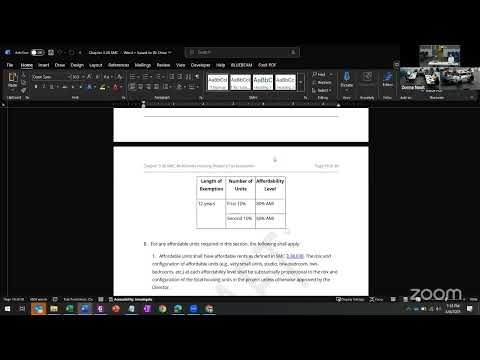
Hill said the city is considering two initial residential targeted areas (RTAs): a downtown RTA and an area near the Wallace Neyland interchange and the Walmart corridor (temporarily named in the session). Under state law Hill cited (RCW discussion and the MTE statute), the proposed MTE would be limited to properties inside designated RTAs. The draft ties the length of an exemption to affordability commitments: an eight‑year exemption tied to affordability and a 12‑year exemption that requires deeper levels of affordable units in exchange for a longer tax exemption.
Hill described key draft elements: eligibility limited to projects creating at least 10 new dwelling units; a requirement that at least 50% of the building’s space be for permanent residential occupancy (not transient uses); and affordability thresholds for years of exemption. He explained staff’s current proposal that an eight‑year exemption require a baseline share of units at area‑median income (AMI) and that the 12‑year exemption include additional units at 60% AMI, with deed‑restricted covenants enforced by the city for the required units. Hill said only the city’s portion of property tax can be exempted under state law.
Hill and councilmembers discussed how the MTE pairs with zoning changes the comprehensive plan process is proposing: a new multifamily zone that would allow by‑right development where development standards are met (avoiding the current planned‑development/PUD public‑hearing process), and the RTAs would be the geographically eligible areas for the MTE. Hill said the RTAs could be tailored — downtown and the Wallace/Walmart area were proposed initially, and staff could add additional RTAs such as areas near Peacock Ridge or Shell Springs depending on council direction and suitability.
Councilmembers raised affordability tool options that could work alongside the MTE, including density bonuses, mandatory inclusionary requirements, community land trusts and local source‑of‑income protections; Hill said staff would return with a prioritized list of tools. On administration, Hill said the city would be responsible for holding and monitoring affordability covenants and that the program requires auditing and staff time; he asked whether the council wanted a fee to cover application and monitoring costs, suggesting cost recovery as an appropriate approach.
No ordinance vote occurred; Hill said he will “work on polishing this up” and bring a refined ordinance, fee recommendation and maps of proposed RTAs back to council for formal consideration.