
Keystone Central SD policy committee reviews student-discipline procedures amid calls for stricter measures
Get AI-powered insights, summaries, and transcripts
Sign Up Free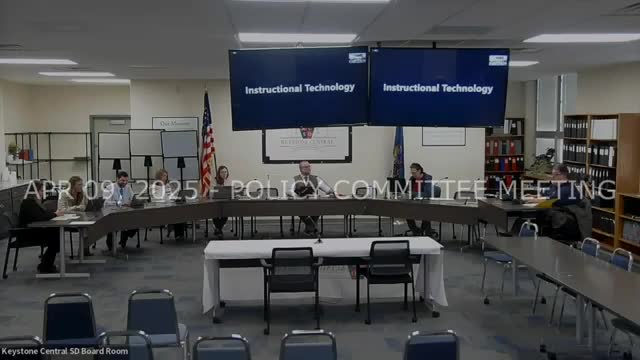
Summary
Board members raised concerns about perceived leniency for serious incidents; district staff described progressive-discipline steps and 45-day AEDY placements as alternatives to immediate expulsion and agreed to invite principals to a future policy meeting for specifics.
Keystone Central SD Policy Committee members on April 9 discussed whether the district’s student-discipline policy (Policy 2-18) should be made stricter after several board members said they had received complaints that the district was too lenient on serious incidents.
Board member Elizabeth said the committee should consider a “three-strike” approach for serious incidents, suggesting escalating punishments that could include in-school suspension, out-of-school suspension and, as a last resort, expulsion. “We could have like a 3 strike policy. First time you're in school suspension x amount of days. Second time could be an out of school suspension. Third time could be an expulsion,” Elizabeth said.
Superintendent Dr. Redmond and other staff described the district’s existing progressive-discipline framework and alternatives to expulsion. “Right now we do have a progressive discipline system so that, if a student continues to exhibit the same sort of behavior, then, the consequences get more severe over time,” Dr. Redmond said. He added that some students are referred out of regular school for targeted interventions and that the district uses the AEDY program for some placements. “AEDY is alternative, education for disruptive youth,” Dr. Redmond said.
Dr. Redmond explained AEDY placements are typically 45 days and may be at River Rock Academy or Nittany Learning Services to address a range of behaviors—from vaping to fighting—while staff work on transition plans and behavioral goals. The superintendent said some students return successfully after meeting goals; others ultimately are recommended for expulsion when district staff determine the student’s conduct is too disruptive for the learning environment.
Committee members requested more operational detail from school principals about how violent or threatening incidents are handled, including detention and immediate response protocols. Dr. Redmond offered to bring a group of principals to the next policy meeting to explain school-level practice and the point at which administrators recommend expulsion.
Several board members suggested nonpunitive options as well, including the district’s cyber-school option, so threatened students could be offered an alternative learning environment while behavior issues are addressed. The committee did not change Policy 2-18 at the meeting and did not take a formal vote on revisions; members requested additional information and a principals’ presentation at a future meeting.
The committee also discussed whether some incidents should be handled in executive session if the details implicate privacy or personnel concerns; staff said the district’s code of conduct and privacy rules limit what can be discussed publicly and that any items requiring privacy protections could be scheduled accordingly.