Get Full Government Meeting Transcripts, Videos, & Alerts Forever!
Get email alerts on the Land Use topic
No spam. Unsubscribe anytime.
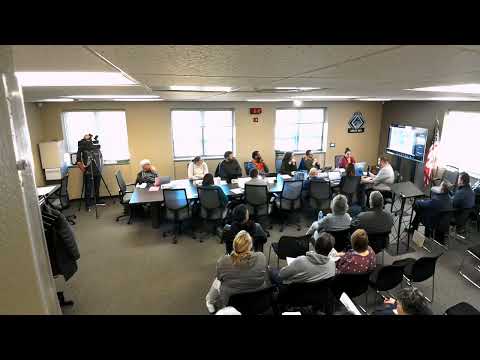
Plan commission tables Guns Road rezoning and comp‑plan amendment tied to proposed post‑office distribution center and multifamily project
Summary
The Plan Commission voted to table proposed comprehensive plan and rezoning requests for three parcels on Guns Road that developers want to split into multifamily and a light‑industrial parcel to house a U.S. Postal Service distribution center and multifamily buildings.
The Plan Commission voted to table proposed amendments to the Smart Growth 2022 comprehensive plan and a companion rezoning that would change future land use and zoning for properties in the 1100–1141 Guns Road area to permit two multifamily buildings and a light industrial distribution facility proposed by TMD Properties.
Applicant Todd DeBiller of TMD Properties asked to amend future land‑use designations for 1135 and 1141 Guns Road and adjacent parcels currently shown as low‑density residential. The proposal would reserve the rear parcel (Lot A) for medium‑high density multifamily (R‑3) and the Main Street frontage (Lot B) for light industrial to accommodate a U.S. Postal Service distribution center and related operations. The applicant and property owners said the site has been vacant for decades and that limited access to Main Street constrained purely commercial redevelopment.
Planning staff recommended approval of the medium‑high density designation and R‑3 zoning for the rear parcel (Lot A) but recommended denial of rezoning the Main Street frontage to light industrial. Staff warned that light industrial zoning would allow a wide range of industrial uses that could be inconsistent with the city’s Main Street commercial corridor and that a rezoning could not be conditioned for a single tenant’s operations. Staff suggested a potential path: a city‑wide text amendment that would allow limited distribution or postal distribution uses in a commercial district by conditional use or specific code language, but that change would require more study and a formal text‑amendment process.
Speakers at the public hearing included property owners and local representatives who said the site has been for sale for decades and argued the postal distribution center and multifamily mix would activate a long‑vacant parcel. Darwin Swilly and Randy Swilly (landowners), consultant Steve Beater of Burecker, Mark Burris of RE Commercial and Alderman Bill Morgan spoke in favor, citing investment, added housing and the site’s constrained access. Opposing input included a written comment from the Village of Bellevue’s community development director expressing concern about industrial zoning on the city edge.
Commission discussion focused on the appropriateness of light industrial along Main Street, possible tools to achieve the applicant’s operational goals without a blanket industrial rezoning, and whether staff could craft a text amendment to allow limited distribution uses in the C‑1 corridor with explicit conditions (for example limiting hours, building orientation, loading dock placement, and maximum size). Commissioners also noted that once a property is rezoned, the city cannot compel a specific tenant to operate in a particular way and that a PUD would not be an appropriate vehicle to circumvent code standards.
After extended discussion, Commissioner Betsky moved to table the comprehensive plan amendment and rezoning and direct staff to work with the applicant on possible text amendments to the zoning code that could allow a constrained distribution use within the C‑1 corridor or otherwise address the commission’s concerns; Alder Jim Hutchinson seconded. The motion to table passed on a voice vote. Staff said a text‑amendment timeline would likely be six to eight weeks depending on scope and workload. The tabled items will return to the commission when staff and the applicant have had an opportunity to pursue a tailored solution or the applicant chooses to proceed with the existing rezoning request.