Get Full Government Meeting Transcripts, Videos, & Alerts Forever!
Get email alerts on the Social Media topic
No spam. Unsubscribe anytime.
Ellensburg reviews social media strategy and comment moderation amid growth on Facebook and YouTube
Summary
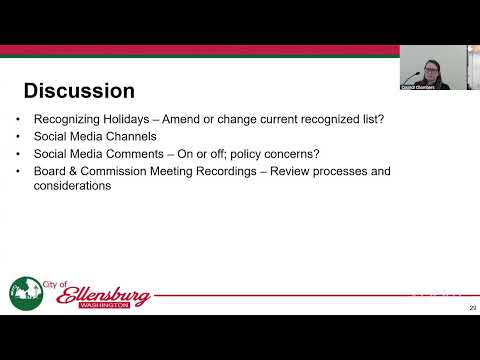
City public information staff presented social media metrics and options for comment moderation at the April 17 study session; councilmembers debated leaving comments on, turning comments off for some posts, or limiting responses because of staff time and archive requirements.
Nicole Klaus, the City of Ellensburg’s public information officer, told the City Council that the city uses multiple channels to reach residents and that Facebook remains the largest audience, with about 35,000 followers across city and facility pages.
Klaus said the city’s website is the primary information source and that other channels — Facebook, Instagram, X (formerly Twitter) and YouTube — are used as bulletin boards that share material posted to the website. She reported growth in several areas: the city newsletter (Ellensburg Insider) subscriptions rose 18% year over year and the newsletter open rate is 66%, while average click‑through rates were higher than the government industry benchmark.
On social media specifically, Klaus said the city maintains a social media policy posted on the website that describes comment rules, when staff may hide or remove content, and that posts and comments are public records and must be archived. She noted archiving software is required to meet public records obligations and that platform choices carry ongoing costs.
Klaus presented the tradeoffs between leaving comments enabled and turning them off. She summarized the experience of another city (Moscow, Idaho), which turned comments off after pandemic‑era backlash; that city saw lower engagement after disabling comments. Klaus said turning comments off reduces staff time spent moderating but also reduces engagement that drives algorithms and content distribution.
One councilmember said, “I would go for comments completely off,” citing toxic interactions on social media and staff time. Others urged a more measured approach: limiting responses to direct, legitimate questions, correcting inaccuracies, or directing people to staff or website resources. Klaus described a set of practical reply rules used by other cities: respond only to legitimate questions, correct inaccuracies, or offer a staff contact or link for more information.
Council members also raised the operational burden of archiving removed comments; Klaus confirmed that hidden or removed comments remain retrievable through the city’s archiving software and are retained per records rules.
Why this matters: the city’s choice about comment moderation influences public engagement, staff workload and public‑records obligations. The council asked staff to return with policy options, cost estimates, and advice on whether to apply changes only to the main city page or to all department and facility pages.
What happens next: staff will analyze options for comment moderation (comments on, comments off, or hybrid approaches), identify affected pages, estimate staff time and archive costs, and report back to council for future policy decisions.