Get Full Government Meeting Transcripts, Videos, & Alerts Forever!
Get email alerts on the Electric Grid Infrastructure topic
No spam. Unsubscribe anytime.
Ellensburg council accepts 2023 electric system plan that projects large load growth, recommends follow-up studies
Summary
Ellensburg City Council voted to accept the city’s 2023 Electrical System Plan as complete after a presentation by Power Engineers; the study projects large load increases tied to university decarbonization, residential gas‑to‑electric conversions and EV charging and recommends substation expansions, BPA coordination and an AMI cost/benefit study.
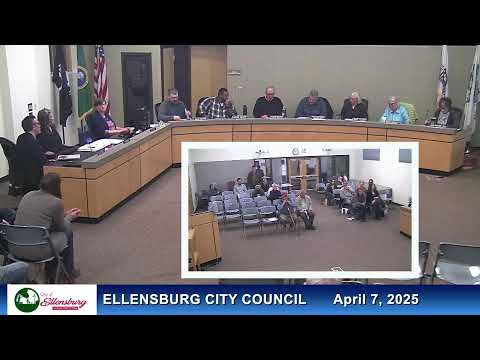
Ellensburg City Council voted to accept the city’s 2023 Electrical System Plan as complete after a presentation and questions from council. Buddy Stanovich, Energy Services Director for the City of Ellensburg, introduced the report and representatives from Power Engineers presented the study and recommended next steps.
The plan projects steep increases in peak demand tied to several factors: Central Washington University’s staged decarbonization, assumed conversions from residential natural gas to electric heat pumps and increased electric vehicle charging. Evan Powers, an electrical engineer with Power Engineers, said the study used conservative assumptions and scenario multipliers supplied in part from a Lighthouse Energy Consulting report the city referenced. “These are conservative assumptions,” Powers said, and the study’s six‑ and 20‑year scenarios show large step changes tied to identified spot loads and staged campus changes.
Why it matters: the study lays out capital work and coordination the city and its wholesale supplier will need if the projected loads materialize. Power Engineers recommended expanding the East Ellensburg substation from a single bank to a two‑bank configuration, building a new South Ellensburg substation that would require a tap from a Bonneville Power Administration (BPA) transmission line, and a third substation to serve growth and residential gas conversions. The consultants estimated those transmission and substation components in today’s dollars at multi‑million‑dollar levels and stressed that the plan should be revisited as laws, regulations and identified loads change.
Key technical points and next steps cited by presenters included: - Base peak load reported in the presentation was about 53.8 megawatts; modeled six‑ and 20‑year scenarios showed major upward steps when campus and residential conversion loads are applied. Powers described the scenario increases as substantial and driven by discrete project stages reported to the city. He told the council the modelling produced what the study team considered conservative multipliers for residential gas‑to‑electric conversions and EV charger additions. - Recommended capital investments over 20 years include expansion of the East Ellensburg substation, a South Ellensburg substation (including a BPA tap and transmission work), and a potential East Helena substation to serve natural‑gas conversion growth. Presenters estimated the combined projects in the multi‑million dollar range (figures presented as order‑of‑magnitude planning costs in today’s dollars). - Bonneville Power Administration coordination: consultants noted BPA has identified a potential transmission capacity constraint on the south (Moxie) line and has planned reconductoring work now scheduled for 2028; the city’s planners were urged to track that schedule because transmission improvements affect local planning and reliability. - Advanced metering infrastructure (AMI): the report analyzed AMI as a tool for outage response, remote connect/disconnect, customer access to detailed usage data and demand‑management options for heat pumps and EV charging. Presenters did not recommend immediate AMI implementation; they recommended a dedicated cost/benefit study to estimate payback, operational savings and multi‑utility benefits if electric, water and gas meters are combined on a rollout.
Council discussion focused on planning assumptions, the role of distributed local generation and how growth inside the city’s urban growth boundary was reflected in the forecast. Presenters said the study incorporated identified spot loads and distributed projected 2% customer growth over the study horizon; they also said local rooftop solar and other distributed generation could reduce net city load and so should be tracked going forward.
A motion to accept the 2023 Electrical System Plan as complete was made and seconded and passed by voice vote. The council’s acceptance will allow staff and Power Engineers to proceed with next steps described in the study — continued coordination with BPA, a contingency‑sensitive capital plan and follow‑up analyses such as an AMI cost/benefit study.
The plan is advisory: presenters and staff emphasized it should be updated as federal, state or local regulations change and as spot loads are confirmed. The city will use the study as the basis for more detailed capital budgeting and for continued partnership and scheduling with BPA and with Central Washington University.