Get Full Government Meeting Transcripts, Videos, & Alerts Forever!
Get email alerts on the County Governance Rules topic
No spam. Unsubscribe anytime.
Will County committee advances rewrite of board rules, asks legal check on chairing and virtual-attendance language
Summary
Will County board committee reviewed edits to county rules and Title 30 (Administration), approved sending the draft to the executive committee with a request for legal research about who may chair committees in the chair and vice-chair's absence and clarification on virtual-attendance limits.
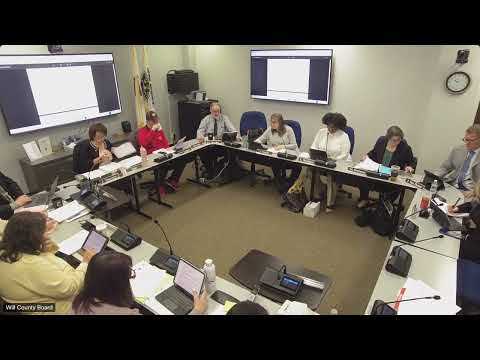
The Will County Board Rules Review Committee voted April 8 to forward a revised draft of county board rules and portions of the code (Title 30, Administration) to the Executive Committee while requesting legal research on who may chair a standing committee when both the chair and vice chair are absent.
The motion, made by Member Newquist and seconded by Member Freeman, asked staff to confirm whether the county ordinance and the committee rules align on whether the county board speaker (the speaker chair) can serve as an ex officio member of committees and fill temporary vacancies with voting privileges; the committee approved the referral with no recorded opposition. "As the presiding officer of the executive committee, the county board speaker chair shall be an ex officio member of all other committees and may, in the event of a temporary committee vacancy, fill such vacancies for the purpose of establishing a quorum with voting privileges," the draft ordinance reads; the committee asked staff to confirm the practical and legal effect of that language.
Why it matters: the draft revises long-standing internal procedures for how matters are assigned to committees, who can serve and vote on committees, and how members may attend and participate remotely. Those changes affect how the board will manage agendas, quorum calculations and committee hearings, and they may change who gets to make or break a tie on committee business.
Most of the meeting focused on procedural language and formatting changes rather than new policy. Staff member Phil Mach explained why the draft removes repeated historical ordinance citations and section symbols: "I took out all those section little squiggly lines, and I took out all the previous ordinances that passed," he said, explaining the aim is a cleaner code that cites only the controlling state statute. Committee members discussed typography changes (bolding titles, using clearer strikethrough color) to improve readability for printed packets.
Committee members debated a recurring operational question: when and how the Executive Committee should recommend committee assignments. Members noted the Executive Committee now meets after most standing committees, which changes the timing of assignment recommendations and sometimes creates uncertainty about whether an item should be moved from one committee to another. Several members said current practice generally results in the speaker chair and staff coordinating assignments, but they asked the ordinance language be clarified to reflect actual practice.
Virtual attendance and state law: members spent substantial time on the county's virtual-attendance language. The draft includes the state statutory language that allows a member to attend by other means when a quorum is physically present, limited to specific reasons such as personal illness, employment duties, family or other emergencies and unexpected child care. Phil Mach summarized the state policy and its intent: "The state...said this is the legislature and the governor signed it said this is what the law is," noting the county cannot adopt rules that are more restrictive than the statute on those limited reasons. Committee members noted past practice had been more restrictive and asked staff to ensure the rules and the ordinance conform to the Illinois Open Meetings Act.
Other clarifications and staff directions: the committee endorsed the approach that the short "§" markers be removed from chapter numbering while retaining the ILCS citation at the end of sections for legal reference. Members asked staff to produce a clean copy and a redlined copy for the board packet and to improve document layout (consistent indentation and clearer section breaks). Staff agreed to add a notation in the ordinance or the rules indicating that, where there is a conflict, the newly adopted rules would be considered controlling until the ordinance is updated to match.
The committee also flagged administrative follow-ups for staff: to ensure the county executive's office provides timely lists of appointments and hires to the board (so appointments can be reviewed on time), to schedule an annual review of the Prairie View Landfill audit in an assigned month, and to correct scrivener's errors (punctuation and formatting) before the draft goes to the executive committee.
Votes at a glance: The committee approved sending the Title 30 revisions to the Executive Committee with the request for legal clarification. The committee previously approved two sets of minutes earlier in the meeting (Feb. 11 and March 11, 2025); those procedural votes were recorded as carried during roll calls.
Looking ahead: staff will reconcile the remaining language inconsistencies between the draft rules and the county code, provide redline and clean versions for the executive committee packet, and return the question about the speaker chair's temporary committee role with a written legal analysis before the Executive Committee meeting in May.