Get Full Government Meeting Transcripts, Videos, & Alerts Forever!
Get email alerts on the Elections topic
No spam. Unsubscribe anytime.
Fruit Heights holds public hearing on proposed switch from caucus to primary elections
Summary
The Fruit Heights City Council held a public hearing on an ordinance (2025-02 Title 2A, Ch. 3) proposing a move from a caucus-based candidate selection to a primary election. Residents and council members debated participation, cost and partisan effects; no final adoption vote is recorded in the transcript.
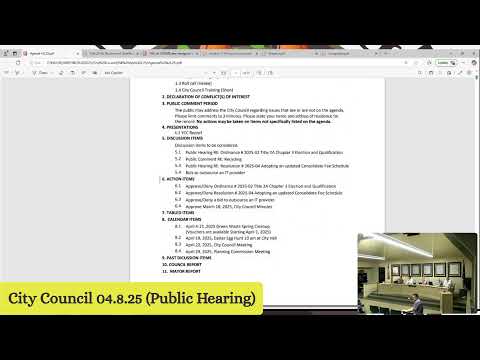
Fruit Heights City Council opened a public hearing on Ordinance 2025-02, Title 2A, Chapter 3 (elections and qualifications), allowing residents to comment on a proposed change from the city’s caucus-based candidate-selection process to a primary election.
The proposal was prompted by staff research and a city survey: 72 residents responded and about 7% indicated they favored a change to a primary system, city staff said during the hearing. Council members and residents discussed trade-offs including turnout, cost and how candidates are vetted.
Why it matters: the change would alter how Fruit Heights residents nominate and select municipal candidates, shifting the deciding body from relatively small caucus meetings to a broader primary ballot that would be open to more voters. Supporters argued a primary would let more residents cast ballots; opponents said caucuses produce more engaged, informed participants and keep costs down.
During the hearing, a city staff member summarized staff outreach and the survey results and explained that, if the council adopted a primary, Davis County Elections could run the primary election. The council and residents referenced details provided by the Davis County Elections Office and the lieutenant governor’s office about differences in participation and cost.
Residents and council members raised these points: - Participation: Several commenters said caucus turnout is small (dozens of attendees) while a primary would reach hundreds. One resident quoted Thomas Jefferson: “We in America do not have government by the majority. We have government by the majority who participate,” to emphasize turnout and participation concerns. - Accessibility and candidate vetting: Supporters of a primary said it lets residents who cannot attend a single caucus night still vote; supporters of caucuses said caucus nights allow voters to meet and question candidates directly. - Partisanship: A staff summary noted Fruit Heights is currently running a partisan-style caucus process for municipal seats; commenters and council members discussed options to keep nominations effectively nonpartisan while increasing access (examples included renaming caucus lists to “Nonpartisan 1/Nonpartisan 2” or allowing candidates to file without attending caucus night). - Cost and barriers: Council members raised that primaries impose filing costs and other expenses on candidates, potentially disadvantaging lower-income residents; others suggested using city funds or waivers to mitigate that effect.
Council direction and next steps: The council held the required public hearing and several members proposed possible changes to the existing caucus system as an alternative to a full switch. At one point a council member said they would like to table the ordinance for two weeks; a motion to table was made during the meeting, but the transcript does not record the outcome of that motion or any final adoption vote for the ordinance. The transcript also contains statements that the ordinance had been prepared and discussed earlier; however, the meeting record here does not show a completed formal adoption roll-call vote for Ordinance 2025-02.
Because the hearing included extended public comment and several follow-up questions from council members, the council indicated it would consider public input and staff research before taking final action. If the council schedules a future adoption vote, more formal documentation and a roll-call vote will appear in the council’s official minutes.