Get Full Government Meeting Transcripts, Videos, & Alerts Forever!
Get email alerts on the Budget topic
No spam. Unsubscribe anytime.
Volusia County schools brace for tighter 2025–26 budget as enrollment and state funding pressures grow
Summary
School leaders told the Volusia County School Board at a workshop that declining traditional enrollment and state funding adjustments have forced a controlled drawdown of reserves and district-level cuts to protect classrooms while program and staffing decisions are weighed for next year.
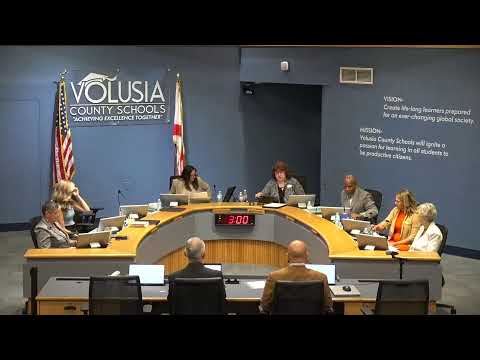
Volusia County School Board members and district leaders spent more than two hours on a preliminary budget update Tuesday, describing a year of revenue uncertainty driven by lower-than-expected traditional student enrollment and late state funding calculations.
Superintendent Carmen Balgobin said the district “was able to save about $2,400,000 from our general fund to help protect our classrooms,” and described steps taken at the district level to limit classroom impacts. She added that the district is working to avoid cuts to direct classroom services while aligning staffing and programs with available revenues.
The presentation, led by Chief Financial Officer Todd Sees and district budget staff, walked the board through the district’s general operating fund and the mechanics of state funding. Sees said the district’s recurring expenditures for the general operating fund are approximately $588,100,000 and noted that the district’s unassigned fund balance is roughly $28,000,000 — an amount that covers “a little over half a month of projected recurring expenditures” at current spending rates. He said the board previously adopted a budget that included a planned spend-down of fund balance totaling $25,800,000, with $10,000,000 still assigned to be drawn down in the upcoming year.
Why it matters: district leaders said late and revised state calculations and faster-than-expected growth in scholarship programs pushed down revenue available to traditional public schools across Florida. Superintendent Balgobin told the board this is a statewide trend, not unique to Volusia: “This is not a Volusia County issue. This is a systematic issue across our state where we have these challenges with enrollment trends.”
State calculations and scholarship programs: presenters described the state’s FEFP (Florida Education Finance Program) third calculation, delivered later than usual this year, as a major factor. Sees said the district absorbed a roughly $4,100,000 proration resulting from an over-allocation to scholarship programs, and staff described how “undistributed FTE” set aside during projection work was later allocated to scholarship students when the state’s third calculation showed more students in scholarship programs than anticipated. District staff also told the board the state’s scholarship program(s) are projected to grow, a pressure that reduces the revenue that remains available to traditional public schools in the consolidated district accounting.
Program funding and legislative risk: board members expressed concern about current state-level proposals that could cut funding for advanced and career programs. Chair Jamie Haynes and Board Member Christa Goodrich highlighted a pending bill the board said would cut certain program funding by 50 percent in the House proposal; board members asked parents and stakeholders to contact legislators to explain local impacts. Superintendent Balgobin and members of the board urged preserving funding for AP, IB, dual enrollment, CTE and CAPE certifications, saying those programs yield direct benefits for students entering college and the workforce.
School-level staffing and utilization: presenters reviewed staffing models that separate fixed and variable school costs and showed how smaller, underutilized schools have higher fixed cost-per-student. The CFO explained the district’s staffing “sweet spot” for school efficiency and said the estimated break-even staffing ratios are roughly $7.50 per student (elementary baseline), about $11.50 at the middle-school level and about $18.50 at the high-school level under current assumptions. Board members and staff discussed boundary adjustments, capacity utilization and the long-term trade-offs of maintaining many low-enrollment campuses.
Federal and special revenues: staff reminded the board that federal grant funds and special revenue funds include required set-asides for charter and private schools and for indirect costs; these monies appear in the budget book but are not all available for district discretionary spending. The district also plans to set an indirect cost rate for federal programs at 4.81 percent for the upcoming year, up from 3.21 percent in the current year.
Next steps and constraints: staff said the district will continue looking first to district-level reductions before touching classroom staffing. They also cautioned the board that some policy or accounting changes proposed during the budget process can require extensive programming work in the district’s administrative systems; those technical constraints may affect the timing of implementation for some board-directed changes.
Ending: Board members thanked staff for the transparent briefing and urged community outreach to explain the drivers behind the budget choices. No formal budget votes were held during the workshop; the presentation was described as an informational step in a multi-stage process toward adoption and possible future adjustments as state action becomes final.