Get Full Government Meeting Transcripts, Videos, & Alerts Forever!
Get email alerts on the Land Use Zoning topic
No spam. Unsubscribe anytime.
Prince Edward supervisors approve rezoning and special-use permit for mini storage at U.S. 460 despite access concerns
Summary
The Board rezoned about 6.82 acres from A‑1 to C‑1 and approved a special‑use permit to allow a mini‑storage facility at the intersection of U.S. 460 and Pisgah Church Road; VDOT recommended a right‑in from 460 and left‑out to Pisgah Church Road, and several supervisors voiced safety concerns ahead of the vote.
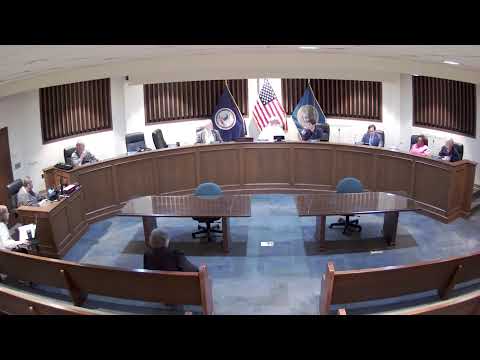
Prince Edward County supervisors on April 8 approved rezoning about 6.82 acres from A‑1 (agricultural/conservation) to C‑1 (general commercial) and granted a special‑use permit allowing a mini‑storage (mini‑warehouse) facility at the southeast side of U.S. 460 at its intersection with Pisgah Church Road.
The request, filed by Anthony Q. and Tracy M. Ellington, was the subject of two public hearings after the Planning Commission unanimously recommended approval. County staff noted the parcel adjoins existing commercial property and the Commission attached 20 standard conditions to the special‑use permit, including buffer and site‑construction requirements.
The rezoning matter was presented by county staff, who said the application had been advertised and neighboring property owners notified. Scott, a Virginia Department of Transportation (VDOT) representative, told the board VDOT reviewed the concept plans and, because of sight‑distance and intersection spacing concerns, preferred a design that provides a right‑in from U.S. 460 and a left‑out onto Pisgah Church Road rather than a full two‑way driveway from Pisgah.
"The access management design guide calls out a minimum spacing of 225 feet from the intersection," Scott said, describing the site as "substandard" for a Pisgah full entrance and explaining VDOT's preference for a right‑in/left‑out pattern to reduce conflict points and rear‑end collision risk.
Applicant Andy Ellington addressed the board and said the parcel previously had a special‑use permit for a campground with an entrance on Pisgah Church Road. Ellington told supervisors the change to a right‑in/left‑out arrangement had surprised him and added cost to his project; he asked the board and VDOT to reconsider allowing at least a right‑in on Pisgah. "This project has already cost me a lot extra money than I'd already planned," Ellington said.
County staff confirmed the Planning Commission recommended 20 conditions and that the Department of Conservation and Recreation (DCR) had no negative comments on the application. Staff also noted that a change of use from a campground triggers a new VDOT access review and that a final site plan and VDOT permitting remain required before construction.
Supervisor David Emmert moved and the board adopted the rezoning. The subsequent motion to approve the special‑use permit carried after an amendment that corrected internal paving language from "pervious" to "impervious" and after clarifying that final access is subject to VDOT review. Two supervisors recorded their opposition to the special‑use permit citing safety concerns about traffic and driveway geometry; the permit nonetheless passed with a majority vote.
Because the approved action is a rezoning and a separate special‑use approval, the applicant must submit a final engineered site plan to county staff and to VDOT. County staff told the board the plan must demonstrate compliance with the Planning Commission conditions and with VDOT access‑management requirements.
Planning‑level traffic estimates supplied during the hearing cited low expected trip generation for a storage facility (the consultant numbers shown in the packet projected roughly six AM peak and ten PM peak hour trips under the conceptual unit count), but supervisors and the VDOT representative said driver expectation and local geometry could produce risk scenarios that will be reviewed during final permitting.
The board's approvals do not guarantee a specific driveway design; VDOT retains authority over final access, and the applicant was told to work with an engineer and VDOT on a final plan.
Votes at a glance: rezoning approved; special‑use permit approved with conditions and an amendment to clarify paving standards.