Get Full Government Meeting Transcripts, Videos, & Alerts Forever!
Get email alerts on the Emergency Management topic
No spam. Unsubscribe anytime.
O'Fallon officials outline emergency operations plan and public communication after recent tornado
Summary
City public safety leaders described the structure, legal basis and practical limits of O'Fallon’s emergency operations plan, noting much of the full plan is withheld from public release for safety reasons and describing how the city coordinated response and communications after a recent tornado touchdown.
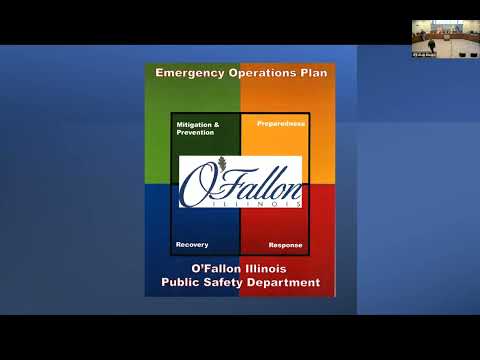
Chief Brad White, the city’s director of public safety, told the O'Fallon City Council that the city maintains a comprehensive emergency operations plan (EOP) that guides prevention, response and recovery for disasters but is not published in full because some operational details would raise public-safety risks. "The entire emergency operations plan is not something that is... published as a whole," White said, adding that the EOP is "a roadmap, it's a guideline in case there is an emergency."
Why it matters: Several residents at the meeting said they could not find the EOP online and asked how the public is informed when incidents occur. Council members pressed staff on how the plan is exercised and how the city coordinates with schools and county agencies during incidents that exceed local capacity. The discussion followed a recent tornado touchdown in the area that prompted multi-department responses but did not lead to a mayoral disaster declaration.
White said the plan is built on federal and state authorities including the Robert T. Stafford Disaster Relief and Emergency Assistance Act and applicable provisions of Illinois administrative code, and is implemented under the city's ordinance (chapter 37) that defines emergencies. He said the mayor is the official who may declare a local disaster in writing and under oath, which would formally activate the city's emergency operations center (EOC) and certain statewide support. In the most recent storm, White said, the city responded using EOP procedures—police and fire patrolled and checked for life-safety needs while public works addressed infrastructure issues—even though the mayor did not issue a disaster proclamation.
White described the EOC setup and common systems used in U.S. emergency planning: Firehouse 4 is the designated primary EOC (the fire training/community room) with a secondary EOC in the public safety community room. The plan relies on National Incident Management System (NIMS) principles to enable interoperable response with county and state partners, and contains functional annexes for damage assessment, evacuation, hazmat, health and medical coordination, mass care (including Red Cross), public information, volunteers and more. "We want our citizens... to be self-sufficient for the first 48 hours," White said, describing a planning assumption that residents should be prepared for initial delays in public assistance.
Council members and staff said the EOP includes memoranda of understanding with schools, hospitals and utilities and that many partner organizations maintain their own plans that the city can access when needed. Jeff Taylor of public works confirmed mutual-aid arrangements exist with neighboring jurisdictions and that public-works staff were mobilized after recent power outages to restore lift stations and ensure treatment-plant backup systems functioned. Mayor Roach noted the city has submitted mutual-aid contacts and that county and state EOCs are engaged when incidents cross jurisdictions.
Residents asked about exercise frequency and communications. White and other staff said departments train regularly: the fire and police command staffs run trainings and incident-management exercises, and the city held a tabletop exercise in the prior year; however, an integrated, large-scale council-level exercise has not been held recently. On communications, the city said it uses multiple methods: automated callouts tied to utility billing accounts, a CodeRED geotargeted alert tool to reach mobile devices in specified areas, social media and routine messaging to elected officials. Destiny Penager (Ward 5) and resident Vern Miller raised concerns about ensuring messages reach neighbors who do not use social media.
Council member Jerry asked when the EOC was last formally activated; staff said the chief recalled a significant activation during an ice storm earlier in the chief’s tenure but the exact year was not specified during the meeting. The council and staff also discussed a potential volunteer program modeled on Community Emergency Response Teams (CERT) to provide trained civilian support for nontechnical tasks during incidents.
Ending: City staff said the EOP materials are available to department heads and directors, and that the chief will continue to brief the council and the public on exercises and improvements. Several council members encouraged more public outreach and routine exercises involving elected officials to improve shared understanding of the plan and communications tools.