Get Full Government Meeting Transcripts, Videos, & Alerts Forever!
Get email alerts on the Taxes topic
No spam. Unsubscribe anytime.
Senate taxes committee advances bill to tax social‑media data collection after amendment
Summary
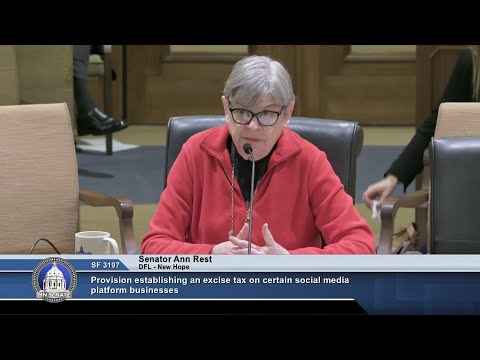
Senate File 3,197, a proposal to impose an excise tax on data collection by large social‑media platforms, was discussed at length in the Minnesota Senate Taxes Committee and laid over as amended.
Senate File 3,197, a proposal to impose an excise tax on data collection by large social‑media platforms, was discussed at length in the Minnesota Senate Taxes Committee and laid over as amended.
Senator Rest, the bill author, told the committee the proposal would “impose[] a tax . . . on the collection of consumer data by social media platform business[es],” and said the measure is aimed at large, for‑profit platforms that “have taken our information, our identifying information, and used it to, make millions and millions of dollars.” The committee adopted an author’s A2 amendment by voice vote; no roll‑call was recorded. Later in the hearing the chair announced, “Senate File 3,197 as amended will be laid over.”
Why it matters: supporters framed the bill as a modernizing change to Minnesota’s tax base and a way to raise new state revenue. Opponents warned of legal risk, economic side effects and pass‑through costs to small businesses that advertise online.
What the bill would do and who would be taxed - Threshold and scope: The bill would apply to a “social media platform business” that collects consumer data on more than 100,000 individuals in a month. A “consumer” is defined in the bill as an individual who establishes an account on an app or a website owned by the platform. The bill treats controlled groups under the Internal Revenue Code as a single entity for counting purposes. - Tax base and administration: The tax is structured as a graduated excise measured per Minnesota consumer on whom data is collected. The author said administration and reporting would follow existing sales‑tax mechanisms (monthly filing) and recordkeeping requirements set by the Commissioner of Revenue. The bill would apply to data collected after Dec. 31 of the current year. Revenues are not dedicated; receipts would go to the state general fund. - Revenue estimate: The bill author cited a state revenue estimate that assumes roughly $45,000,000 in the first (partial) fiscal year and about $100,000,000 in subsequent years. During debate Senator Miller cited a different aggregate projection, saying the measure “will raise over $334,000,000 over the next 4 years.”
Testimony: divided positions - Media and local broadcasters: Wendy Paulson, president of the Minnesota Broadcasters Association, urged caution, saying local broadcasters may be swept in unintentionally. “That’s why we’re concerned about Senate File 3,197 . . . the bill’s broad language could unintentionally include local broadcasters who use digital platforms to serve the public,” Paulson said. - Tech industry and advertising groups: Cory Marshall of the Chamber of Progress opposed the bill, warning it could cause platforms to restrict free services and raise costs for small businesses that use inexpensive digital advertising. Deb Peters, a CPA and former NCSL president testifying for Americans for Digital Opportunity, also opposed the bill on economic and legal grounds, arguing the levy would raise advertiser costs and could violate federal law. - Labor and community groups: Eric Bernstein of the coalition We Make Minnesota and Taryn Fritzinger of the Minnesota Association of Professional Employees supported the tax as an avenue to raise revenue for state priorities and to broaden the tax base. Philip Sandro of Isaiah Minnesota and other community witnesses framed the measure as a source of funds to protect social services. - Legal and policy testimony: Darian Shankski, Martin Luther King Professor of Law at UC Davis, described policy rationales for taxing data extraction and said the bill’s graduated structure is defensible; he also said litigation was likely but argued states should not abandon sound tax policy because of novel legal challenges.
Committee discussion and concerns Members who supported the concept described it as a way to modernize the tax code: Senator Putnam said the bill “is aware of the world we actually live in,” and Senator Hauschildt compared the model to other “extractive” taxes (tobacco, mining). Members who opposed or raised caution cited legal risk under the Internet Tax Freedom Act and commerce‑clause concerns, administrative uncertainty about how platforms would identify Minnesota residents, and potential pass‑through costs to small businesses. Senator Miller repeatedly sought clarity on the definition and counting of Minnesota users. Counsel and the author responded that platforms would report counts to the Commissioner of Revenue and maintain records; the author said the statute’s resident definition would rely on existing Minnesota tax residency rules (referencing Minn. Stat. § 290.01 subd. 7).
Formal actions - The committee adopted the author’s A2 amendment by voice vote. The chair announced adoption: “A2 is adopted.” - The committee laid Senate File 3,197, as amended, over for further consideration (no final enactment vote in committee).
Next steps and outlook Committee members made clear the measure is likely to face litigation and detailed further drafting questions before any final inclusion in an omnibus tax bill. Several senators asked the Department of Revenue for additional technical information about administration and audit capacity; committee staff said they would follow up.
Ending note: The hearing combined legal, fiscal, and policy arguments and underscored both the appetite among some lawmakers to broaden Minnesota’s tax base and the practical/legal questions lawmakers said must be resolved before the state can rely on the revenue the bill projects.