Get Full Government Meeting Transcripts, Videos, & Alerts Forever!
Get email alerts on the State Budget And Beach Revenue topic
No spam. Unsubscribe anytime.
Statehouse delegation briefs council on budget outlook, proposed short‑term rental tax change and state beach revenue decline
Summary
Senators and representatives updated the Westerly Town Council on the governor’s budget, the proposed closing of a short‑term rental tax "loophole" to fund homelessness programs, concerns about infrastructure funding delays and state beach revenue declines; councilors asked for more granular beach‑revenue and DOT roundabout information
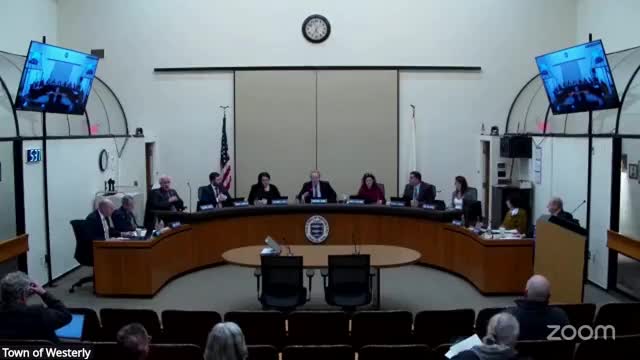
Senators and state representatives met with the Westerly Town Council on Jan. 27 to review the governor’s fiscal proposal and listen to town priorities for the 2025 legislative session.
Delegation members said the governor’s budget proposal faces a large structural gap—figures cited at the meeting ranged from roughly $250 million to reports noting higher shortfalls—and that House rules and committee appointments were being finalized so the finance committee can scrutinize the proposal article by article. The delegation warned that some fee increases are included in the governor’s plan as a partial approach to closing the deficit.
Delegation highlights: - Short‑term rental tax: Delegation members said the governor proposes closing a short‑term rental / whole‑home rental tax difference (a roughly 5% gap) and directing the revenue to homelessness services. Several legislators said some coastal communities are pursuing models to retain locally raised tourism tax revenue for community impacts of tourism; they encouraged towns along the southern coast to coordinate positions. - Accessory dwelling unit (ADU) legislation: Councilors asked about H‑7062 (ADU bill) and the delegation confirmed an amendment allows broader types of residents (not limited to family members or caregivers) to use ADUs and that ADUs would not be authorized for short‑term rentals under the language discussed at the meeting. - State beach revenue: Councilors asked for a breakdown of Musquamicut (state beach) daily‑pass revenue by in‑state versus out‑of‑state visitors. Delegation members said the data is available and estimated Musquamicut has a high out‑of‑state share—one cited ballpark figure was about 75% out‑of‑state in a typical season—and that Musquamicut revenue fell from $366,235 in 2023 to about $310,000 in 2024 (figures discussed by councilors at the meeting). Legislators offered to help request more detailed revenue breakdowns and signage/administration information. - Roads and DOT: Councilors asked about state funding and an RIDOT roundabout study requested for Bradford. Delegation members said the roundabout evaluation will move through State Traffic Commission processes and that town input would be requested as that work proceeds. They also said reported federal holdbacks (discussed in the meeting as about $600 million in regional infrastructure funds) were not expected to affect that roundabout evaluation directly.
Councilors raised questions about transparency of some state DOT and project meetings, and several asked for more public notice when state or regional studies affect Westerly. Legislators encouraged the council to forward town priorities so they may be taken to the House and Senate as the budget and capital program are reviewed.
The council did not vote on any action related to the delegation briefing. Representatives and the senator offered to follow up with requested data on beach pass revenues and to coordinate further on infrastructure requests.