Get Full Government Meeting Transcripts, Videos, & Alerts Forever!
Get email alerts on the Redevelopment Agency topic
No spam. Unsubscribe anytime.
Council asks solicitor to draft ordinance to create Richmond Redevelopment Agency
Summary
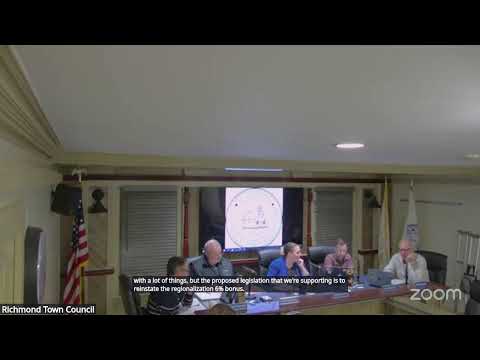
After a lengthy discussion of powers, risks and financing tools, the Richmond Town Council voted to ask the town solicitor to draft an ordinance establishing a Richmond Redevelopment Agency for Council review.
The Richmond Town Council voted to ask the town solicitor to draft an ordinance that would establish a Richmond Redevelopment Agency, a body empowered to plan and pursue redevelopment in designated districts.
Councilor Mendic introduced the item, saying representatives had met with state lawmakers and a land-use attorney about options for encouraging redevelopment. “One of the things that was suggested during that meeting was looking into eventually creating a redevelopment agency in Richmond,” Mendic said, summarizing a review of ordinances from other Rhode Island municipalities and state law.
The council’s discussion detailed the potential scope and powers of such an agency. Councilors were told state statute (Title 45, Chapter 31) authorizes redevelopment agencies that may acquire property, prepare redevelopment plans, construct streets and parks, offer technical assistance to property owners, borrow money and, under narrow circumstances, use eminent domain. Councilor Mendic said membership typically would be seven appointed members with professional qualifications in fields such as planning, legal, finance, architecture and construction.
Councilor Pavitani described one common funding mechanism: tax increment financing (TIF), which captures increases in property tax revenue within a redevelopment district to help fund projects in that same district. “It’s almost like a self-generating sustainability piece to it,” Pavitani said.
Other councilors raised reservations. Councilor Madnick said he was “hesitant to have the town get in the business of redeveloping property” and warned that redevelopment plans give substantial authority to the agency. Another speaker referenced the U.S. Supreme Court case Kelo v. City of New London when urging caution about the use of eminent domain. The town solicitor (unnamed in the meeting) told the council that a draft ordinance could preserve council oversight, require formal findings before designating an area as blighted or underutilized, and narrowly tailor any eminent-domain authority.
Mendic moved and a second was recorded; the motion to request the solicitor draft an ordinance passed on roll call. Councilors voting yes included Ginsmore, Adnick, Palmachano, Reynolds and Wilcox (roll-call names recorded during the vote). The council did not adopt any ordinance at the meeting; members directed staff to return a draft for further review and possible public workshops and hearings.
Why it matters: A redevelopment agency would add a formal tool for the town to designate and pursue redevelopment in specific areas, potentially changing how public investment, private development and property rights interact in Richmond. The council instructed the solicitor to draft an ordinance so members can review specific powers, oversight measures and funding options before any formal designation or action.