Get Full Government Meeting Transcripts, Videos, & Alerts Forever!
Get email alerts on the Municipal Budget topic
No spam. Unsubscribe anytime.
Richmond council trims police budget lines, weighs road strategy and directs finance to lower mill rate
Summary
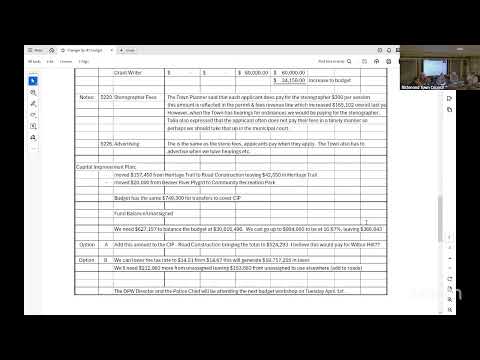
At a budget workshop the Richmond Town Council agreed to several departmental reductions, discussed police staffing and fleet needs, and voted to have the finance director prepare a budget using “Option B” (lowering the mill rate) with remaining fund balance applied to paving.
The Richmond Town Council, meeting in a budget workshop, agreed on several reductions to department budget requests, heard detailed presentations from the police chief and public works director about staffing and fleet needs, and voted to direct the finance director to assemble a budget using Option B — lowering the tax rate to 14.51 mills — and put the remaining fund balance toward road paving.
The action follows a line-by-line review of department requests. Councilors agreed to reduce the animal control supplies line from $3,500 to $2,500 and to cut a legal/contracts contingency from $8,000 to $1,000. Police Chief Johnson recommended trimming patrol overtime from $200,000 to $185,000 and reducing the dispatch part-time wages request from $45,208 to $35,000 if the town hires a fourth full‑time dispatcher.
“These reductions reflect where we believe we can reasonably come in based on staffing forecasts,” Chief Johnson said, describing recent hires, a recruit in the academy and the impact earlier hires had on overtime. He warned the department still needs to hire another officer to reach full complement and said he preferred a conservative overtime estimate until hires are on the roster. “I’m proposing we reduce the request from 200,000 in overtime to 185,” he said.
Chief Johnson also described dispatch staffing as a retention and cost issue. He told councilors neighboring towns that employ four full‑time dispatchers have lower overtime costs, and said the department’s overtime history supports hiring a fourth full‑time dispatcher to stabilize schedules and reduce overtime. He recommended keeping the overtime budget until hires are secured.
Public Works Director Gary outlined the town’s vehicle‑replacement cycle and capital needs, saying earlier practices of replacing roughly 1.5 cruisers per budget cycle had transitioned to a single vehicle per cycle because modern upfits now cost about $60,000 each. “The goal was to try to replenish the fleet,” Gary said, noting upfit costs and revenue from detail assignments that offset replacement costs. He also discussed a $230,000 estimate for a replacement street sweeper and noted there is prior‑year funding available that could cover a portion of capital needs.
On roads, Gary and councilors discussed alternatives to full repaving, including targeted overlays and chip/seal methods used by neighboring communities. Gary said some collector roads will require full engineering and base work, but added there are sections around town where fog‑seal or chip‑seal overlays could be a cost‑effective interim fix. “You could do three areas for the price of one” full repave in some circumstances, he said, citing examples other towns have used.
Councilors asked Gary to prepare a prioritized list of the worst road segments and options for targeted treatments so the council could choose how to allocate road funds strategically. “I think the best thing to do from the budget standpoint is determine how much we can afford to put towards this, and then have it be a discussion point,” Gary said.
After discussion, the council took a formal vote to request that the finance director assemble a budget reflecting the evening’s agreed reductions and implementing Option B — lowering the mill rate to 14.51 — and to apply the remainder of the unassigned fund balance to the paving capital account. The motion passed on a roll call vote: Councilor Dinsmore — yes; Councilor Madnick — yes; Councilor Hamishano — yes; Councilor Reynolds — yes; President Wilcox — yes.
The council framed the decision as a compromise between lowering taxes and preserving funds for infrastructure. President Wilcox summarized the tradeoffs and the council’s progress during the workshop: “We dropped $27,000 from what we had before,” she said, noting other reductions made during prior meetings and the addition of a grant‑writer and consolidated staff positions.
Next steps: the finance director will prepare and post the Option B budget materials ahead of the upcoming public hearing so residents can review the proposed mill‑rate change and the proposed allocation of fund balance to paving. Councilors emphasized the paving plan itself will be refined after Gary provides the prioritized list of problem segments and cost options; the council was clear it did not intend to name specific roads until the public hearings and any engineering needs are known.
Meeting context: the workshop continued into the evening and the council adjourned to reconvene under the posted public‑hearing agenda.