Lawmakers and witnesses clash over extending 2017 small-business tax provisions
Loading...
Summary
A joint House–Senate hearing focused on whether to make parts of the Tax Cuts and Jobs Act of 2017 permanent, with witnesses and members sharply divided on who benefits, the fiscal cost and alternatives targeted at true Main Street businesses.
A joint hearing of the House Committee on Small Business and the Senate Committee on Small Business and Entrepreneurship Wednesday brought lawmakers and small‑business witnesses into stark disagreement over whether Congress should make key provisions of the Tax Cuts and Jobs Act of 2017 permanent.
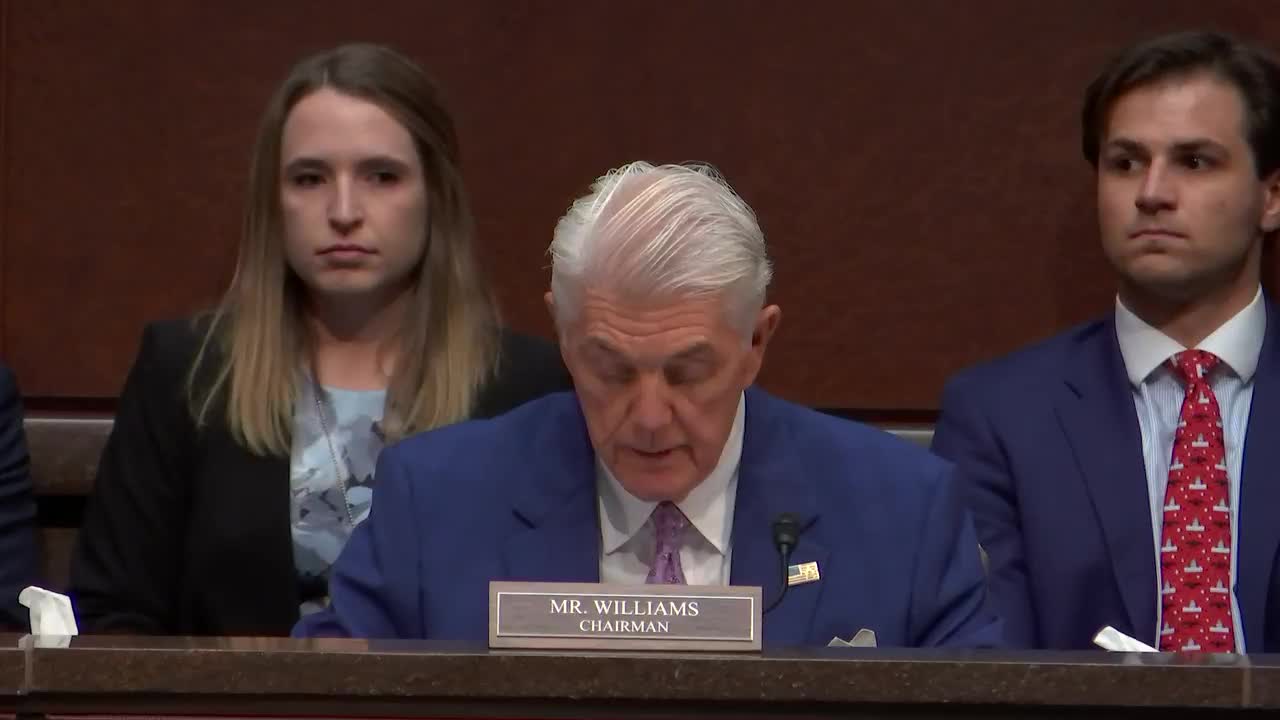
Chairman Williams opened by arguing for permanence, saying, “Extending small business tax cuts will drive growth on Main Street America.” Chairwoman Joni Ernst, representing the Senate committee, told the panel the 2017 law ‘‘was the most significant simplification of our tax code in decades’’ and credited provisions such as the 20% pass‑through deduction and expanded expensing with enabling investment and hiring.
Why it matters: The provisions at issue — notably section 199A (the 20% pass‑through deduction), bonus depreciation/immediate expensing and R&D tax treatment — are scheduled to phase out or change. Proponents say permanence preserves investment and jobs; critics counter that the benefits flow disproportionately to higher earners and that extending the cuts would add substantially to the federal deficit.
Witnesses who run or advise small businesses gave contrasting accounts. Tom Click, president and co‑founder of Patriot Industries, told the committees that TCJA provisions allowed his company’s capital spending and hiring to accelerate: “Since the passage of the 2017 tax cuts and jobs acts, our investments in equipment and workers have increased, fueling economic growth of Patriot.” Click said immediate expensing enabled purchases that would otherwise have been delayed, and warned that expiration would slow planned factory openings and hiring.
Preston Brashears, a research fellow at the Heritage Foundation, framed the issue as avoiding a tax increase, arguing the expiring provisions are ‘‘not about cutting taxes, it’s about avoiding an enormous tax hike’’ that would hit entrepreneurs and owners. He urged Congress to lock in full and immediate expensing, reinstate more favorable R&D treatment and preserve section 199A for pass‑throughs.
By contrast, Anne Zimmerman, a CPA and co‑chair of Small Business for America’s Future, said evidence that TCJA broadly helped Main Street is mixed. “The evidence clearly shows that for most small businesses, they have not,” she said, and recommended targeted reforms such as a small‑business standard deduction, a credit for hiring a first employee and closing corporate loopholes that she said siphon revenue away from public services small firms rely on.
Lawmakers split along party lines. Ranking Member Nydia Velázquez warned that past tax changes have ‘‘repeatedly adjusted to favor the wealthy and the largest corporations, funneling wealth upward,’’ and cited studies that, in her characterization, show large shares of some TCJA benefits landed with higher earners. Several Republican members pressed witnesses about concrete business decisions — purchases delayed, hires deferred, or benefits maintained because of the deduction and expensing rules.
Numbers and clarifications raised during testimony: witnesses and members cited differing estimates of fiscal cost and distribution. One member and witnesses referenced a projection that extending key TCJA provisions could add roughly $4,000,000,000,000 over a decade if applied broadly; witnesses gave business‑level figures — a witness said TCJA saved his firm roughly $11,000 in a recent year, and Patriot reported nearly $4,000,000 invested in equipment since 2017 and about $10,000,000 in inventory across multiple states. Witnesses stressed these business figures are examples, not program‑level estimates.
No formal vote or committee action was taken during the hearing. Members used questioning time to probe how making provisions permanent or altering them would affect payrolls, capital plans and family business transfers. Several witnesses and members said they would welcome targeted reforms to increase simplicity and direct relief to smaller firms while preserving needed public services.
Looking ahead: Members from both parties signaled interest in legislative fixes but differed on the form — a wholesale permanent extension of the TCJA provisions versus targeted fixes and revenue offsets. The hearing record will be used as the committees consider bills and amendments in coming weeks.