Get Full Government Meeting Transcripts, Videos, & Alerts Forever!
Get email alerts on the Education Budget topic
No spam. Unsubscribe anytime.
Anchorage School District previews FY26 budget that uses $49.8M in reserves, cuts staff and programs
Summary
The Anchorage School District on Feb. 4 reviewed a preliminary fiscal 2026 budget that assumes no state revenue growth, would draw roughly $49.8 million from fund balance and would increase class sizes and eliminate or reduce programs and staff across grade levels unless the Legislature raises the Base Student Allocation (BSA).
ANCHORAGE — The Anchorage School District board on Feb. 4 received a preliminary fiscal 2026 budget from district staff that assumes zero growth in state funding, would use roughly $49.8 million in reserve fund balance to balance next year’s books, and would require program and staff reductions if the Legislature does not increase statutory funding.
Chief Financial Officer Andy Ratliff told the board the draft is “the most depressing document I’ve ever had to prepare in my professional career,” and warned it would have “far‑ranging impacts on our students, our staff, our families, the services we’re able to provide, the electives, sports.”
The budget presented to the Anchorage School District Board of Education assumes no increase in the Base Student Allocation (BSA) and sketches a mix of one‑time reserves and recurring reductions to reach balance. Administration said the district would request use of about $49,800,000 in fund balance in FY26; without that one‑time draw the district would need roughly that same amount in additional cuts on top of reductions already proposed.
Why it matters: administrators said the BSA has not kept pace with inflation for more than a decade, shifting costs to local taxpayers and forcing the district to rely on fund balance, federal one‑time aid and program reductions. Board members and staff said those choices increase financial risk and reduce the district’s flexibility to respond to enrollment shifts or unexpected emergencies.
What would change under the draft - Class sizes and staffing: The administration said it increased pupil‑teacher ratios (PTR) by four across grade levels for FY26. That change plus enrollment declines would eliminate about 95 full‑time equivalent (FTE) certificated positions and remove roughly 21 FTE from the district’s holdback pool, which is used to respond to late enrollment changes.
- Elementary schools: For smaller elementary schools (under 300 students) nurses and librarians would move to half‑time; all elementary library assistants would be eliminated; supply budgets would be cut by 10 percent; the district would eliminate the Ignite gifted elementary program and several addenda used for school activities. The presentation also listed the planned closures of Lake Hood and Nenaka Valley schools, with related staffing reductions.
- Middle schools: All middle school sports would be eliminated, with a small activity fund retained; about $1.5 million in middle school athletics funding would be trimmed. Two assistant principals and one counselor reductions were shown at some large middle schools, offset in part by increased building operations support.
- High schools: At the comprehensive high schools administrators proposed reductions including the elimination of library assistants except for one split position, cuts of roughly 2.5 counselor positions, elimination of several high‑cost sports (hockey, swimming and diving, gymnastics) and the dome lease, and continued 10 percent supply cuts.
- District operations and departments: Administration identified roughly 42 FTE and about $8.9 million in reductions across district administration and department functions. The list cited slower response times for accounting and HR, reductions in custodial staffing tied to school closures, cuts to professional development, software and nonessential contracts, and lowered maintenance and capital spending.
- Transportation and food service: Transportation funding remains a pressure point. Administration said the district will request roughly $3.8 million more from local taxes to maintain current bus service levels; the presentation noted transportation reimbursement in statute has not been inflation‑adjusted since about 2015–16. Food service was an exception: child nutrition participation and reimbursement have increased, and the department plans to add sites and expand breakfast programs.
Legislative context and possible offsets Administration walked the board through several bills pending in the Alaska Legislature that, if adopted, would change the district’s projected finances. The presentation described House Bill 69 as tying BSA increases to prior inflation and adding a one‑time boost that could restore many proposed cuts if enacted. Ratliff said passage of HB 69 in the amounts shown could allow the district to “add back” roughly $55 million in cuts and preserve fund balance near board guidelines.
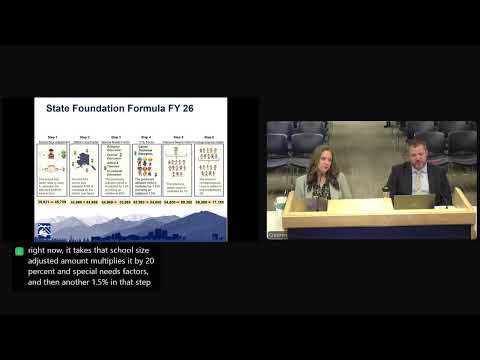
The administration also summarized HB 76 / SB 82, a governor‑sponsored package that would shift some formula multipliers (including increasing the career and technical education multiplier), provide per‑student incentives for reading proficiency, add specified teacher recruitment bonuses, and increase some transportation and correspondence school funding. Presenters cautioned the bills do not fully resolve transportation funding or long‑term structural funding needs.
Board reaction and risk assessment Board members asked for greater specificity about program‑level impacts and timing. Board member Carl Jacobs pressed staff for timelines and said it would be helpful to see what deeper cuts would look like if the board chose to preserve more reserve funds. Member Pat Higgins and others warned that spending down reserves to the levels proposed would increase risk — administrators said drawing fund balance to 5 percent (from a board best practice near 8 percent) would leave only about $6 million in unassigned reserves once required bond reserves are excluded.
Administration repeatedly emphasized the draft’s sensitivity to legislative outcomes. The district said it will finalize the budget schedule and may present the budget for formal action later in February, with tentative adoption dates cited as Feb. 18 or Feb. 25 depending on meeting schedules.
Action recorded At the end of the public portion of the meeting a board member moved to recess into executive session “for the purpose of contracts, negotiations, and personal matters.” The motion was moved and seconded and the board recessed to executive session.
What’s next District staff said they will continue to refine program‑level impacts and provide the board more granular lists of class‑level and course‑level reductions as principals complete schedules. The board also asked staff to provide requested informational items — including details on gifted education feedback, coach training and other board requests — at future board connect meetings.
Sources: Anchorage School District board meeting transcript, Feb. 4, 2025; presentation materials provided to the board during the meeting.