Get Full Government Meeting Transcripts, Videos, & Alerts Forever!
Get email alerts on the Fy26 Budget topic
No spam. Unsubscribe anytime.
Anchorage School District board adopts $886.25M preliminary FY26 budget; rejects amendments to restore several programs
Summary
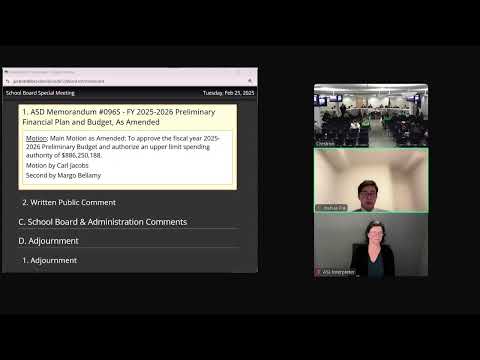
The Anchorage School District Board of Education adopted its FY2025–26 preliminary financial plan and authorized an upper-limit spending authority of $886,250,188 at a special meeting on Feb. 25.
The Anchorage School District Board of Education adopted its FY2025–26 preliminary financial plan and authorized an upper-limit spending authority of $886,250,188 at a special meeting on Feb. 25.
The board approved the budget as amended by a 6–1 vote after rejecting several proposed amendments that would have restored program funding or changed staffing priorities. Separately, the board unanimously (7–0) approved a contingent list of restorations that would take effect only if the state legislature provides a major increase to the base student allocation (BSA).
Why it matters: The budget before the board would cut personnel and programs unless the state increases per‑student funding. Board members said they are balancing classroom priorities against a shortfall in state support; several members urged constituents to press the Legislature for additional funding.
The meeting began with a motion to approve ASD memorandum 096s, the FY2025–26 preliminary financial plan and budget and to authorize an upper‑limit spending authority of $886,250,188. After debate and multiple amendment votes, the board adopted the budget 6–1.
Member Donnelly, a board member who sponsored several restoration amendments, proposed an amendment (Amendment 2) to discontinue the middle‑school extra planning period — described in the meeting as the “middle school model” — to restore the Ignite program. Donnelly said the middle‑school model costs about $3,430,000 annually and that restoring Ignite would result in a net savings of roughly $381,000. "I've never broken a campaign promise. And this was a promise I made during the campaign," Donnelly said while urging support for Ignite. The board defeated the motion 6–1 (Member Donnelly was the sole yes vote).
A subsequent motion (Amendment 4) intended to use savings from discontinuing the middle‑school planning period to restore immersion teachers (estimated at about $1,520,000) also failed by a 6–1 vote. Donnelly later moved Amendment 5, which proposed partial restoration of immersion instructors by cutting portions of the Office of Diversity, Equity, Inclusion, and Community Engagement; that motion failed by the same margin. Several board members objected to cutting that office, saying it provides multilingual outreach, interpreters and volunteer coordination for a district that the board said serves more than 100 languages. "This office accomplishes outreach for not just our 42,000 students, but our staff, our families," Member Wilson said.
Board members repeatedly discussed class size (pupil‑teacher ratio). Donnelly and others proposed amendments (including Amendment 6 and Amendment 7) intended to reduce projected class‑size increases by reallocating administrative and other line‑item funding; those proposals were defeated (Amendment 6 and Amendment 7 each failed 6–1). Administration staff told the board the cost to reduce the PTR by one across the district is roughly in the $5–7 million range, with diminishing per‑PTR value as ratios change.
Member Jacobs and Member Wessels brought a separate amendment (referred to in the meeting as the Jacobs–Wessons or Jacobs–Lisonbee amendment with attachment A) that lays out a spending plan the board would implement only if the Legislature approves a large increase to the BSA. The amendment directs administration to "change" the 2025–26 financial plan to make the investments listed in attachment A if the state provides the funding; the attachment described investments tied to a hypothetical $1,000 BSA increase (the packet cites an illustrative $71 million figure for Anchorage). That amendment passed unanimously, 7–0. Proponents said the attachment prioritizes classroom instruction, reading and math interventions, immersion programs, Ignite, librarian and nurse restorations, special‑education staffing, and funding for charter schools.
Debate reflected competing priorities. Member Higgins, a long‑time supporter of the middle‑school structure, said the collaboration/planning period is critical to support sixth graders and to address social‑emotional and academic needs. "Middle school is a major impact on academic outcomes," Higgins said. Several other members said they prefer protecting programs that would be unrecoverable if cut, such as Ignite or immersion, and emphasized that many staffing actions are difficult to reverse.
Administration staff answered board questions about immediate hiring and visa timelines for immersion teachers. The district estimated the cost to hire seven immersion teachers (three French, three Spanish and one Chinese teacher) at about $883,000; staff said much of the recruitment and interview work can proceed without funding, but actually offering contracts would require identifying offsets if additional state funds do not arrive.
The board also debated deletion or reduction of the Office of Diversity, Equity, Inclusion and Community Engagement. Member Donnelly argued for cutting parts of the office as a funding source; other board members said the office’s community outreach, language supports and interpreters are essential to families and students.
Student representative Josh Pack cast advisory votes that were solicited during roll calls; his vote is nonbinding under board rules.
The board approved the final, amended FY2025–26 preliminary budget by a vote of 6–1. The board also voted to permit the district to draw down fund balance to 5 percent (the board’s policy target is 8 percent) in order to operate under the adopted plan; the board used the same vote as the budget adoption to indicate that authorization.
What happens next: The adopted preliminary financial plan will be used to set municipal and district processes while the Legislature completes work on the state budget. Several board members and the board’s adopted contingent plan call on the Legislature to enact a meaningful increase in the base student allocation; board members urged the public to contact state lawmakers and the governor to support education funding.
The full meeting record shows repeated, close votes on a range of priorities; the district said it will return to the board with recommendations if and when additional state revenue is finalized.