Get Full Government Meeting Transcripts, Videos, & Alerts Forever!
Get email alerts on the Board Access To Staff topic
No spam. Unsubscribe anytime.
Governance committee moves to replace 'readily available' with 'publicly available' in board contact rules
Summary
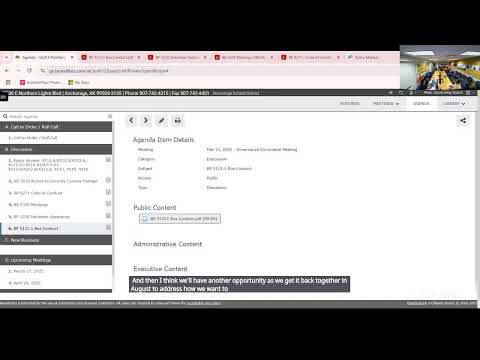
The Anchorage School District Governance Committee debated rules on board members contacting staff and agreed to revise language that currently allows board members to request information that is "readily available," proposing "publicly available" as the clearer standard and directing staff to produce a working draft for March.
The Anchorage School District Governance Committee debated whether board members can directly request information from district staff and agreed to seek clearer language replacing the phrase "readily available" with "publicly available" in the board code of conduct.
Member Haynes, speaking during the governance meeting, pointed to section 25 of the draft code and said, "board members may request information from ASD staff that is readily available." Haynes said the provision is important because it affirms a board member’s ability to get information without administrative interference.
The committee discussed practical limits and staff workload. Dr. Bridal, identified in the meeting as the superintendent, said the distinction matters for whether staff provide information directly to a single board member or whether information should be distributed to the full board. "If it's readily available, they would provide it directly to the board," Dr. Bridal said, and raised a related concern about ensuring other board members could access information when appropriate.
Member Higgins and others pushed for more clarity on what constitutes information that requires minimal staff time versus items that demand technical consultation or research. Higgins emphasized that brief definitional questions—"what does SBSS stand for"—should be obtainable without formal processes, while more technical follow-up conversations should be scheduled: "if we have questions for staff, we just need to find time on a calendar to do it versus popping in and assuming that there's time," Higgins said.
After extended discussion the committee coalesced on replacing the term "readily available" with "publicly available" in the working draft to narrow the threshold for direct staff responses and to reduce ambiguity about when board members should request the superintendent's office to process requests. Committee Chair Carl Jacobs asked staff to circulate an edited draft for continued review; Member Haggins (spelling per transcript) explicitly asked that the change be put in the ongoing edited version for 2025.
The committee did not adopt final bylaws language at the meeting. Instead it directed staff to prepare a revised draft reflecting the "publicly available" standard and encouraged development of complementary expectations—such as advance notice for informal visits and use of the superintendent's office as a clearinghouse when requests require research—so the committee can consider formal adoption in a future meeting.
The discussion included repeated reminders that staff should be treated respectfully and that board members should avoid disrupting employees' workloads. Maryna Sullivan, the executive secretary, and Katie Grama of the superintendent’s office were identified as administrative contacts who typically assist board members with quick information requests.
The committee scheduled further review of the draft language at upcoming governance meetings; no formal vote was taken at this session.