Get Full Government Meeting Transcripts, Videos, & Alerts Forever!
Get email alerts on the Zoning topic
No spam. Unsubscribe anytime.
Brook Park council delays Circle K decision after hours of public comment; amends permit conditions
Summary
Residents delivered sustained opposition to a proposed 16-pump Circle K at State Route 237 and Sheldon Road. Council passed amendments to the permit conditions and returned the item to second reading for further consideration.
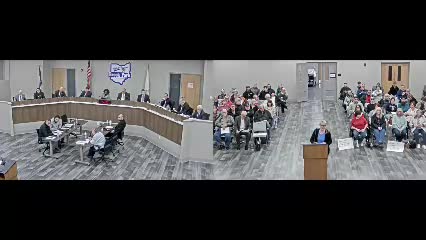
Hundreds of Brook Park residents and multiple council members urged the City Council on April 1 to reject a conditional-use permit for a 16-pump Circle K convenience store and gasoline station proposed at the intersection of State Route 237 and Sheldon Road. After more than an hour of public comment and internal debate, the council approved two amendments to the measure and moved the rezoning/conditional-use item back to second reading rather than adopting it tonight.
The proposal has drawn sustained opposition from neighbors who said the station would increase crime, traffic conflicts and pollution and would conflict with the city’s zoning intent for the U-6 district. Several speakers also said they had not been notified earlier in the application process and presented petitions and legal citations asking the council to follow the ordinance’s standards for conditional uses.
Residents said the intersection is already hazardous. “The proposed plan to construct a Circle K gas station on the corner of 237 and Sheldon Road threatens that along with the safety of our neighborhood,” said Barb Wells of Greyfriar Drive during public comment. Several speakers invoked local zoning language and state law, arguing a conditional-use permit should not be used to place a gas station where the ordinance’s intended uses are office and low-impact retail.
Thomas J. Coyne Jr., who identified himself as an agent for Circle K and Strategies for Success LLC, told the council the applicant is willing to install recommended safety improvements and landscape buffers. “We agree to do that,” Coyne said, addressing a list of conditions included in the draft resolution. Coyne also said the company would pay for a proposed right-turn lane extension along SR-237 if required.
Council members debated two substantive conditions that had been proposed: (1) an hours restriction limiting operations during overnight hours to provide neighbors quiet overnight periods; and (2) a requirement that all road and traffic-safety improvements be completed before any demolition or construction on the site (intended to prevent dig-up-and-replace duplication). Council discussion included the city law director’s advice that certain unusual, burdensome conditions could increase the risk of litigation because they might be viewed as arbitrary or unduly burdensome on a business seeking a permit.
After debate the council approved amendments changing the draft conditions. One amendment removed the requirement that construction be postponed until all traffic improvements were finished; the language was changed to allow the traffic-work and on-site demolition/construction to proceed simultaneously so work would not have to be dug up twice. That amendment passed on a 4–3 recorded vote with yes votes from Roberts, Scott, Mancini and McCorkle and no votes from Poindexter, Dufour and Troyer. (The council president announced the measure had been amended and, because the ordinance was changed, it was returned to second reading rather than being adopted.)
A prior proposed amendment concerning the hours restriction also was considered and its status changed by council action; the meeting record shows council members debated the legal exposure of imposing an hours condition that differed from other like businesses in the city and whether unequal hours could be seen as arbitrary. The law director, Carol Horvath, advised the council that the city must weigh fairness and potential litigation risk when imposing conditions.
Multiple speakers cited specific ordinance sections and state code during public comment. CJ Nash, who described himself as having led a similar neighborhood fight in another city, told council: “You see very few cities have the foresight to recognize gasoline stations pose [a risk] near nearby residents. Brook Park did, and they made a separate zone just for gas stations.” Other residents raised health, groundwater and property-value concerns and urged council to require rezoning instead of a conditional-use approval.
Council did not adopt the conditional-use permit tonight. After adopting the amendments, the council chair announced the item would return to second reading so members could incorporate the changes and give the public additional notice before a final vote. The council did not set a final adoption date at the end of the meeting.
What happens next: The conditional-use ordinance will be revised to reflect the council amendments and returned to the council docket for further readings. Because the item was amended, the council moved the matter back to second reading; any future formal action will be taken after that procedural step and with the opportunity for additional public comment.
Votes and formal actions recorded tonight involving this agenda item were procedural amendments; the council did not adopt the conditional-use permit on first reading.