Get Full Government Meeting Transcripts, Videos, & Alerts Forever!
Get email alerts on the Coastal Resilience topic
No spam. Unsubscribe anytime.
Town’s coastal resilience coordinator outlines risks, projects and funding needs
Summary
Leah Hill, Nantucket’s coastal resilience coordinator, told the Advisory Committee for Non‑Voting Taxpayers that the town faces multiple coastal risks, highlighted three underway projects and summarized estimated costs and funding to 2030 and beyond.
Leah Hill, the town’s coastal resilience coordinator, told the Advisory Committee for Non‑Voting Taxpayers that Nantucket faces five principal coastal risks — erosion, groundwater‑table rise, coastal storm flooding, stormwater (rain) flooding and high‑tide ("sunny day") flooding — and summarized a suite of recommended projects and funding options the town is pursuing.
Hill said the town’s island‑wide risk assessment found more than 2,000 structures at risk through 2070, including 34 essential community facilities, and that, "if we take no action...the projected damages and losses due to erosion and flooding...is as much as $3,400,000,000" from the plan’s baseline out to 2070. She emphasized that planning now reduces long‑term costs: "for every dollar we spend on coastal resilience projects, we'll be saving money in the long run." (Leah Hill, Town coastal resilience coordinator.)
Why it matters: Hill told the committee the Coastal Resilience Plan (endorsed by the Select Board in 2022) lays out 40 recommendations across policy, nature‑based and structural measures. The plan uses NOAA’s high sea‑level‑rise scenario and estimates approximately $900 million to implement all recommendations to 2070; projects targeted through 2030 total roughly $155 million at the high end (Hill said much of that total is tied to wastewater and large Madaket projects). The town has committed about $6.5 million to date for resilience work and budgets roughly $1 million per year for planning and feasibility work, she said.
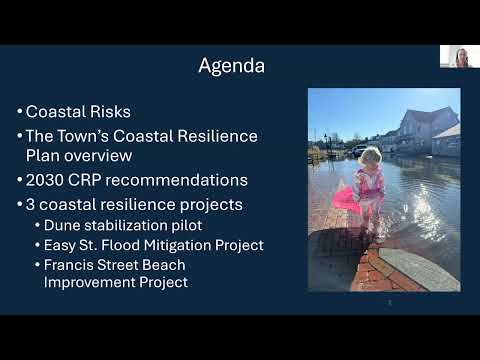
Most urgent projects and near‑term work: Hill described three projects she highlighted for the committee.
- A cliff‑stabilizer pilot in Madaket and at Dionys. The temporary, reusable devices hold dune grass and sediment to encourage root growth; Hill said monitoring will measure elevation change and plant mortality to assess feasibility for private and public use.
- The Easy Street / downtown neighborhood flood‑mitigation study. Hill said the town received a state grant of just under $500,000 to bring a preferred design to 30% design. She reviewed three concept alternatives that raise or extend existing bulkheads and, in the more ambitious options, raise road grades to design flood elevations (6.5 ft and 8.0 ft NAVD88 were used as design references). Hill said any chosen design will likely require pump stations because existing stormwater infrastructure is old and cannot reliably move high‑water into the harbor.
- The Francis Street beach improvement (part of the downtown neighborhood flood barrier). Two concept types — a "dune swoop" and a more geometric "beach overlook" — embed flood defenses into a dune/boardwalk and pair them with inland rain‑garden space (land bank parcels) to intercept runoff and reduce pollutant loads to the harbor.
Context and constraints: Hill described implementation limits: permitting, staff capacity (she is the single coastal resilience staffer in Natural Resources), sediment availability for nature‑based projects (the town’s sediment budget depends on an ongoing dredge plant and sediment‑source study), and state regulatory practice. She said Massachusetts wetlands regulations and review processes remain a hurdle for certain nourishment or structural solutions and that some state officials have judged large Madaket beach‑nourishment measures infeasible because frequently recurring storms could wash funded work away.
Funding and prioritization: Hill said the plan presents low‑ and high‑range cost estimates with contingencies and that project costs typically refine downward as designs progress (30% to 60% to 90% design). She said high‑priority projects through 2030 in the plan have a combined high‑end estimate of roughly $160 million and a low estimate near $140 million, with major shares tied to wastewater facility resilience (~$43 million in the plan) and Madaket projects (roughly $109 million in the plan). She said town funding to date has largely supported planning, feasibility studies and permitting rather than construction; construction will require a mix of capital funding, grants and donations.
Community outreach and regulatory steps: Hill said the Coastal Resilience Advisory Committee and Natural Resources staff are doing outreach (brochures tied to property‑level risk lookups, a continuing education class for real‑estate professionals, and weekly social posts). She said an internal interdepartmental work group is reviewing zoning and development regulations to incorporate resiliency, and the Conservation Commission has already adopted updated wetland regulations that include definitions for coastal resilience and sea‑level rise.
Quotes from the meeting: When asked how residents can get help, Hill said, "They should definitely contact me. I help a lot of people out. That's part of my job." (Leah Hill) Peter Kahn, chairing the meeting, introduced Hill and noted the committee had a quorum to hear the presentation.
Ending: Hill invited committee members to follow the Natural Resources social channels and to contact her directly for project questions and property evaluations. She said the committee meets twice monthly and that she is available for return presentations or deeper dives into the full Coastal Resilience Plan.