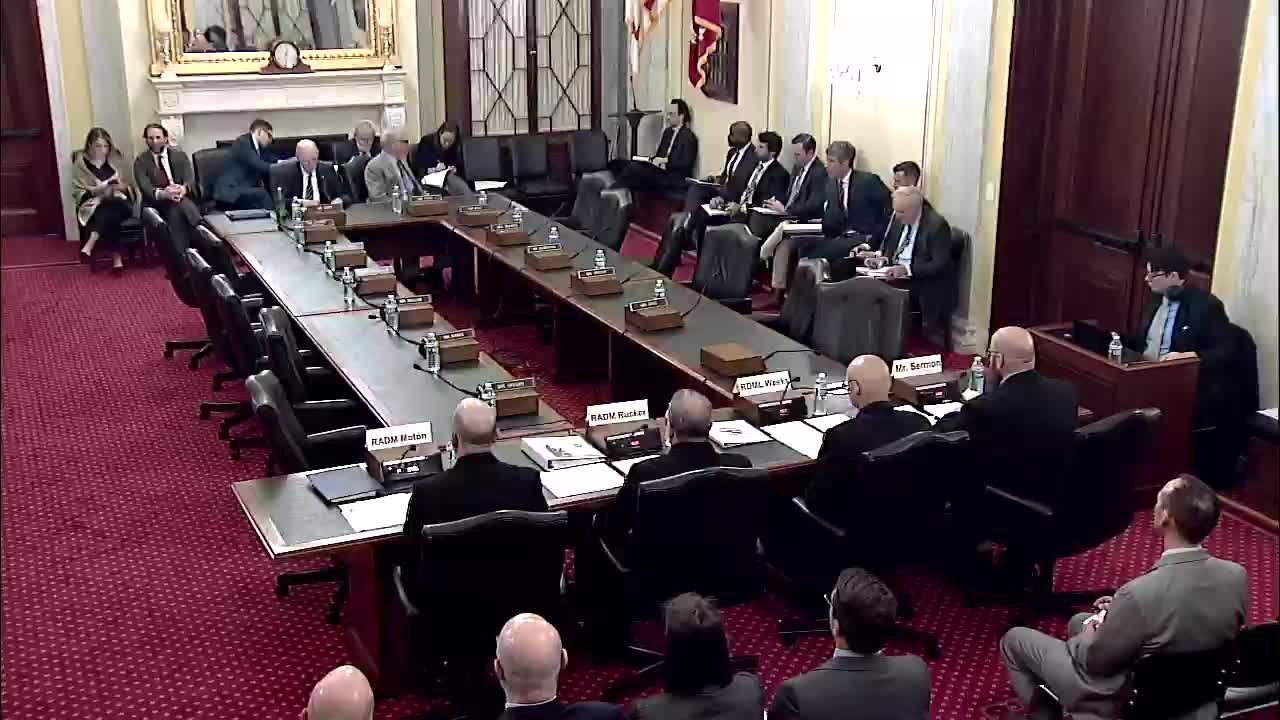
Senate Seapower Hearing: Navy Officials Warn of Delays, Workforce and Supply‑Chain Strains in Nuclear Shipbuilding
Loading...
Summary
The Senate Armed Services Subcommittee on Seapower heard testimony Tuesday that the United States’ nuclear shipbuilding effort is facing sustained delays and capacity shortages that could affect delivery of Columbia‑class ballistic missile submarines, Virginia‑class attack submarines and Ford‑class aircraft carriers.
The Senate Armed Services Subcommittee on Seapower heard testimony Tuesday that the United States’ nuclear shipbuilding effort is facing sustained delays and capacity shortages that could affect delivery of Columbia‑class ballistic missile submarines, Virginia‑class attack submarines and Ford‑class aircraft carriers.
Rear Admiral Todd Weeks, program executive officer for strategic submarines, told the committee that “the Columbia class is the Navy's number 1 acquisition priority and a critical once‑in‑a‑generation recapitalization effort” and that the lead Columbia is projected to be “12 to 18 months late to contract.” He said the second Columbia, the future Wisconsin, is on schedule and that early procurement and construction activities are underway for the next five boats.
The hearing drew sustained attention because those programs underpin the Navy’s force posture and allied commitments. As Rear Admiral Jonathan Rucker, program executive officer for attack submarines, noted, the Navy’s requirement is a force of 66 attack submarines and officials said the industrial base must reach a sustainable annual production cadence — summarized in Navy briefings as “1 Columbia plus 2 Virginia” and later ramping for allied needs — to meet that requirement.
Navy and program witnesses laid out the principal causes of delay and cost pressure: workforce shortages, supplier and material delivery problems, shipbuilder facility constraints and first‑of‑class learning curves. Matt Sherman, program manager for the Navy’s Maritime Industrial Base Office, said the industrial base “must hire approximately 250,000 skilled and well compensated workers over the next decade” and described a mix of efforts the Navy is pursuing, including supplier development projects, workforce partnerships and adoption of advanced manufacturing.
Sherman said the Maritime Industrial Base program has launched nearly 1,200 supplier development, workforce and advanced manufacturing projects in 40 states and pointed to concrete gains in parts production: “Since 2018, we have expanded parts delivery for submarines by more than 250%,” he said. He also highlighted an additive manufacturing effort in Danville, Virginia, where the Navy’s Additive Manufacturing Center of Excellence has printed “more than 270 parts” and expects to mitigate multi‑hundred‑day part delays by substituting printed components.
Program officials and senators discussed production metrics at length. Rucker told the committee that as of March 2025 the Navy had taken delivery of 24 Virginia‑class submarines and had 14 additional boats under construction, and that the 2024 production rate for Virginia class was 1.13 submarines per year versus the two‑per‑year cadence the Navy says it needs. He cited workforce, supplier delays and shipbuilder infrastructure as the main constraints.
On the Columbia program, Weeks and other officials described recovery actions for the lead ship schedule and said the program is using selective Ohio‑class service‑life extensions to preserve operational margin while Columbia production is recovered. Weeks said the Navy is “pursuing every opportunity to drive and improve velocity” and that second‑ship performance has shown early improvements relative to the lead ship.
Aircraft carrier construction and sustainment also drew scrutiny. Rear Admiral Casey Moten, program executive officer for aircraft carriers, said CVN‑79 (the future USS John F. Kennedy) was “95% complete” but that delivery and combat‑readiness remain pressured by critical‑path work and sequence‑critical material. Moten said Ford‑class systems performed well on the class’ initial deployment: “Ford was the initial response… The ship did extremely well,” he said, noting thousands of aircraft sorties and tens of thousands of elevator cycles during the ship’s deployment.
Members pressed witnesses about contracting, accountability and whether existing procurement tools — block buys, fixed‑price vs cost‑plus constructs, advanced procurement and economic price adjustment clauses — are yielding correct incentives. Officials described a range of tools, noting that many modern ship contracts use fixed‑price incentive arrangements that reduce contractor profit as cost overruns increase, while other buys and early‑ship efforts rely on cost‑type contracts because of first‑of‑class risk.
The subcommittee also explored the Navy’s use of strategic outsourcing and new industrial partnerships. Rucker and Weeks described module production being expanded outside the two primary nuclear yards (Electric Boat and Huntington Ingalls/Newport News) to suppliers such as Austal and others; Rucker said the Navy aims to increase strategic outsourcing to roughly 7 million man‑hours annually by 2026 and that the industrial base was at about 3 million man‑hours at the end of 2024.
Witnesses cited recent congressional and executive support as important near‑term steps. The Navy said Congress provided roughly $5.7 billion in emergency FY25 funding included in a continuing resolution to address urgent procurement and wage needs; Rucker noted that roughly $520 million of that sum is intended to address wages on current contracts. Senators and witnesses repeatedly said the fiscal 2026 budget and the National Defense Authorization Act (NDAA) process will be critical for longer‑term stability.
Several senators asked about public shipyard workforce protections and program continuity. Witnesses said they were coordinating with Navy leadership and public shipyard offices on personnel policies and infrastructure investments — including dry dock and facility projects at Portsmouth and other naval shipyards — and that sustainment and timely spare‑parts inventories are a central part of readiness planning.
The hearing closed with senators pressing for additional oversight and quicker results. Members urged faster clarification of delivery dates and of the White House’s proposed Office of Shipbuilding, but witnesses emphasized that many industrial‑base improvements are multiyear efforts: as Sherman put it, “we are planting trees, not growing house plants.”
The subcommittee left the record open for follow‑up requests and signaled continued engagement in the NDAA and appropriations cycles to monitor Columbia, Virginia and Ford class schedules, industrial investments, and workforce initiatives.