Get Full Government Meeting Transcripts, Videos, & Alerts Forever!
Get email alerts on the Budget Supplemental Budget topic
No spam. Unsubscribe anytime.
City staff outline supplemental budget process, 10-year sustainability planning and new surface-water drainage fund
Summary
At an April 8 work session, Laramie city staff briefed the council on the supplemental budget approach for the second year of the biennium, long-term sustainability analyses, a planned new enterprise surface-water drainage fund beginning in 2026, and revenue forecasting methods including a 3% target range.
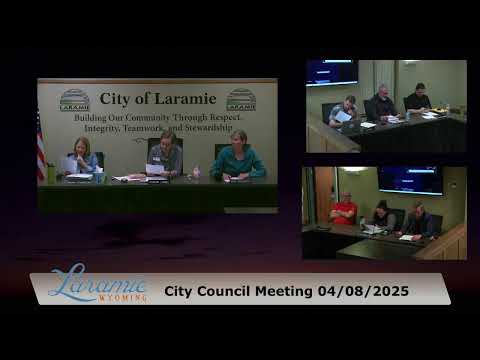
City Manager Jordan and Director Wade led a budget-focused work session with the Laramie City Council on April 8 that reviewed budgeting principles, the supplemental-appropriation timeline for the second year of the fiscal biennium, fund accounting, reserve policy and revenue forecasting.
City Manager Jordan said the recommended budget “is really the common thread that links all of the administrative business units of this city and our governance objectives,” and described the budget as the primary place to see how policy priorities are funded. Jordan described an “ownership culture” approach to municipal budgeting: staff and residents share interest in maximizing the public value of limited resources while funding core services in perpetuity.
Director George Wade gave technical details on the supplemental budget year, noting the city will recommend “a supplemental appropriation in all of our operating funds and an original appropriation in some of our smaller funds.” Wade walked the council through key budget definitions (revenue, available reserves, personnel, operating and capital expenditures), the separate accounting of funds, and the city’s sustainability criteria: funding ongoing expenditures with ongoing resources and reserving one-time receipts for one-time capital investments.
Wade said staff are developing forecasts based on three- to five-year actual trends and are targeting to be within about 3% of expected ongoing revenue, adding “I do not want to be 3% over. I want to be about 3% under.” He reiterated that staff exclude one-time collections from ongoing revenue used to fund basic services and instead recommend appropriating one-time revenues for capital.
On the surface-water drainage program, Wade said the city will create a new enterprise fund for the utility in fiscal 2026 tied to the fee that the council adopted; the fund is scheduled to begin accounting as a separate presentation in 2026 and the fee is due to take effect July 1. He told council “we do have a budget of $5,000,000 transfer from the general fund to support the start up cost” for the new fund and said recommended budgetary appropriations for that fund will appear in the budget document the council will receive in the coming weeks.
Wade and Jordan also reviewed fund-specific trends: general-fund revenue has increased recently — in part from wind-energy related receipts — but most general-fund revenue sources remain flat year-to-year; enterprise funds (water, wastewater, solid waste) show stable user-rate lines and highly variable capital revenue spikes. Wade presented numeric examples: between 2015 and 2024, water charges rose about 16.5%, wastewater charges 16.8%, and certain solid-waste charges about 44% (driven largely by landfill capital and closure liabilities). For the biennium the adopted budget totals about $198,000,000, with forecasted revenue of roughly $152.7 million and planned reserve use of about $45.7 million.
Councilors asked clarifying questions about forecasting methods, the 3% target, the composition of intergovernmental revenue sources, and the county assessor’s preliminary estimates on property-tax changes. Councilor Fried asked about the 3% forecasting target; Wade described that as his “own personal target” for revenue forecasting and said “5% is not bad. 5% is okay with me too. But I prefer it to be 3.” Jordan and Wade repeatedly emphasized that reserves that resulted from one-time collections should be applied primarily to capital and not to recurring operating costs.
Why it matters: The work session described how the city will prepare recommended supplemental appropriations, evaluate fund sustainability on a 10-year horizon, and present the new surface-water drainage enterprise fund for council review. The session lays out the financial assumptions and trade-offs staff will use in the coming formal budget reviews.
Ending: Council members did not take formal votes during the April 8 work session; staff said budget documents and fund-specific appropriations will be provided to council in the next one to two weeks ahead of the May budget work sessions.