Citizen Portal

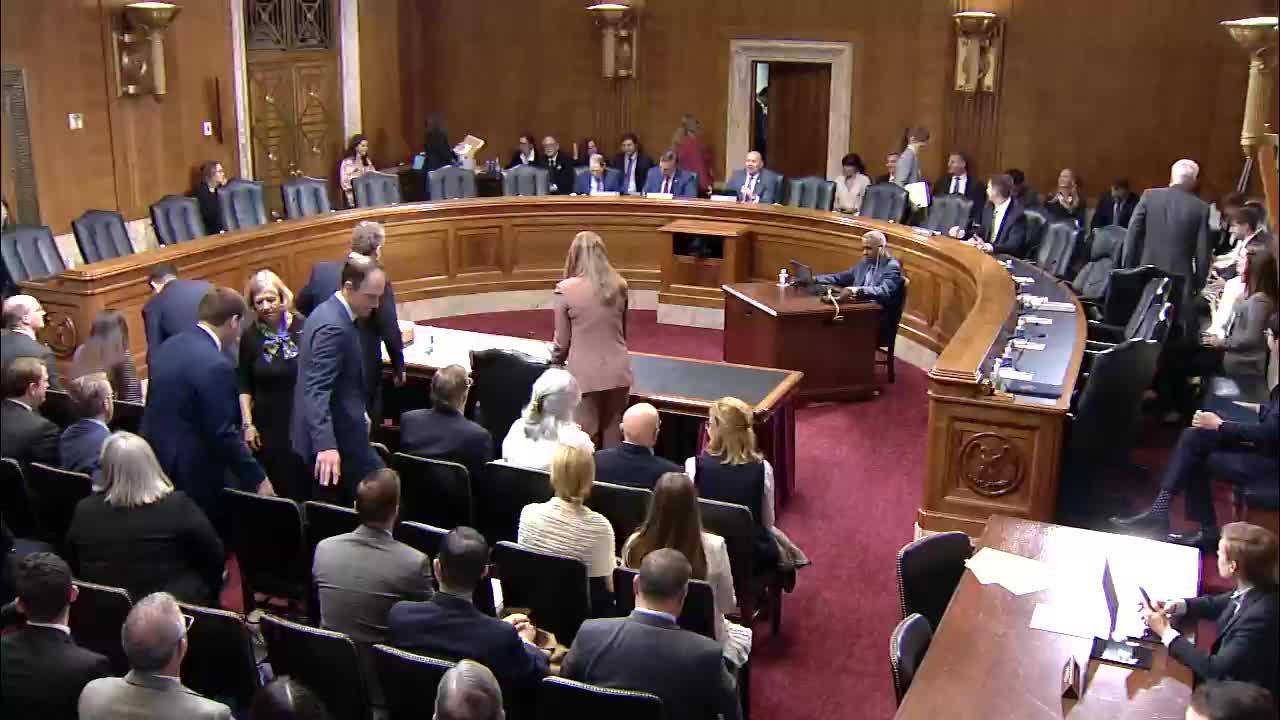
Senate Energy Committee Hears Nominees for Interior and Energy Deputy Posts on Permitting, Labs and Public Lands

2907369 · April 2, 2025

Get AI-powered insights, summaries, and transcripts

Subscribe
AI-Generated Content: All content on this page was generated by AI to highlight key points from the meeting. For complete details and context, we recommend watching the full video. so we can fix them.

Summary

Senate Energy and Natural Resources Committee Chairman Lee convened a confirmation hearing Oct. 12 for two nominees to deputy-secretary posts: Catherine McGregor for the Department of the Interior and James Danley for the Department of Energy.

Senate Energy and Natural Resources Committee Chairman Lee convened a confirmation hearing Oct. 12 for two nominees to deputy-secretary posts: Catherine McGregor for the Department of the Interior and James Danley for the Department of Energy.

Both nominees described management and operational priorities for agencies that oversee large federal workforces, sensitive national-security missions and sprawling public lands. Chairman Lee noted that the deputy secretary role is ‘‘the chief operating officer’’ of the agencies and that their decisions ‘‘will reverberate throughout the American West and of course the nation at large.’’

The hearing focused on a set of recurring themes: permitting reform and transmission bottlenecks for energy projects, the security and access policies of the DOE’s national laboratories, the National Nuclear Security Administration’s production goals for plutonium pits, staffing and maintenance at the National Park Service, and whether department actions will follow federal statutes and court orders.

Catherine McGregor, who previously served as Interior deputy secretary, told the committee she would return to the department to ‘‘drive change and efficiency’’ and to prioritize timely agency action. McGregor said she would ‘‘absolutely’’ work with senators to implement statutes cited by members and pledged to ‘‘obey the law’’ if confirmed. She told lawmakers she would work on staffing for national parks and on implementation of the Great American Outdoors Act and other conservation funding.

James Danley, whose prior service includes roles at the Federal Energy Regulatory Commission, said the Department of Energy must address a shortfall in permitting and generation to meet rapid growth in electricity demand. ‘‘It will be difficult to achieve our goals of assuring affordable, reliable, and secure energy to the American people without tackling the problem of federal permitting,’’ Danley said in his opening remarks. He emphasized that national laboratories and the department’s research mission are central to U.S. technological leadership.

Committee members raised several specific concerns repeatedly. Senator Heinrich warned that DOE is considering canceling or renegotiating awards and contracts and said such decisions ‘‘rests with Congress, not with the president, and certainly not with Elon Musk.’’ Heinrich and others pressed both nominees to commit to following court orders, Congress’s appropriations, and statutory duties.

Senator Wyden and other senators pressed Danley on foreign access to national laboratories. Wyden cited committee findings that ‘‘40,000 foreigners visited these national labs, and fully 1 fifth of those 8,000 were from Russia and China,’’ and asked Danley to act on legislation to tighten research security. Danley agreed to work with Wyden if confirmed, saying he was ‘‘shocked’’ by press reports of large numbers of scientists from adversarial countries working in close proximity to U.S. researchers and that the issue ‘‘has to be dealt with.’’

Lawmakers also pressed Danley on the National Nuclear Security Administration. Senator Wyden asked whether Danley would advocate for resources needed to achieve pit production targets; Danley said he was ‘‘not certain because I am not at the department of energy’’ about the necessary production rate but ‘‘absolutely commit[ted] to doing everything I can’’ to ensure NNSA discharges its mission if he is confirmed.

On public lands and parks, several senators urged McGregor to reverse staffing cuts and address a maintenance backlog tied to implementation of the Great American Outdoors Act. Senator King told her to ‘‘stop cutting people at the national parks and start hiring them.’’ McGregor pledged to work with the committee on staffing and maintenance priorities.

The nominees repeatedly affirmed they would follow the law and cooperate with Congress. When asked by several senators to commit to transparency and to honor statutory notification requirements around reorganizations or reductions in force, both nominees responded that they would ‘‘follow the law’’ and work with congressional offices.

Other topics raised in questioning included the role of DOE in enabling increased LNG exports, support for advanced nuclear technologies including small modular reactors and advanced reactor demonstration programs, supply-chain resilience for uranium and fuel, wildfire management and prescribed burns, housing options on federal land under the Recreation and Public Purposes Act, and regional water issues including the Colorado River. On the specific example of a DOE contract cancellation, Danley said he is ‘‘dedicated’’ to stopping waste, fraud and abuse and that ‘‘every contract that the government signs . . . has to be done in accordance with the law.’’

The hearing concluded with no confirmation vote. Chairman Lee closed the session and directed that written questions for the record be submitted by the committee’s deadline. No formal committee roll-call on the nominations was recorded during the hearing.

The exchange highlighted the operational responsibilities that both deputy-secretary jobs will carry if the nominees are confirmed and underscored several bipartisan priorities — particularly permitting reform, national-lab security, park staffing and wildfire resilience — that senators said will require early attention from the incoming departmental leaders.