Get Full Government Meeting Transcripts, Videos, & Alerts Forever!
Get email alerts on the School Budget topic
No spam. Unsubscribe anytime.
Rockingham staff outline $28.7 million county request and recurring cost pressures for 2025-26 budget
Summary
District finance staff presented a proposed 2025-26 budget draft asking the county for $28.7 million, citing recurring pressures including teacher supplements, classified pay schedule updates, EC shortfalls and one‑time capital and equipment needs.
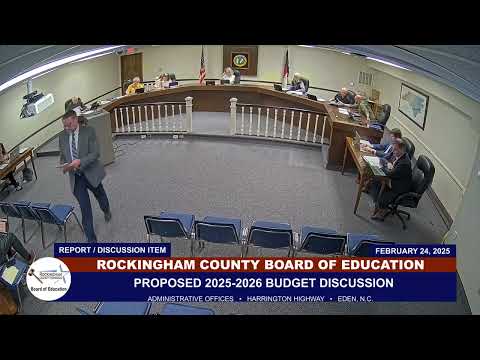
Rockingham County Schools staff presented a revised proposed budget for 2025-26 on Feb. 24 that requests $28.7 million in county funding and highlights recurring and one‑time pressures officials say the district must address.
Annie Ellis, the district presenter, told the board the revised ask to the county totals $28,700,000. She said the district is estimating planning average daily membership (ADM) for state allotments at 10,1985 and anticipates a 3% salary increase for certified and non‑certified staff driven by legislation. Ellis said retirement and hospitalization matching rates are also expected to rise.
Key items the district flagged as requiring local or county support include recurring increases and service needs: a $500 per‑level increase to the local teacher supplement (estimated recurring cost $565,000), an update to the classified salary schedule to reduce step compression (estimated recurring cost $1.9 million), and an exceptional children (EC) shortfall estimated at about $630,000 due to the district’s EC identification rate (19.2%) exceeding the state funding rate (13%).
On one‑time and capital needs, Ellis said the district is requesting $1.5 million to replace teacher and administrative laptops that will reach end‑of‑life, and about $350,000 to replace voice‑over‑IP telephony currently running on Mitel, which the district expects to reach end of life in December 2025. She said the district’s capital outlay fund request totals $20,800,000, but more than $19,000,000 of that represents projects already approved in the five‑year plan and by the board and county commissioners.
Other items called out in the presentation included: • A $595,000 gap for instructional resources previously paid with expiring ESSER funds; if funding is not identified some subscriptions and services may not be renewed. • An inflation request of roughly $373,000 tied to a 3% increase applied to $12,000,000 of non‑salary object codes (utilities, contracted services, supplies). • Funding to retain two pre‑K classrooms (estimated $264,000) to avoid further closures that the district said were possible without local funds. • Estimated CCP (career and college promise) textbook access codes and midday transportation expenses (textbook access codes ~$25,000; transportation costs additional). • A one‑time $75,000 request to furnish and equip an approved CTE Innovation high school pending state biennial budget approval (the district cited that final approval of recurring funding remains contingent on the General Assembly).
Ellis told the board that DPI planning allotments are expected to post next week and that the district will refine the proposed budget then. She said the finance committee will meet March 6 to review changes and that the board expects to present a full proposed budget at the March 17 meeting so the district can transmit it to county commissioners by March 18.
Why it matters: the package includes several recurring personnel costs that would add to the district’s base obligations, and the district said it intends to avoid appropriating fund balance if possible. The board and county commissioners must negotiate funding levels before the budget is finalized.
What was not decided: the board heard the presentation and asked clarifying questions; no formal funding decisions were made at the Feb. 24 work session. The district emphasized uncertainty in state allotments and urged community review of the detailed budget documents posted online.
Clarifying figures: Ellis provided itemized estimates and said the $20.8 million capital amount largely reflects previously approved projects; the local request and expansion items are the updated parts of the proposal. DPI allotments and legislative decisions could change the final numbers.
Next steps: DPI planning allotments, refinements by staff after those postings and a finance committee review in early March. The board anticipates a March 17 vote on the proposed budget for transmission to county commissioners.