Get Full Government Meeting Transcripts, Videos, & Alerts Forever!
Get email alerts on the Urban Forest Tree Preservation topic
No spam. Unsubscribe anytime.
Evanston committee pauses decision on private-property tree-variance rule, seeks clearer standards
Summary
The Human Services Committee heard staff and residents debate a new private-property tree preservation ordinance and a homeowner'initiated variance request before voting to table formal action while staff develops clearer standards and comparative data.
The Evanston Human Services Committee on April 7 paused action on a homeowner'initiated variance under the city'wide tree preservation ordinance and asked staff to develop clearer standards and comparative data before the committee decides.
The committee opened a staff presentation on the ordinance from Angela La Vernier, the city's tree preservation coordinator, who described the rules and goals behind the measure. La Vernier summarized the ordinance's intent: "The Climate Action Resilience and Resilience Plan, of course, was passed in 2018, which has an urban canopy and green space action," and said the ordinance treats trees as long'term infrastructure requiring canopy preservation.
The discussion focused both on how the city processes removal requests and on one homeowner'led appeal. La Vernier described the two permit paths: removals tied to building permits are reviewed as part of construction review, and stand'alone removal permits can be processed by the city arborist; if a tree is not dead, diseased or hazardous, an applicant may appeal to the Human Services Committee. She told the committee the city receives roughly "about 250" tree removal permit requests a year and that "probably 10 or 15" of those have been denied; only two variance applications had been submitted so far.
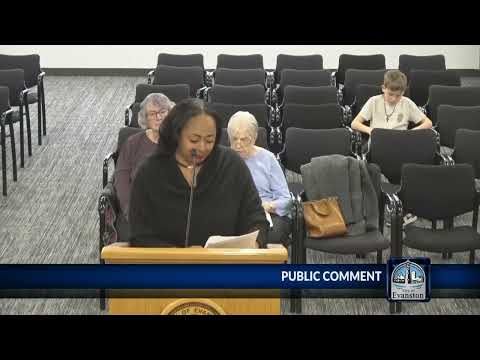
A homeowner who identified herself as Christina described a volunteer elm on her property that she said now leans roughly "at, like, a 45 degree angle" toward her neighbor's garage. She said she had replanted other trees on the lot and asked that the committee allow removal before the tree grew larger and posed higher future costs.
Committee members and staff pressed for more data and a more objective rubric to guide future decisions. Council member Harris cited insurance-related claims and rate increases some residents have reported and asked whether a city assessment can be used by homeowners to contest insurer decisions. La Vernier recommended a paid tree risk assessment as a common next step and offered to collect local price estimates for the committee. She also said the city treats street elms on a regular schedule: "The city treats their their elm trees every year, every 2 years," adding that cultivars vary in resistance to Dutch elm disease.
Committee members asked staff to compare experiences and rules with neighboring North Shore communities, to produce a side'by'side rubric or checklist for variance submissions, and to return with cost estimates for independent risk assessments. After extended discussion about committee authority, appeal routes and timing, the committee voted to table HS3 (the tree'protection variation request under Ordinance 15 O 23) to the next regular Human Services meeting so staff could provide the requested materials.
The committee and staff also discussed procedural pathways if the committee were split on a variance: a denial could be appealed to the city manager within five days and then to City Council.
The committee set expectations that the next packet should include a proposed rubric, permit and variance counts, and comparisons with neighboring municipalities to guide consistent decision making.