Get Full Government Meeting Transcripts, Videos, & Alerts Forever!
Get email alerts on the Landscaping Ordinance Tree Canopy topic
No spam. Unsubscribe anytime.
Fluvanna planning commission reviews landscaping ordinance and new state tree-cap fund option
Summary
At a work session, Fluvanna County planning commissioners and staff reviewed the county's landscaping and tree-protection rules, state code requirements for minimum tree canopy, the newly authorized local "tree canopy fund" under House Bill 2630, and community concerns about timbering and buffer enforcement on rezoned properties.
Fluvanna County planning commissioners at a work session reviewed the county's landscaping and tree-protection ordinance and discussed how recent changes to the Code of Virginia and a new state-authorized tree canopy fund could affect local development and enforcement.
The discussion centered on the county's Chapter 22-24 landscaping provisions, existing requirements for buffers and tree-canopy retention on new development, and a March state law amendment (House Bill 2630) that authorizes localities to establish a tree canopy fund as an optional tool for developers who cannot meet on-site canopy requirements.
Planning staff summarized the county code's current requirements: developers must provide landscape plans with major site plans, meet minimum plant-material standards, and preserve tree canopy and riparian protection areas in many situations. The county's ordinance already includes several of the percentage canopy targets that appear in state law: 10% for business, commercial or industrial sites; 10% for high-density residential (20 or more units per acre); 15% for mid-density residential (more than 10, fewer than 20 units per acre); and 20% for lower-density residential (10 units per acre or less). Staff also noted a separate county standard that expects a minimum 30% existing tree canopy in recorded open space for some residential subdivisions.
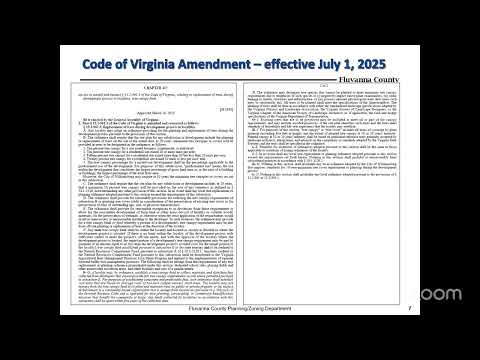
Officials highlighted the new option created by House Bill 2630, effective July 1, 2025, that permits localities to create a tree canopy fund. Under that option, developers who cannot meet full on-site tree-canopy requirements could pay a fee—calculated using standardized cost units tied to typical nursery-stock prices—into a local fund. Localities may use fund monies to plant and maintain trees on public or private property or to disburse grants to qualifying community organizations for tree-planting and stewardship. The statute also requires that funds be spent within five years of collection.
Commissioners and members of the public raised implementation and enforcement questions. Several commissioners asked how proffers and voluntary agreements made during rezoning and community meetings are enforced; staff noted that only written, signed proffers recorded with rezoning approvals are enforceable and that landscape bonds have been used in the past to require replanting when developers fail to meet landscape obligations. Commissioners asked staff to verify specific buffer widths and whether existing buffers remain in place on recently timbered or rezoned properties.
The commission discussed other tools besides proffers and the tree canopy fund, including potential entrance-corridor or highway-overlay zones that could require consistent buffers, berms, plantings and architectural treatments along key routes. Members asked staff to prepare sample overlay language and to return suggested ordinance amendments that would add mixed-use canopy percentages and otherwise update the county code to reflect more recent state changes.
Staff and commissioners agreed to follow up: staff will provide the requested samples and suggested amendments, check on specific properties cited by residents to confirm whether recorded buffers remain, and bring the tree canopy fund option back for further consideration.
Despite community concern about timbering and perceived erosion of buffers on some parcels, no formal action or vote occurred during the work session; the meeting recessed to a regular planning commission meeting at 7 p.m.