Get Full Government Meeting Transcripts, Videos, & Alerts Forever!
Get email alerts on the Land Use Development topic
No spam. Unsubscribe anytime.
LPA backs Arches Bayfront Resort; recommends companion future‑land‑use change after weeks of debate
Summary
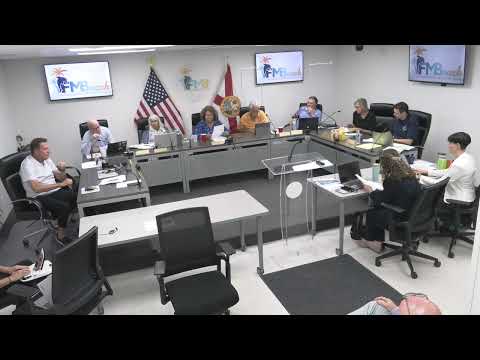
The Fort Myers Beach Local Planning Agency voted unanimously April 8 to recommend approval of the Arches Bayfront Resort commercial planned development and a companion small‑scale change to the town’s future‑land‑use map, provided the applicant accept a list of conditions limiting amplified outdoor sound and adding larger buffers, drainage and emergency‑access requirements.
The Fort Myers Beach Local Planning Agency voted unanimously on April 8 to recommend approval of the Arches Bayfront Resort commercial planned development (CPD) and a companion small‑scale comprehensive‑plan map amendment to change about 4.53 acres from marina / mixed residential to pedestrian commercial. The decision follows hours of testimony from the applicant, town staff and more than two dozen residents and business owners who spoke at the hearing.
City planners and the project team told the LPA the proposal replaces a damaged marina site with a mixed‑use resort anchored by a bayfront promenade, expanded marina slips, hotel lodging, restaurants, a small market, an event chapel, and a linear public park. “I truly believe in my heart that this is the most significant project before us post hurricane,” planner Patrick Venas told the agency during the applicant’s presentation, calling the project a potential catalyst to revitalize downtown and boost visitor spending.
Why it matters: the land‑use change being recommended would allow a denser, mixed‑use redevelopment at the edge of downtown that the applicants say will restore waterfront access, add public space and generate tax and job benefits. Town staff and some neighbors warned that the proposal also raises risks for adjacent single‑family neighborhoods — principally noise, traffic and the loss of the lower‑intensity marina buffer that existed before the storm. Staff recommended denial of the plan change unless the CPD’s design and mitigation commitments were strengthened; the LPA ultimately recommended approval on condition the council adopt a package of limits and enforceable commitments.
The proposal and public concerns: The applicant is seeking a CPD with several deviations from the land‑development code, including a requested increase in maximum floor‑area ratio (FAR), a conversion factor to allow lodging unit equivalency, and a taller maximum building zone of up to 81 feet (102 feet above grade at the highest point). The applicant’s team said they reduced the original concept — once proposed at about 400 lodging units — to roughly 263 lodging units and redesigned massing so buildings step down toward the canal and provide 30–50‑foot vegetated buffers along the neighborhood edge.
Town staff recommended denial of the map amendment, citing the potential for increased nuisance impacts where commercial uses would abut single‑family homes, and asked for stricter, enforceable mitigation. The LPA deliberated on a compromise: it recommended approval of the CPD and of the map change, but only after the applicant and staff agreed to a set of conditions and commitments intended to reduce noise, limit late‑night amplified sound and create substantial landscaping buffers.
Key conditions the agency attached to its recommendation include: limiting amplified/“ambient” music at certain outdoor decks (applicants agreed to ambient‑only sound on a prominent sunset deck, with music ending each night by 9 p.m.); removing an outdoor consumption‑on‑premises (COP) area originally proposed at one small, canal‑side pool deck; enhanced vegetated buffering (larger initial tree sizes and expanded plantings) between the resort and adjacent homes; requirements that back‑of‑house service, deliveries and major vehicle access be routed away from small residential streets; a stabilized emergency access/travel surface between Harbor Court and Bonita Street; and a condition that the rezoning recommendation be contingent on approval of the small‑scale comprehensive plan amendment by the town council.
Traffic, parking and ferry commitments: The applicants proposed multiple traffic mitigations, including a dedicated shuttle/airport transfer, a drop‑off and taxi staging area, bicycle and golf‑cart parking, and a planned ferry/water‑taxi terminal. The CPD would also expand the marina slips (the application moves the site from roughly 55 slips to about 70). The LPA and staff disagreed about the parking deviation requested by the applicant: staff argued a smaller reduction should be applied, while the applicant maintained the walkable, mixed‑use plan and proposed shared parking would suffice. The LPA’s approval recommends that the applicant perform a post‑occupancy parking study to evaluate whether additional public commercial spaces can be made available if demand allows.
Public testimony: Dozens of nearby homeowners spoke at the hearing. Several residents across the canal in Matanzas Court and along Bonita Street and Harbor Court urged the agency to deny the land‑use change unless buffering and noise controls were firmed up. “Building E is a huge problem,” one resident said, warning balconies and pool decks would look directly into back yards. Neighbors also raised long‑standing drainage and emergency vehicle access concerns. Supporters — including local business owners and some community leaders — said the project is the kind of private investment the island needs to restore tourist activity and support small businesses in the downtown core.
What’s next: The LPA recommendation goes to the town council. Council will consider the CPD rezoning and the small‑scale comprehensive plan amendment as separate but related legislative decisions. The LPA captured a list of conditions and asked the council to require a separate, enforceable agreement for commitments that are not readily implemented through zoning (for example, capital funding for passenger ferry facilities). The applicant said it is prepared to negotiate binding language and to submit final engineering, landscape and drainage detail as part of the development‑order process.
Ending: The LPA’s vote was unanimous. Several commissioners said the decision reflected careful balancing of the town’s redevelopment objectives with neighborhood protections. As the council review proceeds, staff and the applicant will need to convert the LPA’s conditions into enforceable permit and agreement language that can be applied if the council approves the map amendment and rezoning.
Speakers quoted (selected)
- “I truly believe in my heart that this is the most significant project before us post hurricane,” — Patrick Venas, planner for the applicant. - “The reduced parking may impact nearby single family homes through increased traffic and illegal parking of customers as they search for parking,” — Judith Frankel, Town of Fort Myers Beach, Community Development. - “We will work with the town on a separate agreement for capital investments such as a ferry terminal,” — Megan Strayhorn, attorney for the applicant. - “I would ask the applicant to dig deeper on storm drainage — Harbor Court and Third Street flood during routine rains,” — Chris Mostero, nearby property owner.
Speakers (selected, attribution whitelist)
- Patrick Venas — planner, The Neighborhood Company (applicant’s planner). - Ken Gallander — planner, The Neighborhood Company (applicant’s planner). - Megan Strayhorn — Attorney, counsel for Freeland Florida Holdings LLC (applicant). - Ben Freeland — property owner/representative, Freeland Florida Holdings LLC (owner/applicant). - Judith Frankel — Principal Planner, Town of Fort Myers Beach (staff). - Nancy — Chair, Fort Myers Beach Local Planning Agency (presiding official). - David Lay, Robin Atwood, Chris Mostero, Jay and Dale Bonema, Linda Miller, Terry Prasad, Leah Gregg, others — residents and business owners who testified during public comment.
Authorities cited in the hearing (excerpted)
- Fort Myers Beach Comprehensive Plan (policies cited: 4 C 10; 4 C 4; 3 D — downtown/Times Square guidance). - Fort Myers Beach Land Development Code (examples cited in staff report: §34‑85, §34‑216, §34‑670–676, §34‑303, §34‑430, §34‑476)." ,