Get Full Government Meeting Transcripts, Videos, & Alerts Forever!
Get email alerts on the School Budget topic
No spam. Unsubscribe anytime.
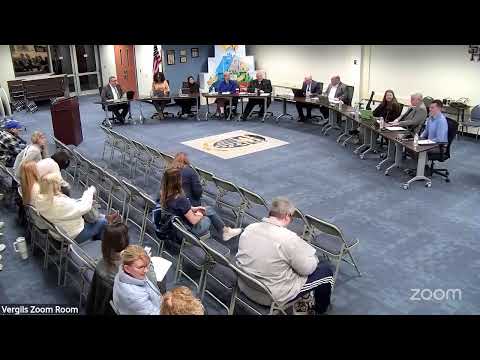
Sweet Home proposes $105.6 million budget for 2025–26; tax levy set at 0.4% tax-cap limit
Summary
District officials presented a balanced 2025–26 spending plan that relies on $3.75 million in additional state aid, federal and state grants for four electric buses, a small rise in sales tax revenue and $350,000 from reserves; board will vote to adopt the budget April 22 and the public vote is May 20.
Sweet Home Central School District officials presented a proposed $105,576,012 budget for the 2025–26 school year during a budget study session, projecting a 5.1% increase over the current year and a local tax levy of $54,486,660 (a 0.4% increase tied to the district's tax-cap calculation). Dr. Genestri introduced the session and Mr. Feldman led the financial presentation.
The nut of the plan is that the district expects roughly $3.75 million in additional state aid (foundation and expense-driven aid) plus $660,000 from an inclusive UPK special-education grant; those increases, together with higher projected sales tax receipts, produce a net revenue gain of about $5.4 million. "We do estimate revenues of $105,576,012," Mr. Feldman said, adding the estimate represents a 5.1% budget-to-budget increase.
Why it matters: the budget sits up against the state's unfinished budget process. District officials said they plan to adopt the budget with or without a finalized New York State budget on April 22 and must submit a property tax report card by April 28; the required public hearing is scheduled for May 6 and the annual budget vote and board election for May 20 in Virgil Center. Mr. Feldman said the district is working from executive-run state-aid estimates and will adjust if the final state budget changes aid amounts.
Key revenue and expense drivers: the district reported a small tax-cap room (0.4%, about $218,590) because recent capital projects increased its building aid, which lowers tax-levy capacity. Sales tax receipts are trending higher than budgeted, with a third-quarter payment of about $1.4 million and an annual projection toward $5.55 million (the 2024–25 budget had conservatively budgeted $5.1 million). On the expense side, salary increases across bargaining units (roughly $1.4 million), rising special-education tuition and costs, larger BOCES service purchases (about $502,000 up), contracted transportation increases and a $1 million increase in employee benefits were flagged as principal cost pressures.
Buses and grants: the presentation included a planned purchase of four large electric buses, one large diesel and one small diesel at a net cost of $1,077,000, with an expected $950,000 in offsetting grant funding from the U.S. Environmental Protection Agency and the New York State school-bus incentive program. Mr. Feldman noted supply-chain and trade risks: the steel used in manufacturing may be subject to a Canadian steel tariff that could increase costs by about 25% if enacted. The administration said it would consider signing a letter of intent to purchase buses after the board adopts the budget.
Budget process and next steps: the board was reminded that petitions for two open board seats are due to the district clerk on April 20, that the board must adopt the proposed budget by state law (deadline April 25), and that the budget will need only a simple majority to pass if adopted within the tax-cap parameters. Dr. Genestri and Mr. Feldman said they will continue to monitor state-aid runs, finalize UPK rate-setting with NYSED and confirm final health-insurance numbers before the April 22 board adoption vote.
Board discussion and community impact: board members asked about charter-school tuition and out-of-district placements, which the administration said are largely driven by student counts and external rate-setting rather than district control. The district projected sample tax-bill impacts under current assessments: on a $250,000 assessed home, Amherst residents would see an estimated $7 increase; Town of Tonawanda residents, $9 (figures use current assessments and will be revised when next year's assessments are final).
Ending: the board will consider final adoption April 22; the administration cautioned the figures remain partly contingent on the state budget and on final aid runs.