Get email alerts on the County Finance topic
No spam. Unsubscribe anytime.
Wakulla County finance staff warn short-term borrowing and policy changes will be needed if both Opportunity Park projects proceed
Summary
County finance briefed commissioners that short-term construction borrowing and later long-term financing would likely be required if the two prospective projects move forward; staff recommended updating the county's debt-per-capita guidance and adding the projects to the JPMorgan borrowing list.
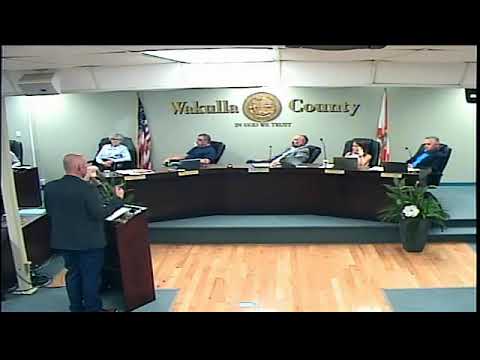
WAKULLA COUNTY, Fla. — County finance staff told commissioners at a workshop that, if both Project Boomer and Project Safety proceed as currently estimated, Wakulla County would likely use short-term construction borrowing to build tenant-ready buildings and later convert a portion of that borrowing into long-term debt.
Greg (county finance staff) said the county’s existing debt policy sets an aspirational guideline of $500 per resident (adjusted for inflation), which currently equates to about $671 per resident; the county’s short-term borrowing related to implementation of grant-funded projects has already driven the county near that guideline, he said.
Why it matters: presenters said the county must be able to cash-flow large grant-funded capital projects while awaiting reimbursement. Staff reported the county has a $90 million short-term borrowing authorization with JPMorgan for grant cash flow; $30 million was previously borrowed and repaid, and another tranche has been used for grant projects. Staff said the county will likely need to extend or expand the short-term borrowing authorization and add the two Opportunity Park projects to the borrowing list if it wants to proceed quickly.
Numbers discussed Finance staff presented illustrative totals: combined construction estimates presented by EDC staff were roughly $42 million before grant reimbursements; staff said the county could face a long-term financing need (converted from construction borrowing) in the range of $14 million to $22 million, depending on final grant awards and reimbursements. The finance office described one prior short-term borrowing: a $30 million draw that cost about $1.8 million in interest and fees; the county offset some borrowing cost by investing the proceeds and earned about $900,000, leaving a net cost that staff said was near 1.5% for that tranche.
Policy and process items County staff said the short-term borrowing shows as short-term debt on county financial statements and must be accounted for in the county’s debt-per-capita calculations. Officials recommended the board consider updating the debt-per-capita target in the debt policy to reflect current financing needs tied to grant-funded capital projects and authorized the finance office to return with exact amortization scenarios once grant awards are finalized.
No formal vote No formal vote or contract authorization occurred in the workshop. Finance staff said the county would need to add projects to the JPMorgan borrowing list and possibly expand the existing short-term program; those steps and any long-term bond issuance would return to the commission for formal approval.
Provenance The county finance briefing and Q&A about JPMorgan short-term borrowing and debt-per-capita calculations occurred near the end of the workshop, after presentations on the projects and workforce training (transcript excerpt: “Your debt policy calls for $500 per citizen per capita... As we stood on March 31, we're currently at right at $619 per capita…”).
AI generated
The text on this page is AI generated. Summaries, highlights, analysis, and video transcripts are all produced from the original source material.
AI can make mistakes, so if you spot one, and we will fix it for everyone.
Note: the source content is unaltered by us. Any content source we link to, be it a video, an audio recording, or a document, is presented exactly as its publisher released it. That publisher is usually a government body, sometimes an individual official or another organisation.