Get Full Government Meeting Transcripts, Videos, & Alerts Forever!
Get email alerts on the Transportation Us98 topic
No spam. Unsubscribe anytime.
Consultants outline smart-regions plan and technology options to ease congestion on U.S. 98
Summary
Kimley‑Horn planners presented the Emerald Coast Regional Council’s Smart Regions plan and recommendations for lower‑cost technology fixes and grant opportunities to reduce crashes and delay at the U.S. 98 / Stalman Avenue corridor.
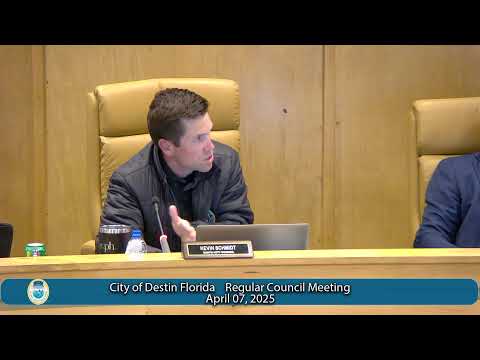
A consultant team working with the Emerald Coast Regional Council on the Smart Regions plan explained April 7 how technology and targeted infrastructure could reduce crashes and long delays on U.S. 98 through Destin.
Lindsay Slaughterback, a transportation planner with Kimley‑Horn, said the Smart Regions work aims to “promote efficiency and safety” across the region and help jurisdictions prioritize investments. Jared Wall, a Kimley‑Horn civil engineer, described lower‑cost technology options the city can deploy before pursuing heavy capital projects.
The presenters highlighted U.S. 98 and the Installment Avenue / Stalman Avenue area as a regional bottleneck with persistently low travel speeds at peak periods and a high crash history. Wall said probe‑based travel‑speed data for a recent March period showed westbound speeds at the intersection falling to roughly 10 mph in the late afternoon and that, over five years, police crash records show 112 crashes near the intersection with a majority of rear‑end collisions.
Kimley‑Horn recommended a range of measures that can be less expensive than full roadway reconstruction: revised signal timing, traffic‑responsive signal systems, queue‑warning systems, pedestrian hybrid beacons and improved pedestrian lighting, passive and active bicycle detection, automated traffic signal performance measures and traveler‑information systems. The team noted the location is eligible for the federal Safe Streets and Roads for All competitive grants, which have an open solicitation through June.
Council members pressed on timing and cost. Councilman Dessen asked how fast the city could deploy a monitoring/response system; Wall estimated vendor procurement and equipment installation could take roughly six to nine months after a contract is awarded and described those systems as “tens of thousands” of dollars rather than the hundreds of thousands typical for capital projects. Councilman Bagby and others discussed using county surtax funds as a local match for larger grant applications; Kimley‑Horn noted Safe Streets grants often require a 20–25% local match and offered to assist with applications.
Several council members raised operational questions the consultants could not answer on the spot, including whether the county or city would retain signal control and how pedestrian push‑button timing could be adjusted. Kimley‑Horn said most adjustments (longer pedestrian phases, detection configuration) are achievable with the city or county’s existing signal equipment, but some solutions—active monitoring and CCTV—require additional staffing or a traffic‑management center to operate in real time.
The presentation concluded with an offer from Kimley‑Horn to provide follow‑up, grant‑writing assistance and a deeper corridor study if the council directs staff to pursue grant funding or pilot technologies.