Get Full Government Meeting Transcripts, Videos, & Alerts Forever!
Get email alerts on the Vacant Buildings topic
No spam. Unsubscribe anytime.
Winnsboro expands vacant-building rules citywide, council approves ordinance
Summary
Council repealed a 2015 downtown-only vacant-building ordinance and approved a citywide replacement intended to register and charge owners of long-empty commercial properties, with staff saying the change aims to recoup lost sales-tax revenue and limit blight.
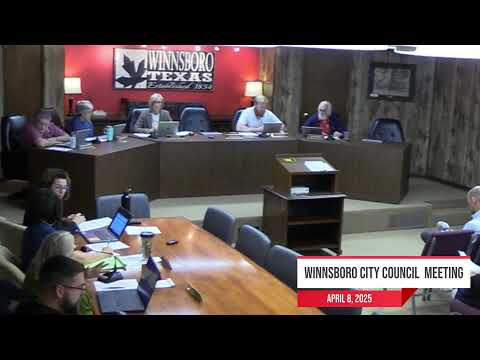
Winnsboro city council on May 1 approved Ordinance 10 84-2025, repealing Ordinance 9 24-2015 and amending Chapter 3 of the city code to establish citywide vacant-building regulations. The ordinance expands the existing downtown-only rules to the entire city and requires registration and periodic charges for qualifying vacant commercial buildings.
City staff told the council the goal is to reduce the fiscal and neighborhood impacts of long-term vacancies. “Basically, we believe there's approximately 30 vacant buildings,” said Tanya (city staff), who presented the draft ordinance and conservative revenue estimates based on sales tax only. Staff said the ordinance would not capture property-tax losses but could recover some sales-tax revenue depending on future occupancies.
Under the new rules, staff said a building is presumed vacant when lawful uses appear to have ceased for more than 90 days. Owners would have 90 days after vacancy to actively market, obtain an active renovation permit or otherwise demonstrate activity that removes the presumption. Tanya summarized the effect: “If you have a vacant building in the sense that there's nothing in it, but you have a utility account for it, it's not vacant.”
Council members pressed staff on definitions and fee structure during the discussion. Councilman Borman asked what constitutes vacancy; staff pointed to the ordinance definitions, which include inactive utility accounts, storage-only use, failure to actively list for sale at market rates and unsecured structures. Staff noted the ordinance uses a single, nominal quarterly charge rather than a square-foot graduated scale used in other cities.
Supporters of the ordinance argued vacant buildings reduce foot traffic and shift the tax burden to operating businesses. Tanya provided sample revenue scenarios: at a conservative $100,000 annual sales estimate per reopened business the city would recover roughly $22,500 in sales-tax equivalent at the low end; at $500,000 annual sales the estimate rose to about $112,000. Staff cautioned these were illustrative ranges, not firm projections.
The council voted to approve the ordinance. No individual roll-call tally was recorded in the meeting transcript; the motion was carried by voice vote.
The ordinance replaces the downtown-limited vacant-building rules and requires owners to register qualifying properties, adopt standards for proof of active marketing or renovation, and pay a quarterly charge if conditions are met. The council and staff said the new code aims to limit dilapidation and encourage reuse without imposing excessive fees on small properties.
Implementation steps and timelines were not detailed at the meeting; staff said additional clarifications appear in the ordinance text and that enforcement would follow the code-change adoption.
Proponents and staff said the change is intended to improve downtown and citywide commercial viability and to remove disincentives for private investment.
Topic provenance: meeting transcript discussion and final motion on Ordinance 10 84-2025 were recorded during agenda item 7.4 and the subsequent vote.