Get Full Government Meeting Transcripts, Videos, & Alerts Forever!
Get email alerts on the International Strategy White Hydrogen topic
No spam. Unsubscribe anytime.
French energy adviser outlines France's hydrogen strategy and reports discovery of large "white hydrogen" resource
Summary
A senior adviser from France's foreign ministry agency described France's France 2030 program, nuclear-backed "pink" hydrogen ambitions and a recent discovery of naturally occurring "white hydrogen" that French researchers estimate could be large enough to affect national supply.
Emmanuel Henriette, senior energy adviser for the French government's international energy program, briefed the task force on France's national hydrogen strategy, the role of nuclear-generated electrolytic ("pink") hydrogen and recent research identifying natural or "white" hydrogen resources.
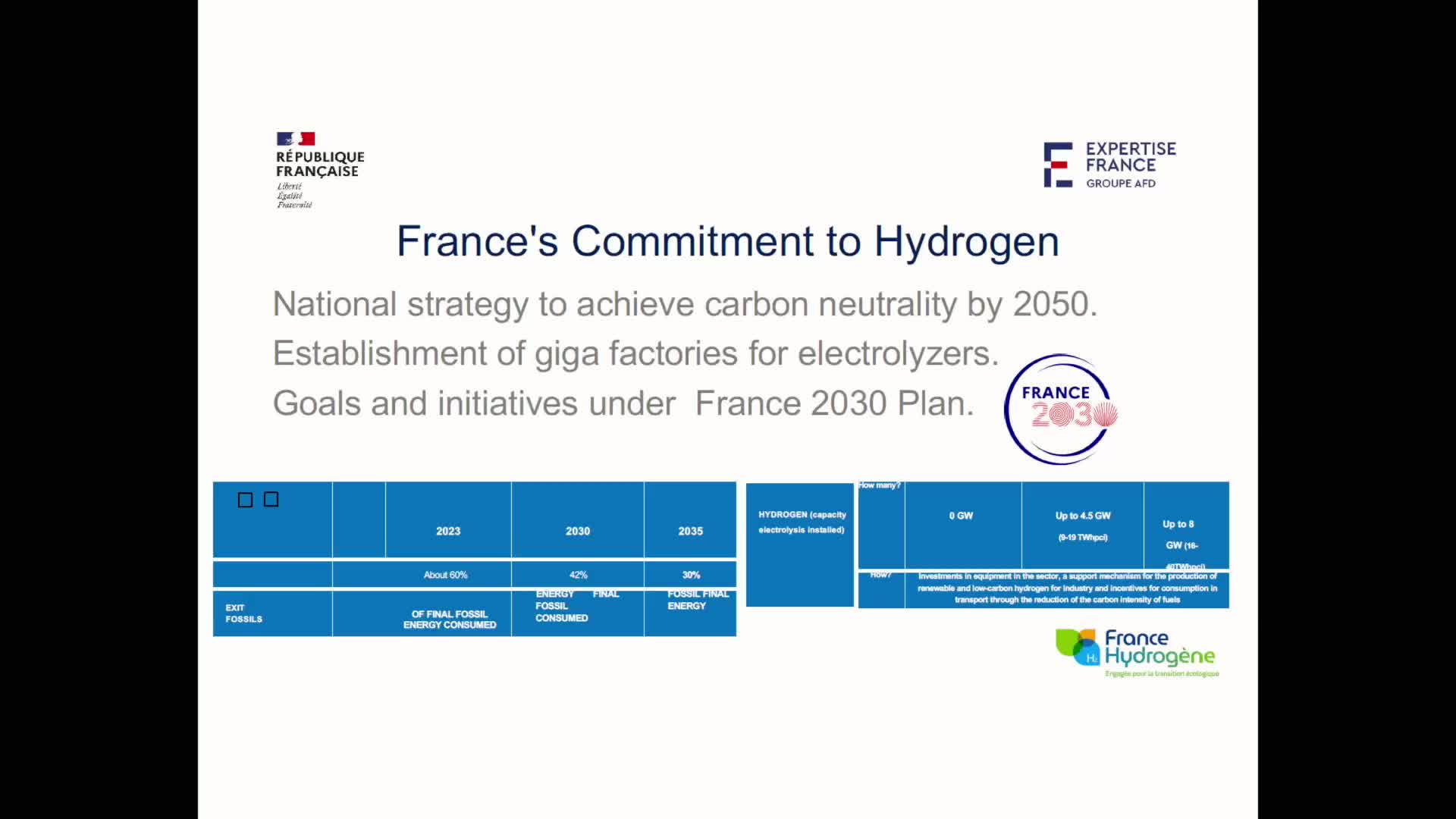
Henriette described France 2030, a national plan launched to support industrial decarbonization and new energy sectors, and said nuclear power remains central to France's electricity mix. "France set a plan which we called France 2030," he said, noting France generates a large portion of its power from nuclear reactors and is investing in electrolyzer manufacturing and low-carbon hydrogen supply chains.
Henriette said French researchers recently identified a significant natural hydrogen resource in subsurface geological strata and cited a published estimate of roughly 46,000,000 tons of natural hydrogen in an area under study. He called that discovery potentially significant for France's long-term hydrogen supply and said extraction, transport and storage are the principal technical and regulatory challenges.
Henriette described several hydrogen pathways under development in Europe: green hydrogen from electrolysis powered by renewables, pink hydrogen from low-carbon nuclear electricity, blue hydrogen from fossil reforming with carbon capture, and naturally occurring white hydrogen. He said applications include heavy transport, port operations, industry (steel, cement) and energy storage.
Why it matters: France's approach highlights a national strategy linking low-carbon electricity (including nuclear) to electrolytic hydrogen manufacturing and industrial decarbonization. The announcement of substantial natural hydrogen finds in France illustrates the range of supply-side options that governments are assessing worldwide.
Henriette asked the task force to consider international collaboration on materials, storage and funding for hydrogen projects. He said France is working with private-sector and research partners on electrolyzer manufacturing, and asserts that international knowledge-sharing on storage, materials and regulatory frameworks will accelerate deployment.