Get Full Government Meeting Transcripts, Videos, & Alerts Forever!
Get email alerts on the Hydrogen Pipeline Safety topic
No spam. Unsubscribe anytime.
Air Products details Gulf Coast hydrogen pipeline network and safety practices; explains material differences with natural gas lines
Summary
Air Products told the task force it operates the largest hydrogen pipeline network on the U.S. Gulf Coast, described safety and integrity-management practices, and explained the material-selection and pressure differences between hydrogen and natural-gas pipelines.
Air Products representatives gave a technical briefing on hydrogen pipeline safety, the company's Gulf Coast system and how hydrogen pipelines differ from natural-gas lines.
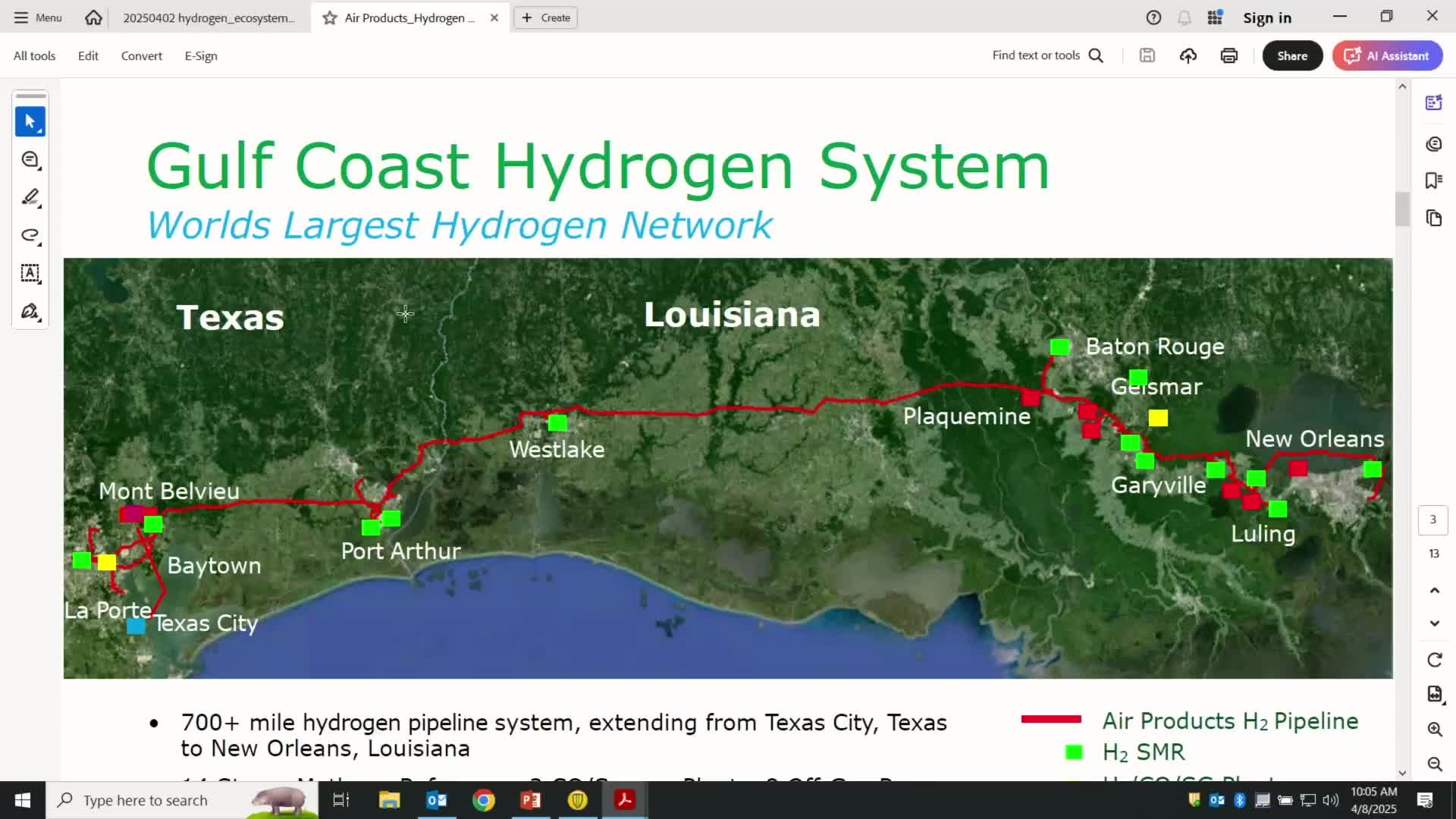
Stanley BME, government relations and community engagement for Air Products Louisiana, and Clayton Spencer, project director, outlined company assets and safety practices. Spencer said Air Products "currently operate[s] the world's largest hydrogen pipeline network with well over 700 miles of hydrogen pipelines that spans from New Orleans all the way to Baytown, Texas." He identified South Louisiana as the region with the greatest concentration of that network.
Spencer said safety is core to design and operations: "Safety is not a consideration. Safety is a requirement for us." He described the company's engineering steps, including flow-assurance and hydraulic modeling for steady and transient states, stress analysis, material selection and integrity management.
Key operational safeguards Air Products described: - Cathodic protection systems and sacrificial anodes to prevent external corrosion. - Alternating-current mitigation when pipelines run in close parallel to high-voltage lines, typically applying copper wire or zinc ribbon to the trench when needed. - In-line inspection ("pigging") programs and post-construction cleaning and drying prior to service. Spencer said PHMSA-regulated gas lines generally undergo integrity assessment by in-line inspection at seven-year intervals; for hazardous-liquid pipelines the transcript cited a five-year integrity interval under the same federal framework. - A centralized SCADA monitoring system tied to a staffed control center to detect upsets and dispatch field response; Spencer said response times for suspected releases are typically measured in minutes rather than hours.
On materials and pressures, Spencer said hydrogen pipelines are generally built with lower-strength steel grades than some natural-gas lines to limit hydrogen embrittlement risk. "We will not exceed API 5L X52," he said, adding that higher-strength grades are more prone to hydrogen-induced cracking. Because design grade is lower, hydrogen pipelines often use greater wall thickness. Spencer said typical hydrogen maximum allowable operating pressures in the company's system are around 1,000 psi, while natural-gas systems commonly operate at different pressure regimes and larger diameters.
Air Products also said routing decisions balance constructability, population density and existing utility corridors. Clayton Spencer summarized a common misconception about routing: "we route a pipeline to protect the pipeline from the people," noting third-party excavation damage is a leading cause of failures.
Spencer said Air Products developed an intelligent inline-inspection tool adapted for hydrogen and holds patents for that technology. He also said the company has not operated hydrogen pipelines as common carriers and has not invoked eminent-domain authority on hydrogen lines.
Why it matters: pipeline routing, materials and operating practices shape risks and costs for any expanded hydrogen network. Air Products urged attention to integrity management, material selection and coordinated permitting and rights-of-way planning as hydrogen use grows in the Gulf Coast.
Task force members asked follow-up questions about construction costs, AC mitigation distance thresholds (Air Products cited typical concern within about 15'0 feet for high-voltage parallel runs), and horizontal directional-drill crossings under the Mississippi River. Air Products said HDD crossings require careful geotechnical work and that prior river crossings were completed by horizontal directional drilling in the 1970s and 1980s.