Get Full Government Meeting Transcripts, Videos, & Alerts Forever!
Get email alerts on the Cdbg Capital Hud topic
No spam. Unsubscribe anytime.
Pasco planning commission approves 2024 CAPER and forwards report for city manager signature and HUD submission
Summary
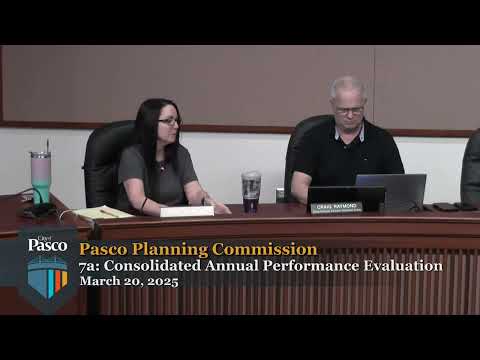
The Pasco City Planning Commission held a public hearing on the 2024 Consolidated Annual Performance and Evaluation Report (CAPER), discussed CDBG spending priorities and administrative costs, and voted unanimously to forward the CAPER for city manager signature and submission to HUD.
The Pasco City Planning Commission on Tuesday heard a presentation of the 2024 Consolidated Annual Performance and Evaluation Report, or CAPER, detailing how federal Community Development Block Grant and related funds were spent and voted unanimously to forward the report for the city manager’s signature and submission to the U.S. Department of Housing and Urban Development (HUD).
The CAPER presentation summarized 2024 CDBG allocations and outcomes and explained next steps required by HUD. “The consolidated annual performance and evaluation report, which we call the CAPER, is a federally required document that reviews how HUD funds were used over the past year,” city staff member Miss Webb told the commission, linking the document to HUD reporting and the agency’s Integrated Disbursement and Information System (IDIS).
Commissioners asked about administrative costs, long-term obligations from Section 108 loans, and HUD income categories for eligible beneficiaries. Webb said administration and planning costs for 2024 were about 11% of CDBG spending and noted local staff are paid from the grant; HUD allows jurisdictions to use up to 20% of CDBG toward administration. She also said Section 108 loan repayments will continue for the next 16 years and that HUD income categories cover only extremely low, low and moderate incomes for program eligibility.
The CAPER materials presented to the commission showed the following allocations for 2024 CDBG funds: housing programs 32%, economic development 19%, public facilities and improvements 11%, administration and planning about 11%, and public services about 3%. City staff reported total CDBG (including COVID-related prior-year) expenditures for the 2024 program year of approximately $1,100,000.
Commissioners suggested the report include year-over-year comparisons for key categories so readers can see trends (for example, whether affordable housing funding rose from one year to the next). Staff responded that HUD prescribes much of the CAPER’s reporting format but said the staff report can include comparative context, and that the previously approved 2025–2029 consolidated plan will allow tracking across future years.
A number of technical clarifications were made on the record: HUD-authorized income bands exclude an “upper-income” category for CDBG eligibility; subrecipients submit invoices when the city issues agreements (often received in August or September), which can create partial draws during the program year; and rental licensing described in the 2024 materials is no longer a city program for 2025 and will be noted accordingly in future reports.
After a public hearing during which no members of the public spoke, the commission considered a staff-recommended motion on the CAPER. Commissioner Kim Lerman moved to approve the CAPER and forward it for city manager signature and HUD submission; Commissioner Pat Jones seconded. The motion passed unanimously.
Staff also told the commission that several planning projects — including the comprehensive plan update, transportation system master plan, energy resilience work and regional climate action/greenhouse gas efforts — are close to being placed under contract, and that a new director of Community and Economic Development will join the city in April and be introduced to the commission.
The commission closed the CAPER item after the unanimous vote and then adjourned the meeting.