Get Full Government Meeting Transcripts, Videos, & Alerts Forever!
Get email alerts on the Public Pensions topic
No spam. Unsubscribe anytime.
Senate Bill 55 would move many teachers into state supplemental retirement accounts; fiscal impacts still being calculated
Summary
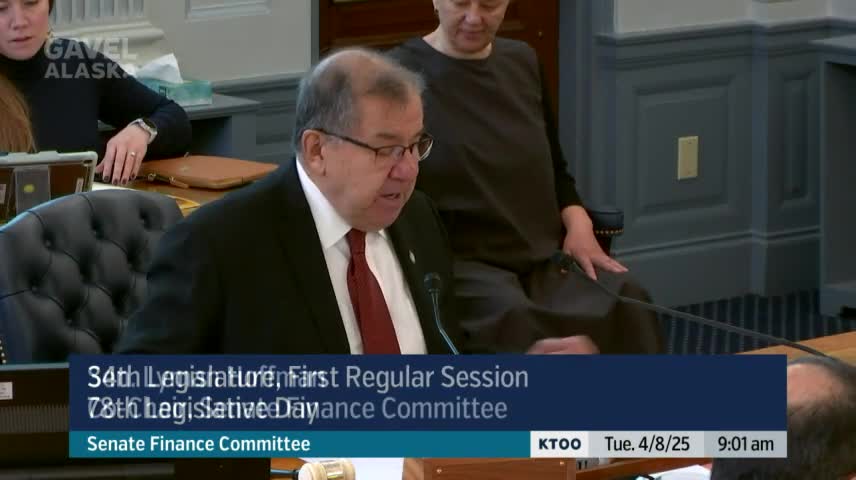
Sen. Bert Stedman introduced Senate Bill 55 to the Senate Finance Committee on April 8, proposing to enroll many Teachers' Retirement System participants in the state's Supplemental Benefit System (SBS). Committee members asked for additional fiscal analysis; no vote was taken and public testimony was deferred.
Senator Bert Stedman introduced Senate Bill 55 to the Alaska Senate Finance Committee on April 8, proposing steps to enroll Teachers' Retirement System (TERS) employees in the state's Supplemental Benefit System (SBS), which would add a 6.13% employee contribution matched by employers.
The bill, Stedman said, is intended "to enhance our retirement system, attract and retain employees and ensure that they have a quality retirement along with a fair and equitable salary along the way in benefits." He told the committee that many nonstate employers — including about 52 local governments, school districts and housing authorities — do not currently provide Social Security or an SBS-equivalent and estimated roughly 5,000 workers statewide are affected.
Stedman described differences in contribution rates across plans: the committee heard that some state defined-contribution plans show an employee contribution of 8% and an employer contribution of 5%, SBS today is 6.13% employee and 6.13% employer, and TERS tier 3 participants pay 8% while employers pay 7%, totaling about 15% of payroll for many teachers. Stedman argued the SBS match compounds over a career to produce substantially higher retirement account balances for state workers than for many teachers.
The sponsor estimated a full 6.13% inclusion for TERS participants would cost on the order of $45 million annually; he said adjustments could reduce that estimate into the mid-30s of millions. Committee members urged more precise numbers from the Division of Retirement and Benefits.
Eric Paul, identified in the meeting as administration services director, said he would follow up with retirement benefits staff and provide an updated fiscal note addressing changes tied to the committee substitute (CS). The committee recorded two fiscal notes to the bill's original version: a Department of Administration fiscal estimate showing an FY2026 operating impact of $620,800 (including $110,000 general fund) and five full-time positions in out years; and a University of Alaska estimate showing a first fiscal impact in FY2027 of $6,521,000 of unrestricted general funds.
Committee discussion touched on implementation options and phasing. Stedman and other senators noted phasing employer contributions over several years rather than imposing an immediate payroll increase to avoid sudden hardship for small communities. Senators also discussed 403(b) plans and deferred-compensation options that some districts use; Stedman said those plans typically lack an employer match and are not equivalent to SBS.
No committee vote was taken. The sponsor and staff said they will produce additional fiscal analysis and lists of affected employers; public testimony and invited testimony were deferred to a later meeting when the bill returns to the committee.
Senator Stedman closed the session by urging equal treatment across employer groups, saying, "This is messed up. And it's not fair." The committee adjourned with plans for follow-up fiscal work before any formal action on the bill.