Get Full Government Meeting Transcripts, Videos, & Alerts Forever!
Get email alerts on the State Payments topic
No spam. Unsubscribe anytime.
Committee reviews bill to speed state payments to nonprofits, tribes and municipalities
Summary
House Bill 133 would extend prompt‑payment parity to nonprofits, Alaska Native organizations and municipalities; departments described high workload, systems limits and proposed staff increases to meet timely payment goals.
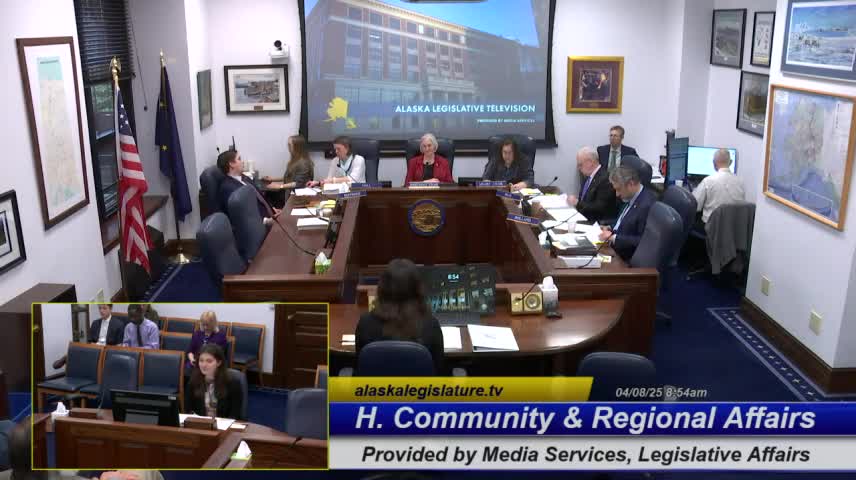
House Community and Regional Affairs took a full hearing on House Bill 133 on April 8, 2025, a measure to bring "parity" for nonprofits, Alaska Native organizations and municipalities in prompt state payments for contracts, grants and reimbursements.
Ella Lubin, staff to Cochair Rebecca Hemshutt, summarized the bill as aimed at addressing long‑standing delays that force low‑revenue service providers to front expenses they cannot absorb. The Department of Health, which provided multiple fiscal notes, said delays are driven by high volume, staff capacity and the complexity of juggling federal funding streams.
Pam Halloran, assistant commissioner for the Department of Health, told the committee the department manages hundreds of grants and contracts across divisions and identified turnover, invoice quality and budgetary timing as contributors to payment delays. "We are very committed to timely payments," Halloran said, and described recent steps including new grants leadership and requests for additional positions to speed processing.
Zoe Olsen, grants administration manager for the Department of Health, said the department is administering approximately a hundred and $40,000,000 in FY25 and currently has eight full‑time grants employees. She told the committee the department processes roughly 440 awards across some 80 grant programs in a typical year and that grants are often issued on a multi‑year cycle but require year‑by‑year administration.
Jason Grove, procurement manager for the Department of Health, said the department’s standard is to pay within 30 days of receipt of a proper invoice once the invoice is reviewed against the contract. He said timing is often negotiated in contracts but the typical performance standard and expectation is payment within 30 days.
Committee members pressed for specifics: Representative Ruffridge asked whether the bill’s provisions would merely duplicate internal reforms or whether statute is necessary. Halloran and Olsen described systems work under way — including a new procurement module (Periscope), plans to integrate grants and accounting systems, and consideration of a new grants management system — but said those projects are one to two years from full implementation. The Department of Health’s fiscal work estimated roughly $1.5 million in annualized interest that would have been charged at a 10.5% rate on the late payments identified in their notes; Halloran said the department instead proposed adding staff (PCNs) targeted at accounting and grants capacity to reduce delays.
Other agencies said their exposures varied. Bonnie Jensen, administrative services director for the Department of Fish and Game, estimated the department’s exposure would be low and said late payments typically stem from isolated issues such as a vacant position or an employee on leave. Hannah Lager, administrative services director for the Department of Commerce, Community and Economic Development, said her department’s fiscal note was indeterminate because it was difficult to predict which future invoices might be late; she noted a small potential revenue change tied to advance payments in the bill’s section three. Angela Laflamme of the Department of Military and Veterans Affairs said the department manages large disaster funding portfolios and requested additional grants administration capacity for the Division of Homeland Security and Emergency Management because disaster reimbursements can be complex and time‑sensitive.
Committee members acknowledged the need to balance due diligence and internal controls with timeliness. Several members encouraged continued departmental work on systems integration and process improvement while considering whether statutory requirements or administrative investments (or both) would be most effective.
No final committee vote was taken on HB 133 at the hearing. Committee staff said a committee substitute (CS) was being developed and that members have an amendment deadline; the discussion will continue in subsequent committee work.