Get Full Government Meeting Transcripts, Videos, & Alerts Forever!
Get email alerts on the Right To Repair topic
No spam. Unsubscribe anytime.
Alaska committee hears bill to expand 'right to repair' for digital products
Summary
A first hearing on House Bill 162 proposed requiring manufacturers to provide parts, tools and documentation to independent repairers and owners; sponsors and witnesses emphasized reduced e‑waste and rural access while staff said carve‑outs for vehicles and some equipment are being negotiated.
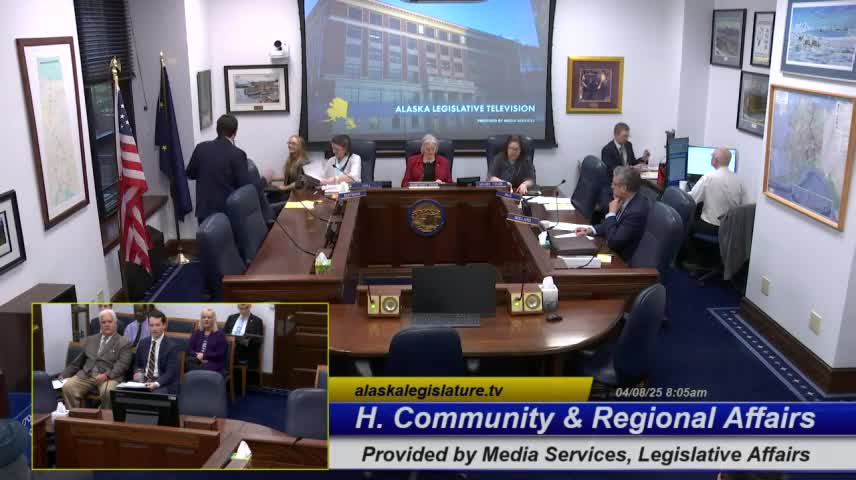
House Community and Regional Affairs held the first hearing on House Bill 162 on April 8, 2025, a measure that would require digital product manufacturers to make repair documentation, parts and diagnostic tools available to independent service providers and product owners in Alaska.
The bill’s sponsor office was represented by staff who told the committee the aim is to give “individual Alaskans the means to repair the digital components that are currently incorporated into most modern equipment.” Kipan Nayak, legislative intern to Representative Maxine Deibert, said the measure would make manuals, parts and specialized tools available at market prices and allow small independent service businesses to operate in-state.
Joe Torma, general manager of Green Star of Interior Alaska, described the local recycling and reuse work his nonprofit does and said manufacturers’ restrictions currently prevent reuse of many devices. “Our mission is to encourage and enable our communities to reduce waste and increase recycling,” Torma said, and he added that phones and tablets are often unusable for reuse because data‑removal and manufacturer locks block refurbishing.
Committee members asked detailed questions about scope, warranty language and software access. Representative Kai Holland asked whether the bill’s exclusion for "motor vehicles required to be registered" would include off‑road vehicles and motorcycles; staff said they are working with Senator Dunbar’s office on carve‑outs and modifications for automobiles, farm equipment and some off‑road vehicles. Howard Maxwell, staff to Representative Deibert, and other staff said the bill includes protections for trade secrets and does not require disclosure of trade secrets except as necessary to make parts and documentation available.
Committee members also raised security and warranty concerns, including whether the bill would require manufacturers to disclose firmware or source code and how resetting or disabling security features would be handled. Staff acknowledged those are key issues and said the bill as drafted would allow certain software or reset capabilities without requiring disclosure of source code; they said further amendments and clarifying language are expected. Benjamin Hedges, a repair technician who works with Green Star, noted many manufacturers will not honor a warranty unless the original owner requests it.
Witnesses and staff emphasized the bill’s potential to reduce e‑waste and improve access to repairs in remote Alaska communities where authorized service providers are scarce. Staff presented a sectional analysis that would add a new article to AS 45.45 (trade practices) with sections (as presented to the committee) that include requirements to make documentation, parts and tools available (AS 45.45.800–.890 as drafted), definitions, a prohibition on contract terms that waive the manufacturer’s obligations, and an effective date provision (January 1, 2026).
No formal committee vote was taken on HB 162 at the hearing; staff and the sponsor’s office said they will work on amendments addressing vehicle carve‑outs, medical device exceptions and software/security language before further committee action.
The committee set HB 162 aside and moved on to other agenda items.