Get Full Government Meeting Transcripts, Videos, & Alerts Forever!
Get email alerts on the Education.student Records topic
No spam. Unsubscribe anytime.
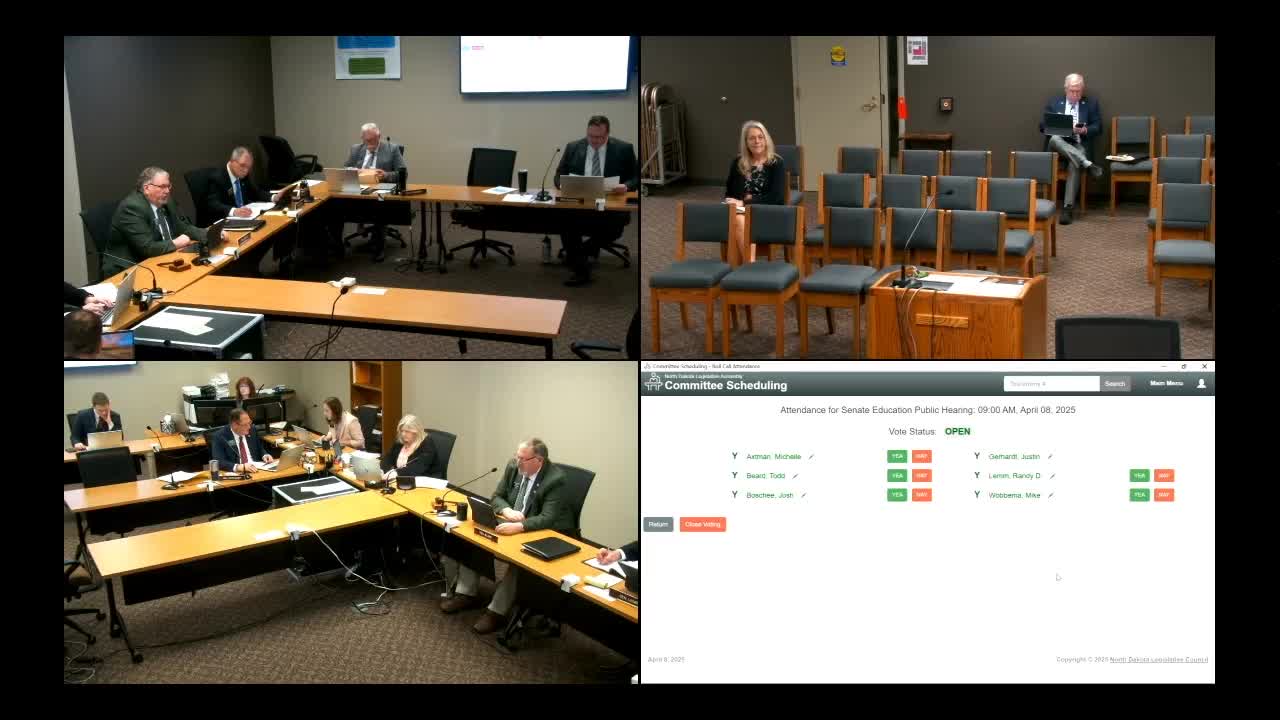
Senate Education panel examines applicant-record protections; NDUS urges clarity with FERPA
Summary
The Senate Education Committee considered House Bill 1542, which would let applicants who do not enroll request destruction of their application records.
The Senate Education Committee met to consider House Bill 1542, sent from the House by Representative Hendricks, a measure aimed at allowing applicants who do not enroll to request destruction of their application records.
Committee members and North Dakota University System officials said the bill addresses a perceived gap that exists before FERPA protections apply — the period after application submission but before attendance.
Lisa Johnson, vice chancellor for academic and student affairs for the North Dakota University System, told the committee that FERPA (the federal Family Educational Rights and Privacy Act) protects student records once a person has attended the institution, but that the application phase prior to attendance is not covered by FERPA. She said institutions treat some application elements as public unless a student elects to restrict them and that retention practices vary depending on whether a fee was paid or the applicant later attended.
Johnson described the system's document-retention practice: basic applications are retained for the current fiscal year plus one year when no payment is involved; applications submitted with payment are retained for the current fiscal year plus three years; materials for enrolled students are kept through the last date of attendance plus five years. She also said a parent or guardian may request destruction of an application for an applicant under 18, but once the applicant is over 18 the individual controls their educational record.
Senators pressed for precise statutory language to match the sponsor’s intent and to avoid unintended consequences, such as permitting a parent to erase the application record of an adult student who applied while under 18. Committee members also discussed which sections of the North Dakota Century Code the bill should reference; the bill sponsor and NDUS supplied differing citations during the hearing (including references to a provision governing email retention and a general public-records provision), and staff said more drafting work would be needed to reconcile those choices.
The committee agreed to pause further action and work with the bill sponsor and stakeholders to reconcile the competing amendments and to craft language that clarifies the endpoint of the application period and the treatment of parental requests. No final vote was recorded; the item was tabled pending further negotiations and amendment drafting.
Next steps: committee members asked sponsors and NDUS counsel to confer and to circulate an agreed amendment before the item returns to committee.