Get Full Government Meeting Transcripts, Videos, & Alerts Forever!
Get email alerts on the Child Protection Ai And Terminology topic
No spam. Unsubscribe anytime.
Committee approves study of statutes on criminal conduct against children, AI and terminology changes
Summary
House Bill 14‑10 garnered a due‑pass recommendation after lawmakers and child‑welfare experts urged a legislative study to modernize statutes addressing crimes against children, remove offensive terminology and examine artificial intelligence's role in child exploitation.
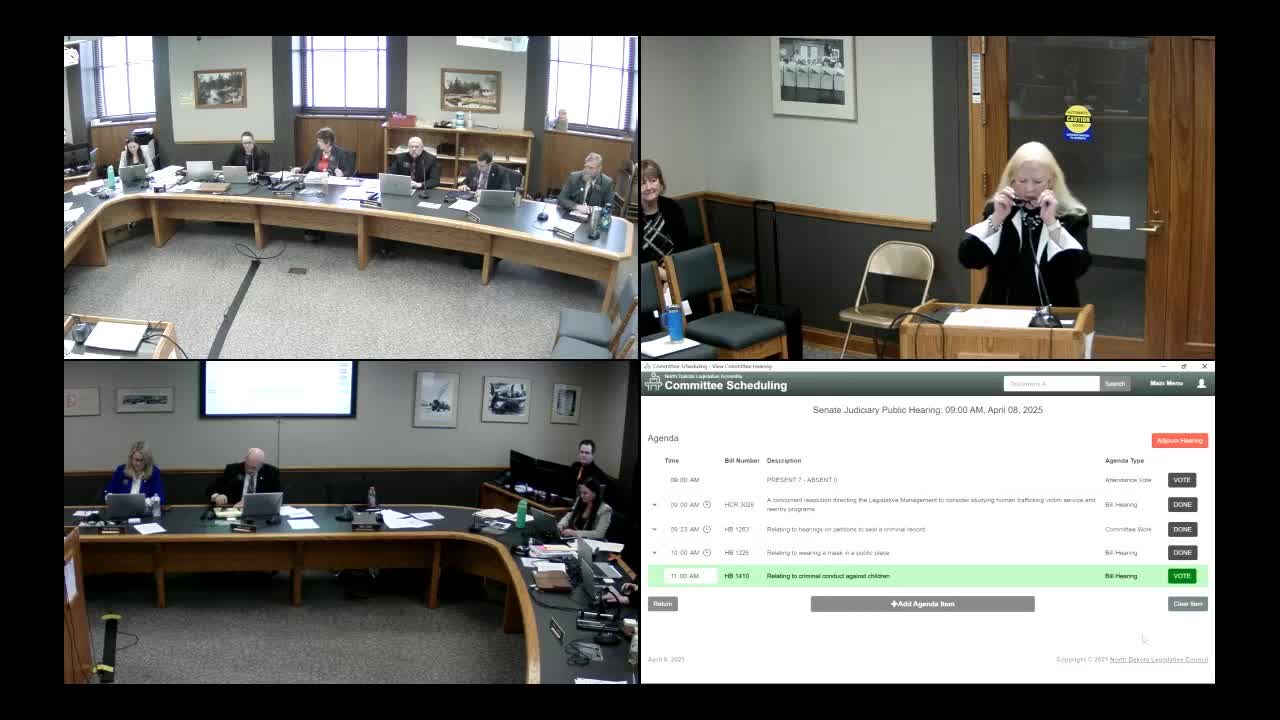
The Senate Judiciary Committee voted to recommend a due‑pass on House Bill 14‑10, which directs legislative management to study state laws on criminal conduct against children, including child sexual assault, child physical abuse and neglect, the interaction of artificial intelligence with exploitation statutes, and the replacement of outdated legal terminology.
Representative Mary Schneider (District 21, Fargo area) sponsored the bill and told the committee it seeks a targeted legislative management study to review outdated statutory references — in particular the term “sexual performance” — and to recommend consistent, modernized language across the criminal code. “House Bill 14‑10 is one of our chances to make a difference in the lives of our North Dakota children at risk of victimization,” Schneider said.
Witnesses including Anna Frizzell of YouthWorks and Greg Kosowski of the Children’s Advocacy Centers of North Dakota supported the study. Frizzell described the task force’s prior prevention work and asked that the study consider terminology and the evolving threat from artificial intelligence. Kosowski said prior attempts to do a one‑for‑one replacement of the phrase “sexual performance” with “child sexual abuse material” ran into drafting and grammatical complications; he called a study the appropriate next step to produce consistent statutory edits across the code.
Scope and concerns: The study would review criminal statutes referencing “sexual performance,” evaluate insertion of AI‑related offenses and reconcile multiple bills that use inconsistent language. Committee members noted the complexity of replacing language throughout the code and the need to avoid unintended drafting errors; supporters argued a formal interim study would provide time and expertise to harmonize statutory language and propose clean bill text.
Committee action: Senator Merdahl moved a due‑pass recommendation; the motion carried on a recorded vote. Committee members commended the task force’s work and emphasized coordination with prosecutors, child advocates and technical experts during the interim study.
Next steps: If legislative management approves the study, the appointed study group would prepare findings and recommended legislation for the next legislative assembly. The committee’s due‑pass recommendation does not itself change criminal law; it authorizes study and reporting.