Get Full Government Meeting Transcripts, Videos, & Alerts Forever!
Get email alerts on the Human Trafficking Victim Services topic
No spam. Unsubscribe anytime.
Senate Judiciary backs study on human trafficking victim services and reentry
Summary
The Senate Judiciary Committee on a voice vote recommended House Concurrent Resolution 3028 for a due-pass, advancing a legislative study on human trafficking victim services, workforce reentry and protections for survivors.
The Senate Judiciary Committee on a voice vote recommended House Concurrent Resolution 3028 for a due-pass, advancing a legislative study on human trafficking victim services, workforce reentry and protections for survivors.
Representative Steve Vetter, R‑District 18 of Grand Forks, introduced the resolution and told the committee the study has three goals: provide up‑to‑date information to legislators about victim services, examine programs that help survivors reenter the workforce and evaluate ways to protect survivors from returning captors. “The study is to propose a study on the subject of human trafficking,” Vetter said, adding the research should produce “better bill draft ideas to help this issue along.”
Why this matters: Witnesses and providers said legislators lack a clear statewide picture of services and outcomes, and that gaps in reentry support — from basic life skills to housing — can prevent long‑term recovery. Jacob Thompson, a policy analyst with North Dakota Family Alliance Legislative Action, cited clinical literature on trauma and urged a study to inform policy. “Human trafficking crimes are incredibly traumatic to their victims,” Thompson said in testimony summarizing research on mental‑health consequences and the challenges of reintegration.
Committee testimony and evidence: David Tamasia, executive director of the North Dakota Catholic Conference, told senators the state’s bishops and local service providers have urged stronger, coordinated responses and that the study could address disagreements providers already report, including the appropriate length of stay in residential treatment and inconsistent data collection. Anna Frizzell of YouthWorks described front‑line service statistics and casework: YouthWorks served 147 people ages 12–24 through its anti‑trafficking team in the last biennium, provided roughly 400 hours of clinical services, about 1,800 hours of crisis intervention, and supplied thousands of nights of emergency housing support, she testified. Frizzell and other witnesses offered to provide data and technical assistance to the study.
Discussion vs. decision: Committee members pressed on practical scope. Senator Lewick and others warned the study could be broad and recommended focusing on reentry and actionable program models rather than duplicating existing work. Senator Brownberger said victim needs — basic life and job skills — were often overlooked and supported a focused study. Following discussion, Senator Lewick moved a due‑pass recommendation; the motion was seconded and carried.
What the resolution directs: HCR 3028 asks legislative management to consider an interim study of human trafficking victim services and reentry programs; the resolution does not itself change statute or allocate funds. Committee members and witnesses repeatedly described the measure as study authority to gather information and recommend future legislation if warranted.
Next steps and context: With the committee’s due‑pass recommendation, HCR 3028 moves forward for further consideration by the legislative management process, which would determine study membership, scope and timeline for interim work. Witnesses asked that the study coordinate with existing criminal‑justice, child‑welfare and victim‑service stakeholders to avoid duplication and to collect consistent statewide data.
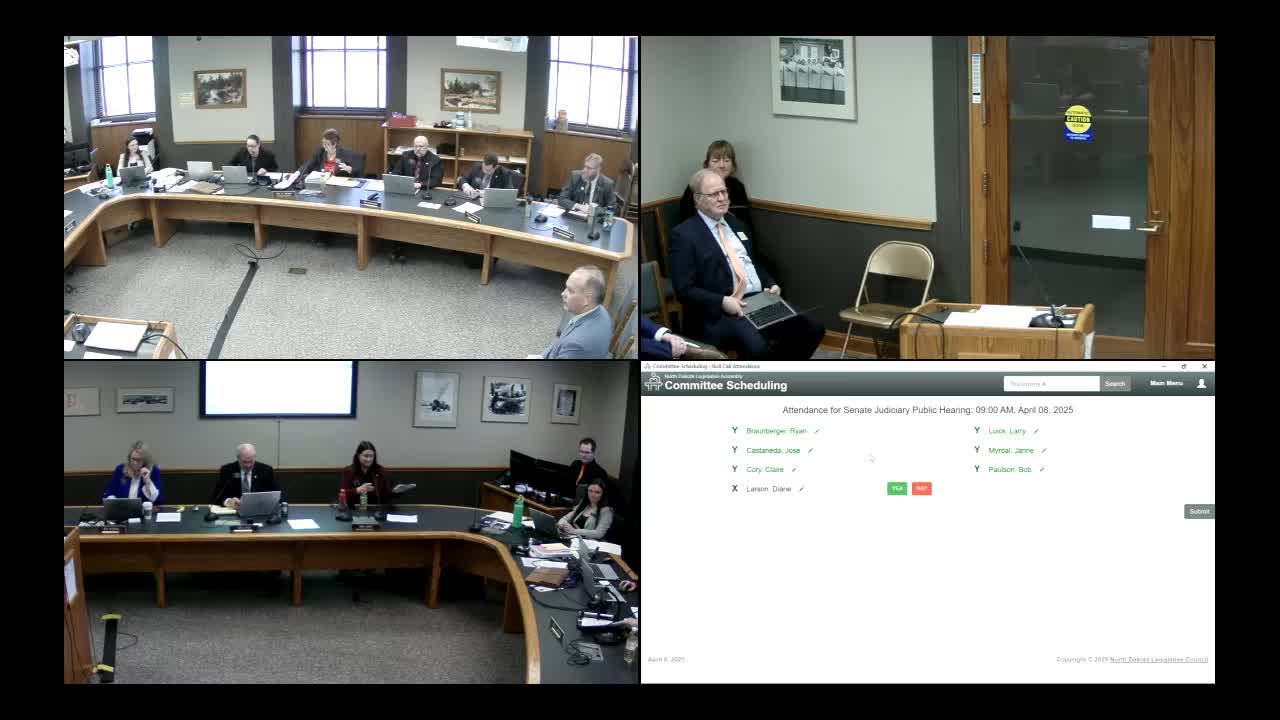
Votes at the committee: The roll call recorded senators Callexa Castaneda, Luke, Merdahl, Paulson, Brownberger, Corey and Chair Larson voting in favor; the motion carried. The committee did not adopt specific program designs; sponsors and witnesses emphasized the study is intended to produce those options for later legislative action.