Get Full Government Meeting Transcripts, Videos, & Alerts Forever!
Get email alerts on the State Budget Legislative topic
No spam. Unsubscribe anytime.
Appropriations panel amends SB2001 to add lodging, printing transfers and space for 25 legislative staff on 15th floor
Summary
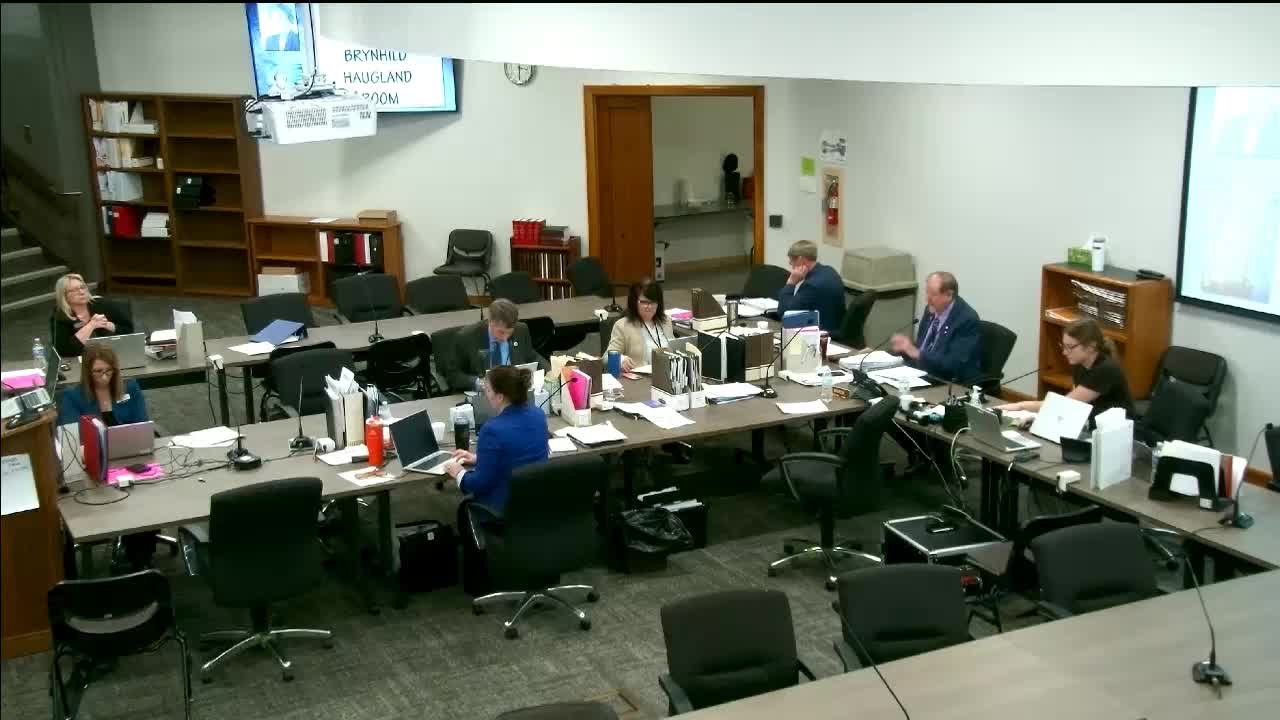
The Appropriations - Government Operations Division on Thursday amended Senate Bill 2001 to change budget lines for the Legislative Assembly and Legislative Council, including increasing the anticipated maximum monthly lodging expense, transferring public‑printing funds, removing funding for an advanced nuclear study, and adding authority to use legislative rooms on the 15th floor to house 25 additional employees.
The Appropriations - Government Operations Division on Thursday amended Senate Bill 2001 to change budget lines for the Legislative Assembly and Legislative Council, including increasing the anticipated maximum monthly lodging expense, transferring public‑printing funds, removing funding for an advanced nuclear study, and adding authority to use legislative rooms on the 15th floor to house 25 additional employees.
Committee chairmen and staff told members the House changes were “pretty minimal” and walked through line-item adjustments before the panel voted to adopt the amendment and send the amended bill to the full committee.
Representative Sam Meyer, the House carrier, opened the discussion and asked staff to describe the House changes. “The House changes were pretty minimal actually from what the Senate did,” Meyer said as staff reviewed the amendment. Sheila, a committee staff member, then walked members through the long‑sheet budget detail for the Legislative Assembly and Legislative Council.
Major ongoing changes in the amendment include an increase in the anticipated maximum monthly lodging allowance for legislators from $2,079 to $2,475 (the amendment cites a prior passage of Senate Bill 2084 as the reason for the change), an added $40,000 in dues for the North Dakota Legislators Forum (bringing the biennial total to $40,000 in the House version), and a $290,000 transfer of public‑printing funding from the Secretary of State to the Legislative Council because of earlier legislation on printing costs. Sheila described the lodging and dues increases as adjustments tied to bills already passed earlier in the session.
John Bjornson of the Legislative Council described the amendment’s facility component: the Council identified space on the Capitol’s 15th floor that could accommodate the 25 FTE added in the Senate budget. “We went through a process with facility management, and...after discussion with leadership...that seemed to be the most logical in a number of ways, and that's the Fifteenth Floor,” Bjornson said. He said the space selection followed meetings with facility management and with CTE leadership to flag impacts on an executive‑branch tenant.
Committee members pressed staff about how the move would affect the Department of Career and Technical Education (CTE). Bjornson said CTE is authorized for about 22 FTE and that some CTE staff are located offsite in Fargo; he described ongoing discussions with facility management and CTE Director Sick about relocation options. Bjornson said the Legislative Council plans to cover remodeling costs either from carryover in its budget or via other budget amendments and that CTE would have moving‑expense assistance in the agency’s budget.
On the budget totals, Sheila reviewed ongoing and one‑time items for Legislative Council: approximately $4.9 million for the 25 FTE added by the Senate, one‑time operating funding of $375,000 for furniture and computers, $280,000 for IT capital assets such as tape library and video encoders, and a $225,000 one‑time consulting line the Senate had added for a study of legislative term limits (the House zeroed out $650,000 the Senate had proposed for consulting on advanced nuclear energy). She also summarized an estimated $556,444 increase in ongoing IT operating expenses and a $220,000 item for audio/video storage and streaming quality improvements for the Legislative Assembly.
Members asked whether the committee should treat several sections as emergency provisions so money and authorities would be available immediately; committee staff described the sections as standard emergency clauses that allow the legislature flexibility to move money between line items and carry over or cancel unexpended appropriations.
Representative Meyer moved the House amendment to SB2001; Representative Pyle seconded. The clerk took a roll call and the amendment carried unanimously. Meyer then moved that the committee give SB2001 a “do pass as amended” recommendation; Pyle seconded and the committee voted to advance the amended bill to the full committee.
The committee record also shows a separate notice from Representative Paul that he will bring an unrelated amendment later on the Industrial Commission budget concerning homelessness grants; that item was not discussed further in this hearing.
The panel did not set a specific date for full‑committee consideration; staff said the bill may come before the full committee at its next meeting.