Get Full Government Meeting Transcripts, Videos, & Alerts Forever!
Get email alerts on the Criminal Justice Diversion Pretrial topic
No spam. Unsubscribe anytime.
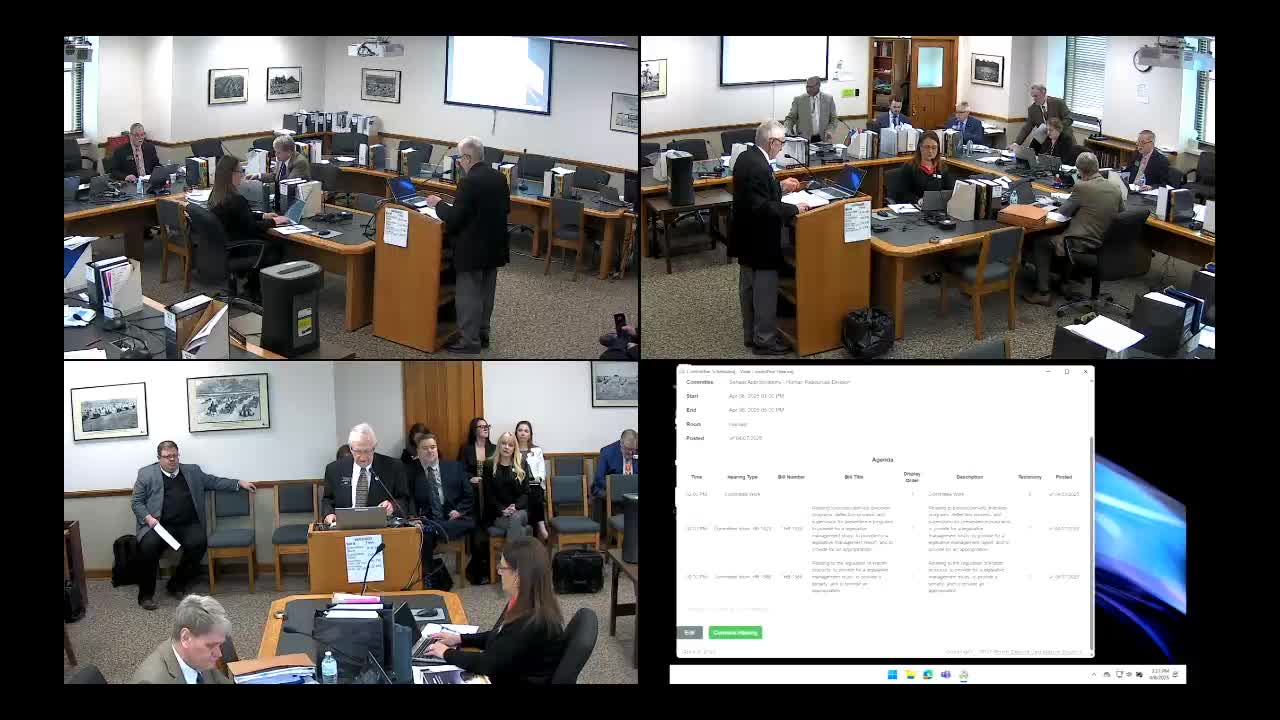
Senate Appropriations panel backs HB1425 to pilot prosecution-led diversion, deflection and pretrial services
Summary
The Senate Appropriations Committee recommended a do-pass on House Bill 14 25, a package bill that would authorize prosecution-led diversion, establish deflection processes, and fund a three-county pilot for pretrial supervision and services.
At a Senate Appropriations Committee hearing, members recommended a do-pass on House Bill 14 25, a criminal-justice package bill that would expand prosecution-led diversion, authorize community deflection programs and fund a three-county pretrial services pilot. The bill includes a $1,000,000 appropriation to the Department of Corrections and Rehabilitation (DOCR) for one full-time equivalent (FTE) and contracting, $750,000 to the Department of Health and Human Services (DHHS) for treatment services, and $55,000 for a study of pretrial services.
The bill sponsor, Representative Killeen, told the committee the measure "targets the front end of reentry" by strengthening diversion, deflection and pretrial programs so returning justice-involved people can access supervision and services outside of incarceration. He said the bills are intended to "serve public safety, make the best use of our overcrowded prison and jail beds," and noted North Dakota's recidivism rate is about 40 percent and the state prison is operating over capacity (discussed in testimony as about 112 percent of capacity).
The measure would codify Rule 32.2 of the North Dakota Rules of Criminal Procedure to clarify the prosecution-led diversion process and require written guidelines and eligibility criteria where counties adopt such programs. Section 3 would permit DOCR to provide supervision for participants; Section 4 would create a three-county pilot for supervision; Section 6 requests $1,000,000 to DOCR for one FTE and contracts with third-party providers to monitor compliance and connect participants to behavioral health services; Section 8 requests $750,000 for DHHS to provide treatment services; Sections 5 and 7 address pretrial services and fund a $55,000 study of cost savings and outcomes.
Travis Fink, Executive Director of the Commission on Legal Counsel for Indigence, described the three program distinctions the bill addresses and explained pretrial services "is simply someone as a condition of bond or bail can be ordered to participate in pretrial services, which is essentially pretrial supervision while they're out in the community." Fink said deflection is a separate process in which someone is not charged and is instead connected to services rather than booked into jail.
Committee members asked about eligibility, prosecutorial discretion and the role of local stakeholders. Representative Killeen and witnesses emphasized the programs are prosecutorially initiated and court-approved, not mandatory: "it's at the initiation of the prosecutor" and the court must approve the diversion agreement, the sponsor said. Senators pressed whether violent crimes would qualify; Killeen said the rule contains criteria and he "would doubt it" would be used for violent offenses, though the rule does not explicitly prohibit it.
Members also questioned the appropriation language and whether the FTE was authorized; legislative counsel language in the bill was discussed and committee members noted the authorization text appears on page 4. Committee members asked which counties would participate; the bill leaves selection to DOCR and witnesses said Cass County had expressed interest. Several senators suggested a pilot would allow evaluation before statewide expansion.
On a procedural motion, Senator Maggroom moved a do-pass recommendation on HB1425, seconded by Senator Cleary. The committee called the roll and the motion carried. Recorded votes included Senators Clary (aye), Davidson (aye), Chairman Deaver (aye), Magrum (aye) and Mathern (aye). The committee instructed the bill be carried to the full committee and referred back to the policy committee for further action.
The bill package sponsor pointed to prior study work and stakeholder support, including the governor's office, DOCR, DHHS, Job Service North Dakota, the North Dakota State's Attorneys Association and the North Dakota Commission on Legal Counsel for Indigence. Supporters framed the pilot as a front-end investment to reduce recidivism and limit future prison expansion costs.
The committee discussion focused on implementation details—who would contract for services, how DOCR and DHHS would coordinate, the limits of prosecutorial discretion, the pilot county selection process and the fiscal language authorizing funding and the FTE. The committee left those implementation details to be clarified in the next stages of the process.
Ending: The committee carried HB1425 forward with a do-pass recommendation and directed that the bill be placed before the full committee and returned to policy for follow-up; staff and witnesses indicated further technical fixes and implementation details would be addressed as the bill progresses.