Get Full Government Meeting Transcripts, Videos, & Alerts Forever!
Get email alerts on the Infrastructure Project Management topic
No spam. Unsubscribe anytime.
Legislative auditors find weaknesses in Met Council oversight of Southwest LRT; council disputes some findings
Summary
A Legislative Audit Commission briefing on April 7, 2025, opened with the Office of Legislative Auditor presenting findings that the Metropolitan Council and its civil construction contractor, Lunda‑McCrossan, showed instances of noncompliance and internal control weaknesses while building the Southwest Light Rail Transit project.
A Legislative Audit Commission briefing on April 7, 2025, opened with the Office of Legislative Auditor presenting findings that the Metropolitan Council and its civil construction contractor, Lunda‑McCrossan, showed instances of noncompliance and internal control weaknesses while building the Southwest Light Rail Transit (Southwest LRT) project.
“For the record, my name is Lori Lisen, I’m the deputy legislative auditor for the financial audit division at the Office of the Legislative Auditor,” Lisen told commissioners and later summarized the office’s conclusions: “we found that the Metropolitan Council had instances of noncompliance and weaknesses [in] internal controls in the areas of change order, disadvantaged business enterprises, contaminated soils, and the monitoring over the physical security.”
Why it matters: the Southwest LRT (also called the Green Line Extension) is one of the largest infrastructure projects in the state. The OLA audit covered January 1, 2019 through March 31, 2023 and focused on Lunda‑McCrossan’s subcontractor and supplier activity, change orders, prompt payment, use of disadvantaged business enterprises (DBEs), contaminated‑soil disposal, and security at contractor laydown areas. The matters affect taxpayer oversight, contractor compliance with federal DBE rules and the council’s ability to verify that paid work and disposed materials relate to the project.
Major findings and figures
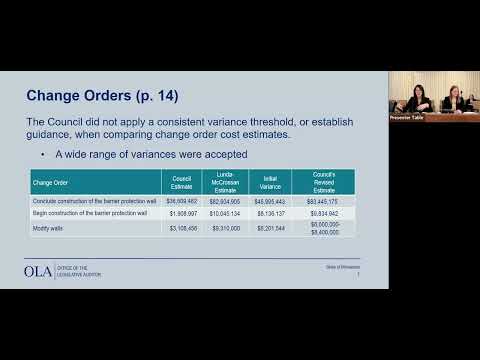
- Change orders and cost estimating: OLA found the council did not apply a consistent variance threshold or written guidance when comparing its cost estimates to those of Lunda‑McCrossan for change orders. The auditors showed examples where initial Met Council and contractor estimates differed widely and the council’s revised estimate moved toward the contractor’s number without a documented rule for determining whether a contractor’s estimate was “fair and reasonable.” The report lists multiple large variances (exhibit 5 in the report) used by the auditors to support the finding.
- Disadvantaged business enterprises: The audit recorded two DBE issues. First, the council’s monitoring documentation was incomplete for a portion of DBEs: auditors reviewed 50 DBEs engaged on the project as of March 30, 2023 and found insufficient documentation of monitoring visits for 9 firms and no documented monitoring initiated for an additional 12 firms that had begun work by September 2021. Second, OLA found instances in which contractor‑reported billing and payment amounts used to compute DBE participation were incorrect; the report noted reconciling two contractor‑produced reports is not an effective control because both reports originate with the contractor. The council had set a DBE participation goal of 16% for the civil contract; Council leadership told the commission the project has achieved roughly 22% DBE participation.
- Contaminated soils: The contract required contaminated soils identified on the project to be removed and tracked. OLA found deficiencies in how the council approved disposal (pre‑printed bulk forms lacking excavation location and estimated quantities), did not require environmental consultants to be present for all excavations, and did not demonstrate reconciliations linking hauled loads to contaminated areas. In payment testing the auditors reported the council had overpaid the contractor by about $330,000 as of March 30, 2023. The Met Council dispute: Charlie Zelle, chair of the Metropolitan Council, and Ryan O’Connor, regional administrator, told the commission they completed subsequent reconciliations and that the council’s later review showed the amounts reflected payments for services rendered.
- Physical security at laydown areas: OLA tested 14 active laydown areas and reported security deficiencies in 7 of them. Reported examples included removed fencing to allow construction to start, inconsistent surveillance and access control, and the council’s limited monitoring of contractor adherence to contract security plans.
Metropolitan Council response and disputed items
Charlie Zelle, chair of the Metropolitan Council, acknowledged the audit’s recommendations and described reforms the council said it has implemented since the period covered by the audit. Zelle said the project is “85% complete,” that the council has re‑baselined the project budget and is on a schedule for revenue service in 2027, and that the council hired a new, independent cost‑estimating consultant after a MnDOT peer review. “We have learned a lot from all of the OLA reviews, and I’m pleased to report that we have actually instituted a number of reforms and processes,” Zelle said.
On the $330,000 overpayment the OLA identified, Zelle told the commission the council’s subsequent reconciliations “assured that there was no overpayments,” saying invoices and loads were later verified. Ryan O’Connor thanked auditors for working with council staff on technical questions and said the council has adopted electronic manifests and other process changes to improve recordkeeping.
Questions from legislators
Committee members pressed council leaders on several points. Senator John Dibble and other members criticized the council’s accountability and governance, saying repeated audits show persistent problems and urging structural reform. Representative Jacob directly challenged Zelle over the contaminated‑soils finding and the reported $330,000 overpayment: “I don’t think you can just simply take the position we don’t admit that there was overpayments when that’s exactly what the report found,” Jacob said. Zelle replied that the OLA field work reflected a point in time and that later reconciliations supported the council’s position.
Members also questioned procurement and estimating practices. OLA and council witnesses described a procurement environment that shifted during the project; the council said some procurement methods now available by statute would be used in future projects and that AECOM (the earlier independent cost estimator) was replaced by HNTB after peer review.
Numbers and scope cited in the hearing
- Audit period: January 1, 2019–March 31, 2023 (OLA) - Audited DBEs at time of review: 50 (OLA); 9 lacked sufficient monitoring documentation; 12 had not had monitoring initiated by March 30, 2023 - Reported contractor change orders executed as of March 31, 2023: roughly $228 million in change orders added to the civil contract (OLA presentation) - Contract total reported by OLA presentation after change orders: just over $1 billion; the contractor was eligible for an additional settlement payment the presentation said could be up to $285 million (figures from OLA presentation) - OLA‑reported possible overpayment for contaminated‑soil disposal: about $330,000 as of March 30, 2023 - Laydown areas tested for security: 14; deficiencies found in 7 - Approximate number of contaminated‑soil truckloads referenced by council: as many as 30,000 over the full project period (Metropolitan Council)
What the commission asked for next
Commission members and audit staff emphasized the need for the Metropolitan Council to implement the OLA’s recommendations: adopt written guidance for change‑order estimate comparisons, strengthen DBE monitoring and controls over DBE payment reporting, require environmental consultant presence or equivalent verification for contaminated‑soil excavations, reconcile disposal manifests to payments on a sample basis, and tighten monitoring of contractor security plans.
No formal votes were taken at the commission meeting. The commission accepted the OLA presentation, heard the Metropolitan Council response and took no final action during the session.
Ending
The audit adds to a sequence of OLA reviews and legislative hearings that committee members said show persistent oversight challenges on the Southwest LRT project. Metropolitan Council leaders said they are applying reforms and new tools to address the audit’s findings and that they will continue reconciling records and improving procurement and monitoring processes as work continues toward the council’s stated revenue‑service target in 2027.