Get Full Government Meeting Transcripts, Videos, & Alerts Forever!
Get email alerts on the Housing Revolving Loan Funds topic
No spam. Unsubscribe anytime.
State plan could reclaim local housing-rehab revolving loan funds, Sawyer County told
Summary
Northwest Regional Planning Commission staff told Sawyer County officials the Wisconsin Department of Administration is proposing to recapture community development housing revolving loan funds statewide and retool them for a vacant-spaces redevelopment program; Sawyer County has about $16,000 in its fund.
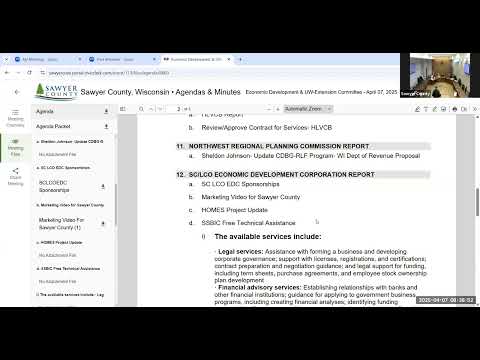
Sheldon Johnson, planner with the Northwest Regional Planning Commission, told Sawyer County officials that the Wisconsin Department of Administration (DOA) sent letters in March saying the state intends to collect local community development block grant (CDBG) revolving loan fund (RLF) balances and retool the money for a statewide program.
"Right now, Sawyer County has about $16,000 that are available for lending to qualifying low to moderate income households," Johnson said, describing the program's typical uses for roof, septic or window repairs. He said the state letter referred to roughly $22,000,000 statewide as of a snapshot taken March 31, 2024.
The RLFs Johnson described are currently administered locally or regionally to make deferred, 0% loans for homeowners at or below 80% of county median income, with repayment due when the property is sold. Johnson said the DOA proposal would consolidate those balances into a new repair-or-redevelopment program focused on revitalizing vacant spaces, which could shift the funds away from small-scale homeowner repairs.
Johnson said DOA planned three meetings for units of local government: one in Madison, one in Wausau and a virtual session later in April. He and regional staff planned to attend the Madison session and report back. "Tomorrow there's the first of three meetings ... We'll know a lot more information come Wednesday morning on what the actual discussion is," Johnson said.
County officials pressed for clarity about timing and local impact. A board member observed that the county would prefer the funds remain available locally for small housing-repair loans and suggested contacting legislators. Johnson said Douglas County currently serves as lead for a 10-county regional fund that typically holds $1 million to $2 million; that regional fund is currently depleted and on a waiting list, he said, underscoring the local reliance on RLFs.
Johnson described the DOA letter as vague and called the DOA consolidated plan a draft that had not yet been shared. He said the DOA indicated HUD requires states to demonstrate use of existing HUD dollars before requesting additional HUD funding, and that the cited $22 million was a single-day snapshot that may change as repayments occur.
County staff said they would monitor the DOA process, suggested spending down local balances when practical, and discussed the possibility of advocating for a regional approach that would keep funds available nearby. Johnson said regional staff would return with more information after the in-person meeting.
The county did not take formal action on the item at the meeting; staff said they would follow up once DOA releases details.